Election campaign planning in India runs in six phases across roughly 180 days: constituency assessment, budget and team setup, narrative building, ground operations, the war-room fortnight, and polling day itself. The money involved demands that discipline — India’s 2024 general election reached an estimated ₹1.35 lakh crore in total spend (Centre for Media Studies, 2024), and at the seat level a competitive assembly campaign manages dozens of workstreams against a fixed legal cap. This playbook walks through each phase in order, with the D-day countdown, budget proportions, and the links to our deeper guides on every component. It applies to any Indian election; a dedicated section covers what changes in Tamil Nadu.
Key Takeaways
- Six phases, counted back from polling day: assessment (D-180), budget and team (D-150), narrative (D-120), ground operations (D-90), war room (D-15), polling day (D-0).
- The ECI caps candidate spend at ₹40 lakh for assembly seats (₹95 lakh Lok Sabha) — planning is the art of allocating a capped budget, not raising an unlimited one.
- Working allocation for an assembly seat: ground operations 40%, digital and media 25%, logistics 20%, contingency 15%.
- Every phase depends on the one before it. Campaigns that skip assessment plan blind; campaigns that skip narrative execute noise.
What Are the Steps to Plan an Election Campaign in India?
Six, in strict sequence. As of 2026, India’s electorate votes across 10.51 lakh polling stations averaging 931 voters each (ECI granular data release, December 2024), and the entire planning discipline exists to point a capped budget at the right subset of those booths. Here’s the sequence — each phase gets its own section below.
| Phase | Window | Core Output |
|---|---|---|
| 1. Constituency assessment | D-180 to D-120 | Booth-classified winnability verdict + vote path |
| 2. Budget, team, legal | D-150 to D-90 | Allocated budget, named leads, compliance structure |
| 3. Narrative and communication | D-120 to D-60 | One message architecture, all platforms |
| 4. Ground operations | D-90 to D-15 | Booth committees, canvassing waves, voter contact |
| 5. War room fortnight | D-15 to D-1 | Daily response cycle, turnout modelling, MCC discipline |
| 6. Polling day and counting | D-0 | GOTV execution, agents at every booth, counting readiness |
The phases overlap at the edges, but their order doesn’t change — because each produces the input the next one consumes. What does a campaign plan actually optimise? One thing: putting your capped rupees and limited volunteer hours into the booths that can change the result.
Phase 1 (D-180 to D-120): How Do You Assess the Constituency?
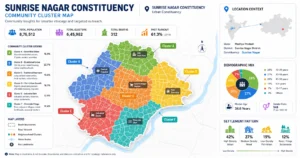
Everything starts with the seat. A constituency assessment classifies every booth from two cycles of Form 20 results, audits the voter roll, verifies swing booths in the field, and ends in a winnability verdict — the full method is in our
constituency analysis framework. For a typical seat, the sequence takes six to ten weeks, which is exactly why it anchors the earliest phase.
This phase also answers the make-or-buy question: what your own team can build and where professional help pays. If you’re engaging consultants, this is the window — our
when to hire an election consultant timeline shows what stops being possible after D-90. The phase’s deliverable is blunt: a vote target, the booth-and-community path to it, and the budget that path implies. Everything downstream allocates against that path.
Phase 2 (D-150 to D-90): How Do You Set Budget, Team, and Compliance?
Start from the legal ceiling and work down. The Election Commission caps candidate expenditure at ₹40 lakh for an assembly seat and ₹95 lakh for a Lok Sabha seat (ECI Notification, January 2022), with attribution rules that tighten once the schedule is announced. Structure the budget with counsel from day one — clean books are a strategic asset, not an administrative chore.
Our working allocation for a Tamil Nadu assembly campaign: ground operations 40%, digital and media 25%, logistics 20%, contingency 15% — the full phase-wise breakdown is in our
election campaign budget planning guide. The team chart matters as much as the money: one named lead each for ground, communication, data, and finance, reporting to a single campaign manager. Committees don’t run campaigns; named owners do.
Phase 3 (D-120 to D-60): How Do You Build the Narrative?
One message, chosen from evidence, repeated until the campaign is sick of it — because that’s roughly when voters start hearing it. The baseline survey from Phase 1 tells you which issues are salient in which booth clusters; the narrative phase converts that into a message architecture: one core promise, three supporting proof points, and translations for each audience and platform.
Platform strategy follows the message, not the other way around. WhatsApp for direct household reach, YouTube for long-form candidate narrative, Instagram for urban youth — the platform-by-platform build is in our
social media campaign service overview. Whatever the channel mix, the discipline is the same: every local leader, pamphlet, and reel carries the same core promise. Message freelancing by allies is a bigger threat than the opponent’s counter-narrative.
This is also when opposition research matures into response preparation: a one-page rebuttal brief for every attack you expect. Write them at D-90, when heads are cool — not at D-10, when they aren’t.
Phase 4 (D-90 to D-15): How Do You Run Ground Operations?
Ground operations consume the largest budget share — 40% in our allocation — because direct contact still decides Indian elections. The unit of organisation is the booth committee: five to seven volunteers per polling station who own its voter list, its turnout on polling day, and everything between. Building committees for every priority booth is the single longest task in the campaign; start at D-90 or don’t bother.
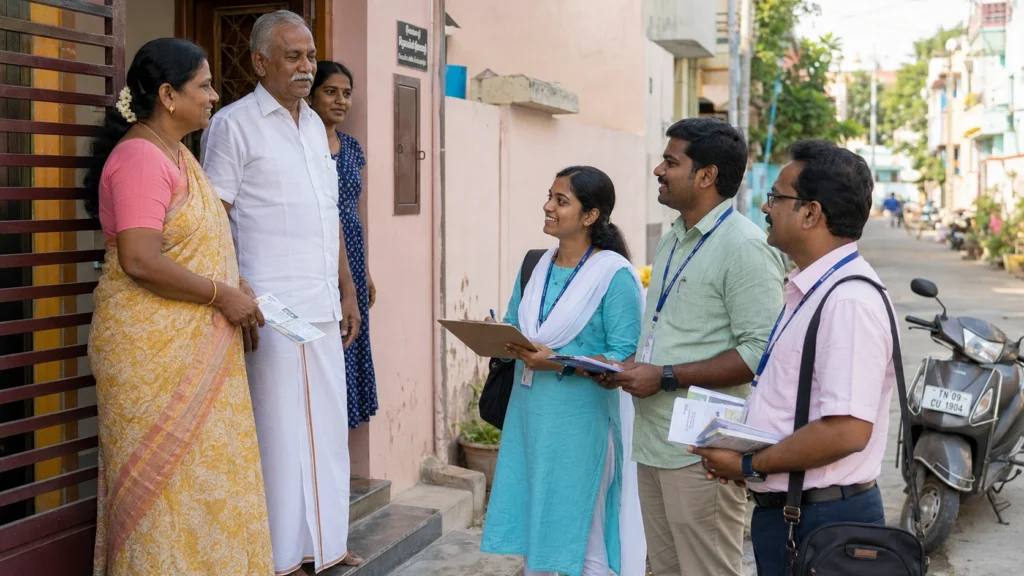
Canvassing runs in waves mapped to the booth classes from Phase 1: identification sweeps in swing booths first, persuasion visits to households the data flags as movable, and commitment calls in the final weeks. The operational detail — scripts, agent training, route planning — lives in our
door-to-door campaign management and
booth management services guides.
Phase 5 (D-15 to D-1): What Does the War-Room Fortnight Look Like?
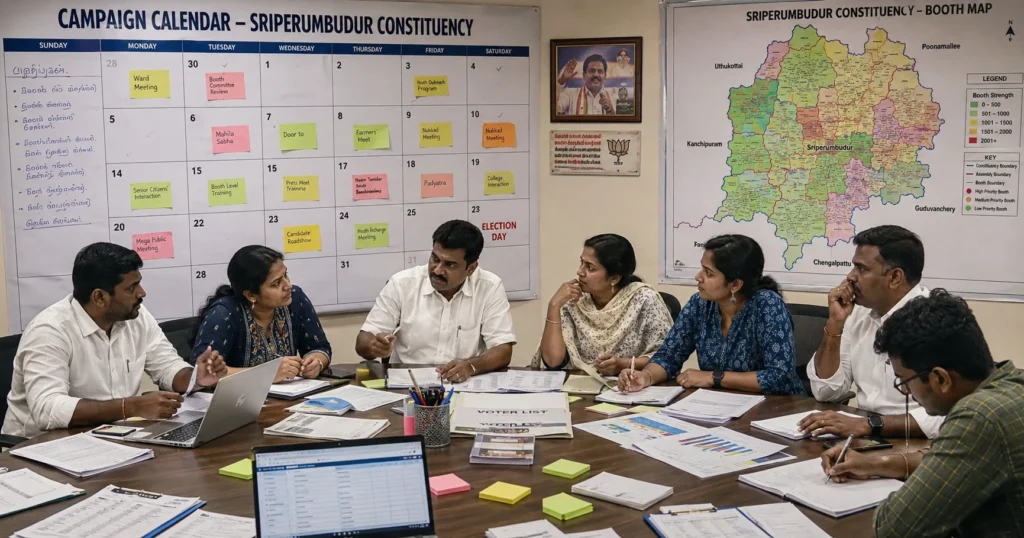
The last fortnight compresses everything: a daily cycle of overnight data review, morning message call, field dispatch, and evening media response. That cadence needs a physical war room with named desks — data, media, legal, logistics — running from D-15; the setup checklist is in our
election war room setup guide.
Two disciplines dominate. First, Model Code of Conduct compliance: every expenditure, vehicle, and speech now happens under observation, and an MCC violation in the final week costs more attention than any rally buys. Second, turnout modelling: the war room re-forecasts booth-level turnout daily from committee reports, and reallocates polling-day resources to where the model says the margin actually lives. By D-3, the campaign should know its expected result booth by booth — and be working the gap, not the average.
Phase 6 (D-0): How Do You Execute Polling Day and Counting?
Polling day is a logistics operation wearing a political costume. Every booth needs a trained polling agent inside and a turnout team outside; the booth committees built in Phase 4 now run GOTV — tracking who among their committed voters hasn’t turned up by early afternoon, and going to get them. Transport for elderly and outstation voters is arranged days earlier, not improvised at noon.
Counting readiness is the forgotten step: agents for every counting table, briefed on the process and on when to seek recounts. The campaign that planned from D-180 shows up to counting day with its paperwork in order and its agents trained. Then — win or lose — the post-poll review: booth-wise results against the Phase 1 model, so the next campaign starts smarter. Common failure points across all six phases are catalogued in our
election campaign mistakes post-mortem.
What Are the Steps to Run a Winning Election Campaign in Tamil Nadu?
The same six phases — executed on Tamil Nadu’s distinctive terrain. The 2026 assembly election showed how demanding that terrain is: turnout surged to 85.1% from 74.26% in 2021, and a first-time party won 108 of 234 seats (ECI results, May 2026). No state punishes stale planning assumptions faster.
Three TN-specific adjustments. First, the booth math: seats here averaged 321 polling stations in 2026 (75,064 across 234 seats, ECI) — booth committee recruitment is a bigger lift than in most states, so Phase 4 starts at the early end of its window. Second, the media ecosystem: Tamil-language channels, local cable networks, and film-culture reference points make imported Hindi-belt communication templates useless; narrative work must be native, not translated. Third, community geography: sub-caste clusters shift block by block between Kongu, Delta, and southern districts, which is why the Phase 1 assessment leans so heavily on field enumeration here.
The state-specific playbook — alliances, candidate positioning, and the 2026 lessons — is in our guide on
how to win a Tamil Nadu assembly election.
Get Your Campaign Plan Pressure-Tested
Planning a run in the local body polls or the next assembly cycle? Sivakumar and the Think Politically team will review your seat, your timeline, and your draft plan against this six-phase playbook in a free 30-minute call — and tell you honestly which phase you’re already late on.
Frequently Asked Questions
How do I plan an election campaign in India?
Work backwards from polling day in six phases: constituency assessment (D-180), budget and team setup (D-150), narrative building (D-120), ground operations (D-90), the war-room fortnight (D-15), and polling day execution. Each phase produces the input the next consumes — assessment first, always, because every later allocation depends on its booth-level verdict.
How much does it cost to run an election campaign in India?
The ECI caps candidate spend at ₹40 lakh for assembly seats and ₹95 lakh for Lok Sabha seats (2022 notification), with party expenditure governed separately. A disciplined assembly campaign allocates roughly 40% to ground operations, 25% to digital and media, 20% to logistics, and 15% to contingency.
When should campaign planning start?
Around D-180 — six months before expected polling day — because the constituency assessment alone takes 6-10 weeks and everything else consumes its output. Candidates who start after the schedule is announced skip straight to execution with no plan underneath it; by D-60, research-led planning is no longer possible.
What is constituency campaign strategy?
The seat-level plan that allocates budget and volunteers across booth classes: which of a seat’s roughly 300 booths get persuasion visits, which get turnout maintenance, and which get minimal spend. It’s built from booth-classified Form 20 results, a roll audit, and a baseline survey — the constituency assessment’s outputs.
What are the steps to run a winning election campaign in Tamil Nadu?
The same six phases, with three TN adjustments: earlier booth-committee recruitment (seats averaged 321 booths in 2026, ECI), native Tamil-language narrative work rather than translated templates, and field-heavy community mapping across Kongu, Delta, and southern sub-caste geographies. The 2026 turnout surge to 85.1% made fresh assessment non-negotiable.
How do political consultants structure a campaign plan for first-time assembly candidates in India?
\n For a first-time candidate, consultants typically front-load the constituency assessment phase since there is no prior campaign data to build on, then compress team-building and infrastructure into a tighter window than a repeat candidate would need. The plan usually leans more heavily on booth-level ground operations relative to digital spend, since a first-time candidate has less name recognition to leverage through media alone.\n
What does an election campaign timeline from nomination to polling day look like?
\n From nomination filing to polling day is typically a compressed 3-5 week window once the Model Code of Conduct takes effect, focused on execution rather than research: candidate visibility, final-round voter contact, rapid response to developments, and polling-day turnout operations. All the planning-heavy work, constituency assessment, narrative development, infrastructure building, should already be complete by the time nomination is filed.\n
What is an election campaign roadmap?
\n An election campaign roadmap is the phased sequence a campaign follows from initial constituency assessment through to polling day, typically spanning assessment, infrastructure building, active execution, and a final war-room-led push. It exists so that campaign planning in India, and election campaign planning generally, follows a deliberate order rather than activities happening in an ad hoc sequence driven by whatever feels most urgent that week; candidate campaign planning built on a clear roadmap consistently outperforms planning done reactively.\n
What should an election campaign planning guide for first-time candidates cover?
\n At minimum: how to conduct a constituency baseline assessment, how to build a booth-level team from limited existing networks, how to budget within the ECI’s expenditure cap, and how to sequence ground and digital execution against the electoral calendar. A guide aimed at first-time candidates should assume no prior campaign infrastructure exists and explain how to build it from scratch, not just how to run an existing machine.\n
How do you run a winning assembly election campaign?
\n Winning assembly campaigns consistently follow the same underlying discipline regardless of constituency specifics: a genuine constituency assessment before committing resources, booth-level infrastructure built well ahead of the Model Code of Conduct, and ground and digital execution run as one coordinated effort rather than separate tracks. Campaigns that skip the assessment phase and go straight to execution are making resource-allocation decisions on assumption rather than evidence.\n
Plan Backwards, Execute Forwards
Every winning campaign we’ve studied or run shares one habit: it was planned backwards from polling day and executed forwards without skipping a phase. The capped budget, the MCC, the booth math — none of it rewards improvisation. The playbook above is the order of operations; the linked guides carry the depth for each phase.
Start where every plan starts: the seat itself. Read the
constituency analysis framework, pull your Form 20, and put a date on your own D-180.
Sources: Centre for Media Studies via ADR, 2024 Lok Sabha election expenditure estimate (₹1.35 lakh crore), April 2024, retrieved 2026-07-07, adrindia.org · Election Commission of India, candidate expenditure limit notification (₹40 lakh assembly / ₹95 lakh Lok Sabha), January 2022 · ECI via PIB, “Granular Data of Lok Sabha Elections 2024” (10.51 lakh polling stations; 931 average electors), December 2024, retrieved 2026-07-07, pib.gov.in · ECI, Tamil Nadu assembly election 2026 (75,064 polling stations; 85.1% turnout; 2021: 74.26%), April-May 2026, retrieved 2026-07-07, eci.gov.in.
About the author: Sivakumar Devasagayam is Campaign Strategy Lead at Think Politically, a Chennai-based political consulting firm focused on Tamil Nadu state and local elections. He has worked on assembly and Lok Sabha campaigns across Kongu, Delta, and Chennai urban constituencies since 2011.