The best social media strategy for a political candidate in Tamil Nadu is WhatsApp-first, Tamil-language, and booth-aligned: WhatsApp for direct household reach, YouTube for long-form candidate narrative, Instagram for urban youth — with every piece of content written in Tamil for specific booth clusters, not translated from a national template. The reach case is simple: as of 2025, India has roughly 535 million WhatsApp users and 491 million YouTube users (Statista / platform ad-reach data, 2025), and Tamil Nadu sits among India’s most connected states. This guide covers the platform-by-platform playbook, the Tamil-specific content rules, the ground-campaign alignment that most digital teams skip, and the legal lines the ECI actually enforces.
Key Takeaways
- Platform roles, not platform presence: WhatsApp = direct contact, YouTube = narrative, Instagram = urban youth, Facebook = 30-55 semi-urban, X = media narrative. Being everywhere with one message beats being everywhere with everything.
- India had ~535 million WhatsApp users in 2025 (Statista) — in Tamil Nadu campaigns, WhatsApp is ground operations, not “social media.”
- Content must be native Tamil, segmented by booth cluster — the same promise, translated into each community’s priorities and idiom.
- Social media that isn’t aligned with the booth plan is entertainment. Align distribution lists with booth committees from D-90.
What Does a Winning Political Social Media Strategy Look Like?
Three tiers with distinct jobs. In 2025, India’s platform audiences reached roughly 535 million on WhatsApp and 491 million on YouTube (Statista, WhatsApp and YouTube India user forecasts, 2025) — but raw reach is the wrong metric. A campaign’s social strategy succeeds when each platform does the one job it’s structurally best at, feeding the same core message.
| Platform | Campaign Job | Format That Works |
|---|---|---|
| Direct household contact, booth-aligned distribution | Voice notes, short video, community-specific cards | |
| YouTube | Candidate narrative, long-form credibility | 3-8 min Tamil videos, constituency issue stories |
| Instagram / Reels | Urban and youth visibility | 15-45s reels, behind-the-scenes, candidate persona |
| 30-55 semi-urban and rural reach | Live streams, event albums, local group presence | |
| X (Twitter) | Media and narrative-setting, not voter reach | Statements, data points, journalist engagement |
One message architecture runs through all five: the core promise from your campaign plan, translated per platform and per audience. That message comes out of the planning sequence — narrative is Phase 3 of our
election campaign planning playbook — and social media is its distribution system, not its replacement.
Why Is WhatsApp the Backbone in Tamil Nadu?
Because it’s the only platform that reaches every voter demographic directly, in their own group ecosystem. With India at roughly 535 million WhatsApp users in 2025 (Statista) and near-universal smartphone penetration among TN’s connected households, WhatsApp isn’t a social channel — it’s the digital layer of ground operations.
The structure that works mirrors the booth plan: distribution organised by booth committee, so the family in booth 214 receives the message about their street’s drainage works, voiced by a coordinator they recognise. Broadcast content follows a weekly rhythm — one candidate voice note, one local-issue card, one short video — and everything is forwardable by design. The full operating model, including group hygiene and volunteer roles, is in our
WhatsApp political campaign guide.
How Should Candidates Use YouTube and Tamil Video?
As the credibility engine. India counted about 491 million YouTube users in early 2025 (platform ad-reach data via Statista), and Tamil Nadu’s political video culture is unusually deep — this is a state where political narrative has always run through screens. Long-form video is where a candidate stops being a poster and becomes a person.
The working format: three-to-eight-minute Tamil videos, one per week from D-120, each anchored to a constituency issue with the candidate on location — not studio monologues. Paid distribution concentrates on your own constituency’s geography and interests; our
YouTube political ad spend analysis breaks down what TN campaigns actually pay and where the waste hides. Shorts recut from the long videos feed Instagram and WhatsApp, so one shoot powers three platforms.
How Does Tamil-Language and Community Segmentation Change Content?
It changes everything — and it’s the layer national playbooks can’t copy. Tamil Nadu’s media ecosystem runs almost entirely separate from Hindi-belt strategy: Tamil-first platforms, film-culture reference points, and sub-caste geographies that shift block by block between Kongu, Delta, and southern districts. Content that reads as translated — or worse, dubbed — signals “outsider” faster than any attack ad.
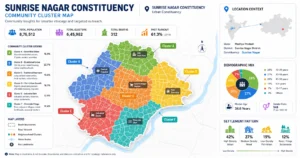
Practically: build a translation matrix in week one. Rows are your booth clusters and their priority issues (from the constituency assessment); columns are platforms. Every content slot gets filled with the local version of the core promise. It’s more work than one glossy state-wide video — and it’s why local campaigns out-perform template agencies here.
How Do You Align Social Media With the Ground Campaign?
By making the booth plan the distribution plan. Social content that isn’t wired to ground operations gets impressions; wired content gets turnout. The alignment is mechanical: every booth committee doubles as a WhatsApp distribution node, canvassing waves and content waves share a calendar, and the war room reads platform response as another field report.
For smaller contests, the same logic scales down — our
digital campaign guide for local body elections covers the panchayat and ward version. And if you’d rather have the whole system run for you, that’s what our
social media campaign management service does — strategy, Tamil content production, and booth-aligned distribution as one operation.
What Are the Legal Lines for Political Social Media in India?
Four rules the ECI actually enforces. First, political advertisements on electronic media require pre-certification by the Media Certification and Monitoring Committee (MCMC), and paid social ads fall under this regime. Second, campaign-period expenditure on social media counts toward the candidate’s ₹40 lakh assembly spending cap (ECI Notification, January 2022) — including boosted posts and influencer payments. Third, the 48-hour silence period before polling closes (Section 126, Representation of the People Act) applies to paid political advertising. Fourth, Section 123 corrupt-practice rules — including caste and religious appeals — apply to a WhatsApp forward exactly as they do to a stage speech.
Build compliance into the workflow: one approval owner for paid content, an expenditure log that includes every boost, and a hard content freeze scheduled before the silence window. Campaigns rarely lose elections over these rules — but they lose weeks answering notices they could have avoided.
Get a Booth-Aligned Digital Plan for Your Seat
Think Politically runs Tamil-first, booth-aligned social media campaigns as one system with the ground game — strategy, content production, WhatsApp architecture, and compliance. Book a free 30-minute call and we’ll map what a 90-day digital calendar looks like for your constituency.
Frequently Asked Questions
What is the best social media strategy for political candidates in Tamil Nadu?
WhatsApp-first, Tamil-language, booth-aligned: WhatsApp for direct household distribution organised by booth committee, YouTube for weekly long-form candidate narrative, Instagram for urban youth — all carrying one core promise translated per booth cluster. With ~535 million Indian WhatsApp users (Statista, 2025), direct reach beats broadcast reach.
How do you use social media to win elections in India?
By wiring it to ground operations: booth committees double as WhatsApp distribution nodes, the content calendar follows the canvassing phases from D-120 to polling day, and the war room reads platform response as field intelligence. Social media that runs as a separate department produces reach without turnout.
Which platform matters most for an assembly campaign?
WhatsApp, by a distance — it’s the only platform reaching every voter demographic directly in a state where it approaches universal smartphone presence. YouTube ranks second for credibility-building. Instagram, Facebook, and X play supporting roles for specific demographics and media narrative rather than mass voter contact.
How much should a candidate budget for digital campaigning?
Within the 25% digital-and-media share of a disciplined assembly budget — under the ECI’s ₹40 lakh candidate cap (2022 notification), which includes boosted posts and influencer payments. Content production in Tamil is the biggest line; paid amplification works only when concentrated on your own constituency’s geography.
Is WhatsApp campaigning legal in Indian elections?
Yes, with the same rules as offline campaigning: expenditure attribution under the candidate’s cap, no caste or religious appeals (RPA Section 123), no paid political advertising in the 48-hour silence period (Section 126), and MCMC pre-certification for paid electronic ads. Organic group communication is lawful; the content rules still apply.
What are the most effective social media platforms for political candidates to reach voters in Tamil Nadu?
WhatsApp, YouTube, Facebook, Instagram, and Twitter/X each play a different role, and no single platform substitutes for the others. WhatsApp is the primary distribution channel, reaching households directly through booth-organised groups rather than open broadcast. YouTube builds candidate credibility through weekly long-form Tamil content that survives longer than a reel cycle. Facebook and Instagram carry short-form content and paid amplification aimed at urban and youth segments, while Twitter/X mainly shapes media and opposition narrative rather than mass voter contact. A Tamil Nadu campaign that picks one platform and ignores the rest usually gets reach without votes; the platforms work as a stack, not a menu of alternatives.
How can a political candidate in Tamil Nadu create a compelling social media content plan to boost public engagement?
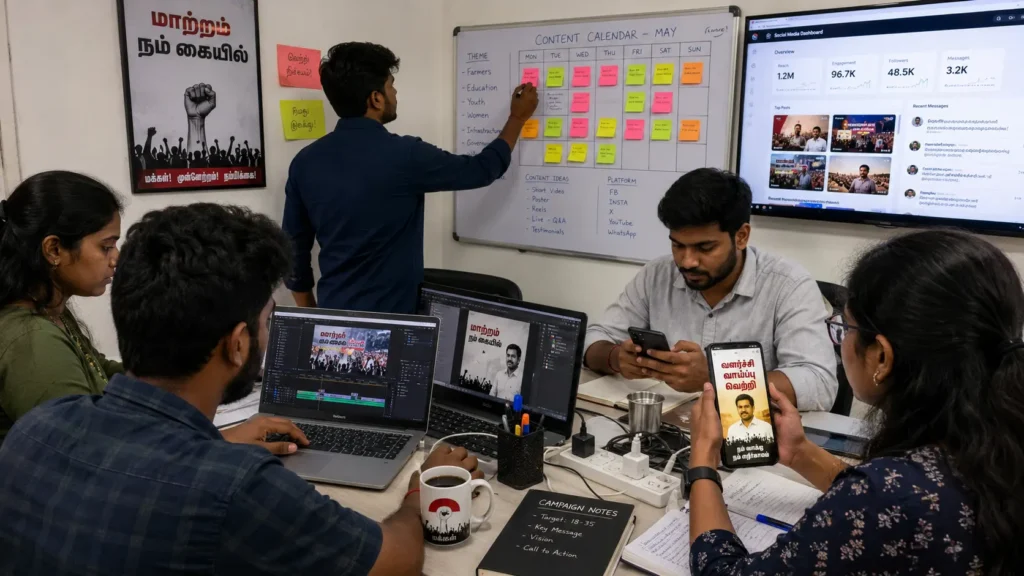
Start from the campaign’s core promise, not the platform. Build a content calendar that maps each canvassing phase (from roughly D-120 to polling day) to a content theme, so social media reinforces whatever the ground team is doing that week rather than running on its own schedule. Produce content natively in Tamil per booth cluster or region instead of translating a single national script, since generic translated messaging reads as inauthentic to Tamil Nadu voters. Mix formats deliberately: WhatsApp carries direct, personal-toned updates; YouTube carries longer narrative and issue explanation; Instagram and Facebook carry short, shareable moments. Engagement rises when volunteers and booth committees are given the content to forward themselves, rather than voters only seeing it as a passive feed post.
What are the key differences between using Facebook, Instagram, and YouTube for political campaigning in Tamil Nadu?
Facebook skews toward an older, broader demographic and works best for community-group discussion and local news-style updates. Instagram skews younger and urban, and rewards short, visually driven content (reels, candidate-in-the-field clips) over long text. YouTube is the credibility platform: longer Tamil-language videos, interviews, and issue explainers that a voter chooses to watch rather than scrolls past, and content stays discoverable long after it’s posted, unlike a 24-hour story. In practice, Facebook and Instagram drive frequency and reach, while YouTube builds the depth of trust that changes undecided voters’ minds.
What type of regional language content and cultural messaging works best for political social media campaigns targeting Tamil Nadu voters?
Content written and shot natively in Tamil, not translated from an English or national template, performs best. Tamil Nadu’s political communication has its own rhetorical conventions: classical and literary references, aspirational framing tied to the state’s political heritage, and language registers that shift by community and region. Messaging should also be localised below the state level, a booth cluster in a rural delta district and an urban Chennai ward respond to different cultural cues even within the same constituency. Candidates who test messaging in Tamil from the first draft, rather than writing in English and translating afterward, consistently see stronger engagement than those running a single translated national script.
What is a good social media strategy for a politician?
WhatsApp-first, Tamil-language, and tied directly to booth committees rather than run as a separate digital team. A politician’s social media should carry the same weekly message the ground campaign is delivering door to door, not a parallel narrative, the platforms that matter most in Tamil Nadu are WhatsApp for reach, YouTube for candidate credibility, and Instagram for younger voters.
What does social media management for politicians involve?
Day-to-day content production in the local language, booth-committee-aligned WhatsApp distribution, a posting calendar that follows the campaign’s ground phases rather than running independently, and monitoring platform response as a feedback signal for the war room rather than a vanity metric.
What is election social media in India?
Election social media in India refers to the platforms and content a candidate or party uses to reach voters digitally, WhatsApp, YouTube, Instagram, and Facebook chief among them, governed by the same ECI expenditure and content rules that apply to offline campaigning. In Tamil Nadu specifically, WhatsApp dominates as the primary reach channel given its near-universal smartphone presence.
How do you build a candidate brand on social media before election season?
Start well before the formal campaign window, ideally 6-12 months out, by establishing a consistent voice and visual identity, documenting the candidate’s local engagement and responsiveness to constituent issues, and building an organic following before any paid amplification begins. A brand built only in the final weeks before polling reads as opportunistic rather than established.
How do you integrate social media with ground campaign strategy in India?
Integration means treating social media as a feedback channel for the ground campaign, not a separate department: booth committees double as WhatsApp distribution nodes, the content calendar follows the same phases as ground execution, and platform response (which content gets shared, which gets ignored) feeds back into what the war room prioritises. Social media run independently of ground operations produces reach without a clear path to turnout.
What is political social media in India?
Political social media in India covers the full set of digital channels parties and candidates use for campaign communication, distinguished from general political discourse online by its direct campaign purpose: voter persuasion, mobilisation, and rapid response, subject to ECI content and expenditure rules rather than unregulated commentary.
How do you build a candidate brand on Instagram before assembly elections?
Instagram works best for reaching younger, urban voters through short-form video and visual storytelling rather than the long-form or text-heavy content that performs on other platforms. Building a candidate’s Instagram presence ahead of assembly elections means establishing a consistent visual identity early, documenting ground engagement authentically rather than as staged content, and prioritising local, Tamil-language material over generic templated posts.
What is a candidate’s online strategy?
A candidate’s online strategy is the specific plan for how they personally, as opposed to the campaign’s broader digital operation, show up across social platforms: tone of voice, posting cadence, which issues they personally address online, and how they handle direct constituent engagement and criticism. It sits within the campaign’s wider social media strategy but focuses specifically on the candidate’s individual presence and credibility.
What social media platforms deliver the highest voter engagement for assembly candidates in rural India?
In rural India, WhatsApp consistently delivers the highest voter engagement given its near-universal smartphone presence and low data requirements, followed by YouTube for longer-form candidate content where connectivity allows. Platforms like Instagram, which skew urban and younger, typically deliver lower engagement in rural constituencies relative to their urban performance, making channel choice a genuinely different decision by geography rather than a one-size-fits-all platform mix.
Reach Is Cheap. Alignment Wins.
Any agency can promise impressions. In Tamil Nadu, the campaigns that convert social media into votes share three habits: they treat WhatsApp as ground operations, they produce native Tamil content per booth cluster instead of translating a national template, and they lock the content calendar to the campaign phases. The platforms are commodity. The alignment is the strategy.
Start from the plan, not the platforms: the digital calendar is one output of the six-phase sequence in our
election campaign planning playbook — and the segmentation underneath it comes from the same constituency work that drives everything else.
Sources: Statista, WhatsApp users in India forecast (~535.8 million, 2025), retrieved 2026-07-07, statista.com · Statista / platform ad-reach data, YouTube users in India (~491 million, early 2025), retrieved 2026-07-07, statista.com · Election Commission of India, candidate expenditure limit notification (₹40 lakh assembly), January 2022 · Representation of the People Act 1951, Sections 123 and 126; ECI MCMC pre-certification guidelines.
About the author: Sivakumar Devasagayam is Campaign Strategy Lead at Think Politically, a Chennai-based political consulting firm focused on Tamil Nadu state and local elections. He has worked on assembly and Lok Sabha campaigns across Kongu, Delta, and Chennai urban constituencies since 2011.