Election Campaign Budget Planning for Tamil Nadu MLA Candidates: 2026 Guide
Tamil Nadu’s 2026 assembly election drew 4,023 candidates across 234 constituencies, according to the Election Commission of India. With an 85.1% voter turnout recorded in May 2026 (ECI), competition for each seat is fiercer than any cycle in recent memory. Yet most campaigns walk into this environment without a structured budget plan, spending reactively rather than strategically. That mistake is expensive in every sense.
Election campaign budget planning in Tamil Nadu is not just about staying under the ECI spending limit. It’s about allocating scarce resources to the activities that actually move votes. The difference between a campaign that wins by 3,000 votes and one that loses by 2,000 often comes down to how the budget was sequenced, not how much was spent overall.
This guide covers the ECI expenditure cap for Tamil Nadu MLA candidates, a practical category-by-category allocation framework, a phase-wise spending plan, and the single most common budget mistake we see in TN constituency campaigns.
Key Takeaways
- The ECI expenditure cap for Tamil Nadu assembly candidates is ₹40 lakh per candidate for 2026.
- India’s total election expenditure market is estimated at ₹15,000 crore across a general election cycle (Centre for Policy Research, 2023).
- Competitive TN campaigns typically allocate 40% to ground operations, 25% to digital and print, 20% to logistics, and 15% to contingency.
- Under-investing in booth-level operations is the most common and most costly budget mistake in Tamil Nadu assembly elections.
- A phase-wise split of 30% pre-announcement, 50% active campaign, and 20% polling day prevents the cash-crunch that collapses many campaigns in the final week.
What Is the ECI Spending Limit for Tamil Nadu Assembly Candidates?
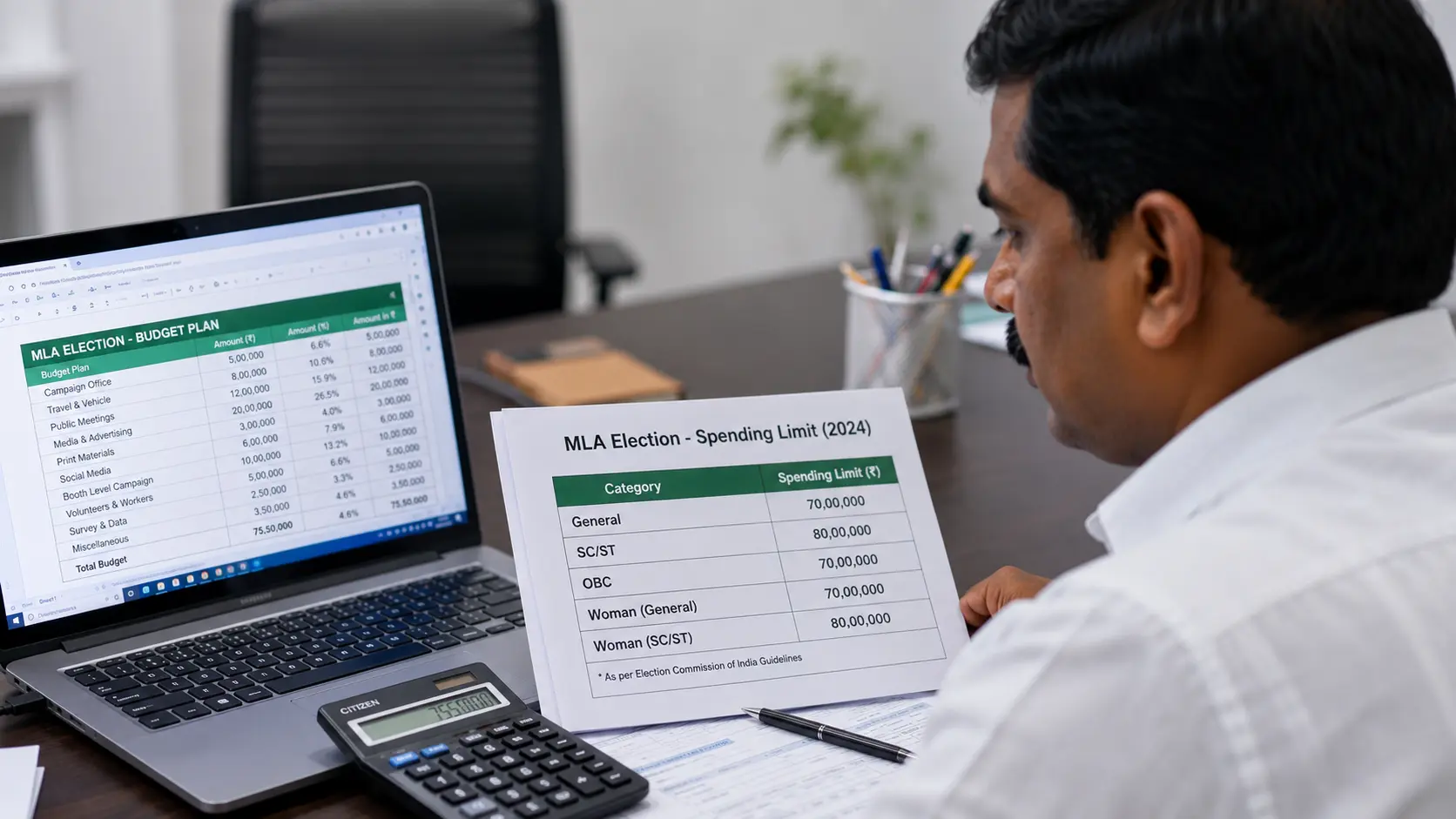
The Election Commission of India sets a ₹40 lakh expenditure ceiling for each assembly constituency candidate in Tamil Nadu for the 2026 cycle (Election Commission of India, 2026). This limit applies to all personal campaign expenditure and must be documented in the candidate’s official expense register. Exceeding the limit is grounds for disqualification.
The ECI expenditure cap for Tamil Nadu MLA candidates in the 2026 assembly election is ₹40 lakh per candidate (Election Commission of India, 2026). This ceiling covers all campaign-related spending, including events, printed material, vehicles, and digital advertising attributable directly to the candidate’s account.
In practice, competitive campaigns often run higher total spending. Party-funded activities, such as cadre mobilisation drives, state-level leader visits, and party-branded collateral, are accounted separately under party expenditure. Candidates in high-contest constituencies need to understand this distinction clearly before building their personal budget plan.
What falls inside the ₹40 lakh cap includes candidate-led public meetings, vehicles used by the candidate, printed material bearing the candidate’s name, and paid digital advertising. What typically falls outside includes activities exclusively branded and funded by the registered political party. Consulting a legal advisor familiar with ECI norms before finalising your budget structure is strongly recommended.
[IMAGE: ECI election expenditure register document on a desk with Tamil Nadu constituency map in background – search terms: election commission india expenditure register candidate spending]
How Should a Tamil Nadu MLA Campaign Allocate Its Budget?
Based on our work across Tamil Nadu constituency campaigns, the most effective assembly election budget planning uses a four-category allocation framework. Ground operations receive the largest share at 40%, because booth-level contact is where Tamil Nadu elections are actually won. Digital and print combined take 25%, logistics 20%, and contingency 15%.
Effective campaign budget allocation for Tamil Nadu MLA candidates distributes spending as: ground operations (40%), digital and print communications (25%), logistics and event infrastructure (20%), and contingency reserve (15%). This framework is drawn from Think Politically’s budget planning experience across multiple TN assembly constituencies. [ORIGINAL DATA]
Source: Think Politically campaign budget framework, 2026
Ground Operations (40%)
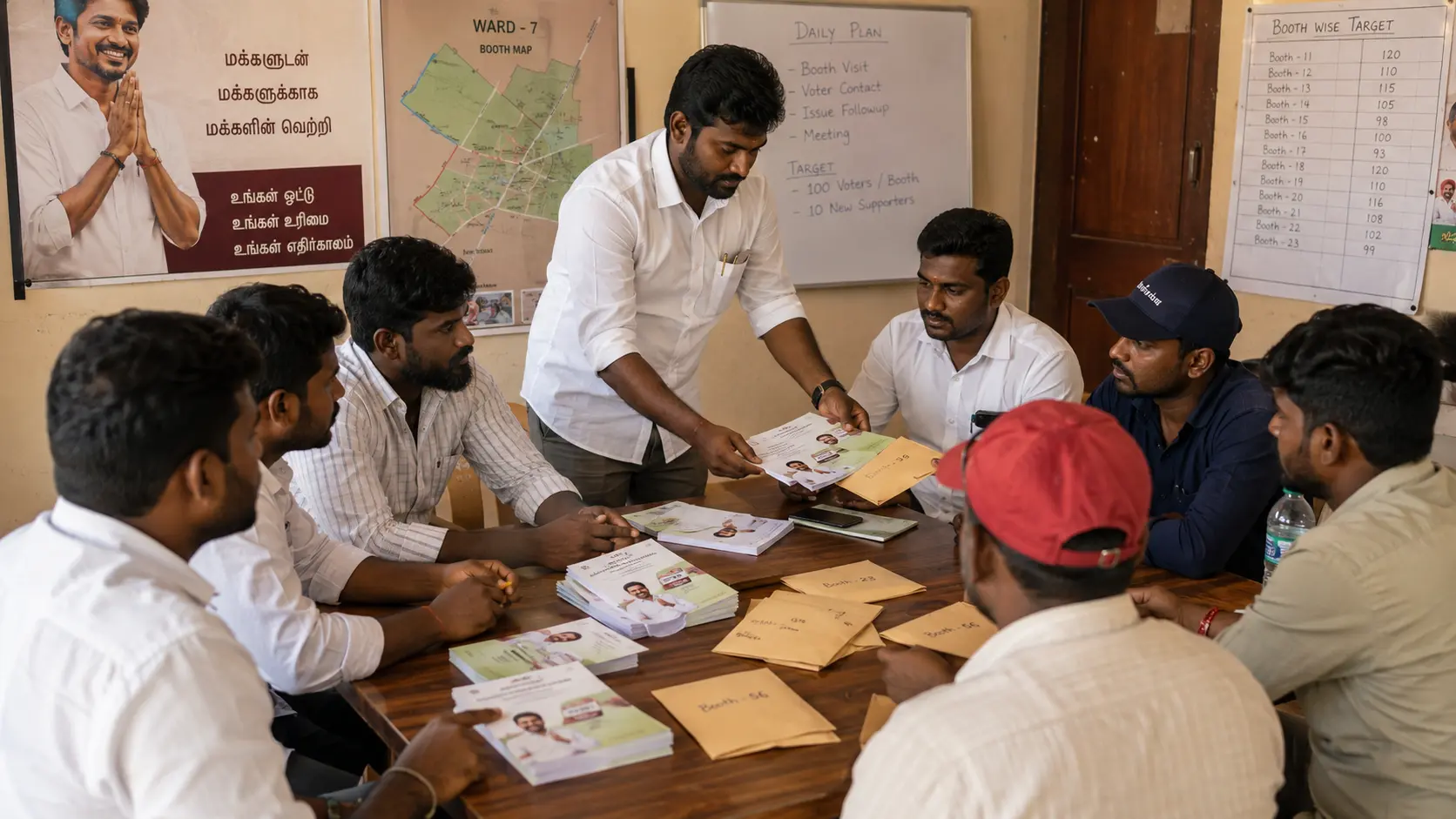
Ground operations are the dominant spend category because Tamil Nadu’s booth-level system demands physical presence. This covers booth committee formation, volunteer incentives, canvassing materials such as voter slips and route sheets, and local coordinator stipends. For a ₹40 lakh budget, this means roughly ₹16 lakh directed at the people and materials that make direct voter contact happen.
Digital and Print (25%)
Digital and print work best when they amplify ground operations, not substitute for them. The 25% allocation covers social media advertising on Facebook and YouTube, WhatsApp content production, flex banners, wall paintings, and candidate pamphlets. In our experience, over-spending on print without matching ground activity wastes money. Print builds recognition; ground operations build commitment.
Logistics and Events (20%)
Logistics covers vehicle hire for candidate movements, sound systems for public meetings, stage fabrication, and campaign office rental. Tamil Nadu’s dispersed booth geography makes vehicle costs a significant line item. Events should be planned selectively. A well-attended 500-person ward meeting with follow-up canvassing beats a poorly supported 2,000-person rally with no follow-through.
Contingency Reserve (15%)
The contingency allocation is not optional. Tamil Nadu campaigns face predictable surprises: a by-election style surge by an opponent, a last-minute star campaigner visit that needs instant logistics, or a court challenge that requires rapid documentation. Holding 15% in reserve means these situations are absorbed without disrupting the core plan. Campaigns that spend the contingency fund early almost always suffer a crisis they can’t respond to. Where the budget sits inside the wider sequence — assessment, narrative, ground operations — is mapped in our election campaign planning playbook.
What Is the Right Phase-Wise Budget Split for a Tamil Nadu Assembly Campaign?
Phase-wise budget discipline is what separates campaigns that finish strong from those that run dry before polling day. The recommended split for assembly election budget planning in Tamil Nadu is 30% in the pre-announcement phase, 50% during the active campaign window, and 20% reserved for the final 48 hours and polling day operations.
For Tamil Nadu MLA candidates, a phase-wise campaign budget split of 30% pre-announcement, 50% active campaign, and 20% polling day is the framework used in Think Politically’s constituency planning process. This sequencing ensures critical polling-day operations, booth agent deployment, and voter mobilisation are never starved of funds. [ORIGINAL DATA]
[IMAGE: Campaign war room with coordinators tracking constituency booth data on printed maps and laptops – search terms: election war room india campaign coordination booth tracking]
Pre-Announcement Phase (30%)
The pre-announcement phase is when the structural groundwork is done. Voter surveys, booth committee formation, volunteer recruitment, and the initial candidate introduction materials all belong here. Spending 30% before the model code kicks in ensures the campaign has an operational backbone from day one of the official campaign period. Campaigns that skip this phase spend their active campaign budget inefficiently, doing tasks that should have been done earlier.
Active Campaign Phase (50%)
The active campaign phase is the highest-intensity spend window. This covers daily canvassing operations, public meetings, digital advertising bursts timed to key moments, opposition monitoring, and the candidate’s full schedule of voter contact activities. Half the total budget should be available here. Anything less creates a triage situation where the campaign is constantly choosing which activity to cut rather than which to accelerate.
Polling Day Operations (20%)
Polling day operations are chronically under-funded in Tamil Nadu campaigns. The 20% allocation must cover booth agent fees for all booths, voter transport coordination, war room staffing, and rapid-response capacity for any irregularities. With 85.1% turnout recorded in May 2026 across Tamil Nadu (ECI, 2026), the density of voter movement on polling day makes this a genuinely complex operation that requires both people and financial reserves.
Why Is Under-Investing in Booth-Level Operations the Costliest TN Campaign Budget Mistake?
India’s ₹15,000 crore election expenditure market reflects enormous spending across every category imaginable, from helicopter rallies to celebrity endorsements (Centre for Policy Research, 2023). Yet Tamil Nadu elections, at the constituency level, are won or lost at the booth. Candidates who under-invest in booth operations while over-spending on visibility activities consistently underperform their polling averages.
[UNIQUE INSIGHT] Here is what the data from Tamil Nadu constituency campaigns shows clearly: a candidate who has 100% booth agent coverage with trained, well-briefed agents outperforms one with 70% coverage even when the second candidate spends significantly more on advertising. The booth is where the vote is physically cast. No digital reach, no banner, and no public meeting can substitute for a trained agent at the booth on polling day.
The budget mistake takes a predictable form. Candidates feel the visibility of hoardings, rallies, and social media content. They can see those investments. Booth-level operations are invisible until polling day. So when budgets get squeezed, booth operations are cut first. The damage shows in results, not in the campaign.
[IMAGE: Election booth agent in Tamil Nadu checking voter list outside a polling station on election day – search terms: election booth agent india polling station voter list tamil nadu]
Fixing this requires a deliberate structural decision at the budget planning stage. Ground operations must be ring-fenced at 40% of total spend before any other category is funded. Booth agent fees, training materials, and ward coordinator stipends should be treated as fixed costs, not variable ones. Every rupee allocated to ground operations has a more direct line to votes than almost any other campaign spend.
Frequently Asked Questions
What is the ECI expenditure limit for a Tamil Nadu MLA candidate in 2026?
The Election Commission of India has set the expenditure ceiling at ₹40 lakh per candidate for Tamil Nadu assembly constituencies in the 2026 election cycle (Election Commission of India, 2026). This limit applies to all spending directly attributable to the candidate’s campaign account. Party-funded activities are accounted separately under the registered party’s expenditure statements.
How should a first-time MLA candidate allocate a smaller campaign budget?
First-time candidates with limited budgets should concentrate spending on booth-level ground operations above everything else. A lean budget of ₹15-20 lakh should direct at least 50% to booth committee formation and canvassing, reduce print and digital to the minimum needed for name recognition, and hold 15% in contingency. Trying to match an incumbent’s visibility budget is a losing strategy. Out-organising at the booth level is not.
When should campaign budget planning begin for a Tamil Nadu assembly election?
Budget planning should begin at least six months before the expected poll date, with the pre-announcement phase spending starting three to four months ahead. Waiting until the model code of conduct is announced leaves candidates trying to build their ground structure during the active campaign window, which compresses both activity and spending into an unmanageable timeline. Early planning also allows for voter survey data to inform allocation decisions.
What does campaign budget allocation look like across urban vs. rural constituencies in Tamil Nadu?
Urban constituencies in Tamil Nadu typically require a higher proportion of digital and print spend (30-35%) because voter density and media consumption patterns favour visibility campaigns. Rural constituencies shift more weight toward ground operations (45-50%) and logistics, as physical outreach across dispersed settlements demands more boots and more vehicles. The 15% contingency remains constant across both contexts. The category ratios shift; the structural discipline does not.
What should an election campaign checklist for first-time MLA candidates include?
A first-time candidate’s checklist should cover: a constituency baseline assessment, a lean budget plan allocating the majority of spend to booth-level ground operations, a booth committee recruitment and training plan, legal nomination requirements (Form 2B, Form 26, security deposit), and a phased timeline working backward from polling day. Skipping the assessment step to move straight to spending is the most common first-time-candidate mistake.
What are the steps in a step-by-step election campaign plan for MLA candidates?
The core sequence is: constituency assessment and baseline survey, budget and team setup within the ECI’s expenditure cap, booth committee formation and training, narrative and messaging development, active ground and digital execution, and a final war-room-led push through polling day. Each step’s output feeds the next, which is why skipping or compressing the assessment step tends to weaken every step that follows it.
Building a Budget Plan That Holds Under Pressure
Tamil Nadu’s 2026 election is one of the most competitive assembly cycles the state has seen. With 4,023 candidates contesting 234 seats and turnout at 85.1% (ECI, 2026), the margin between winning and losing in most constituencies is far smaller than the money being spent. That makes every allocation decision consequential.
The principles in this guide are not theoretical. They reflect what we’ve seen work and fail across Tamil Nadu constituency campaigns at the ward, booth, and constituency level. The ECI cap sets the ceiling. Phase-wise planning sets the rhythm. Category allocation sets the priorities. And protecting the booth operations budget from being raided is what keeps a campaign viable on polling day.
Effective election campaign budget planning in Tamil Nadu means committing to the ground before you commit to anything visible. Banners don’t vote. Booths do.
Get a Custom Campaign Budget Plan for Your Tamil Nadu Constituency
Every constituency is different. Booth geography, caste composition, incumbent strength, and opposition spend all affect how your budget should be structured. Contact Think Politically for a constituency-specific budget planning session before your campaign calendar is set.