What Are the Biggest Mistakes Tamil Nadu Candidates Make in Elections?
Related Service
Door-to-Door Campaign Management Tamil Nadu →Structured canvassing that addresses the ground-contact gap, the most common reason campaigns underperform at the booth level.
The five most costly election campaign mistakes in Tamil Nadu are: (1) Starting too late, campaigns launched fewer than 90 days before polling day consistently underperform on booth coverage. (2) Skipping booth-level systems, a candidate without assigned booth agents in every polling station loses the information advantage on polling day. (3) Ignoring last-mile voters, voters in remote hamlets, apartment complexes, and industrial worker housing decide margins in close seats. (4) Substituting social media reach for ground contact, digital impressions do not convert to votes without accompanying field activity. (5) Treating women voters as a single group, women are the majority of registered voters in Tamil Nadu and split across caste, urban-rural, and employment lines that require targeted messaging. In the 2026 Tamil Nadu assembly election, 61 of 234 seats were decided by under 5,000 votes, any one of these mistakes can change an outcome in a marginal seat.
Avoid these pitfalls with professional election campaign management from Think Politically.
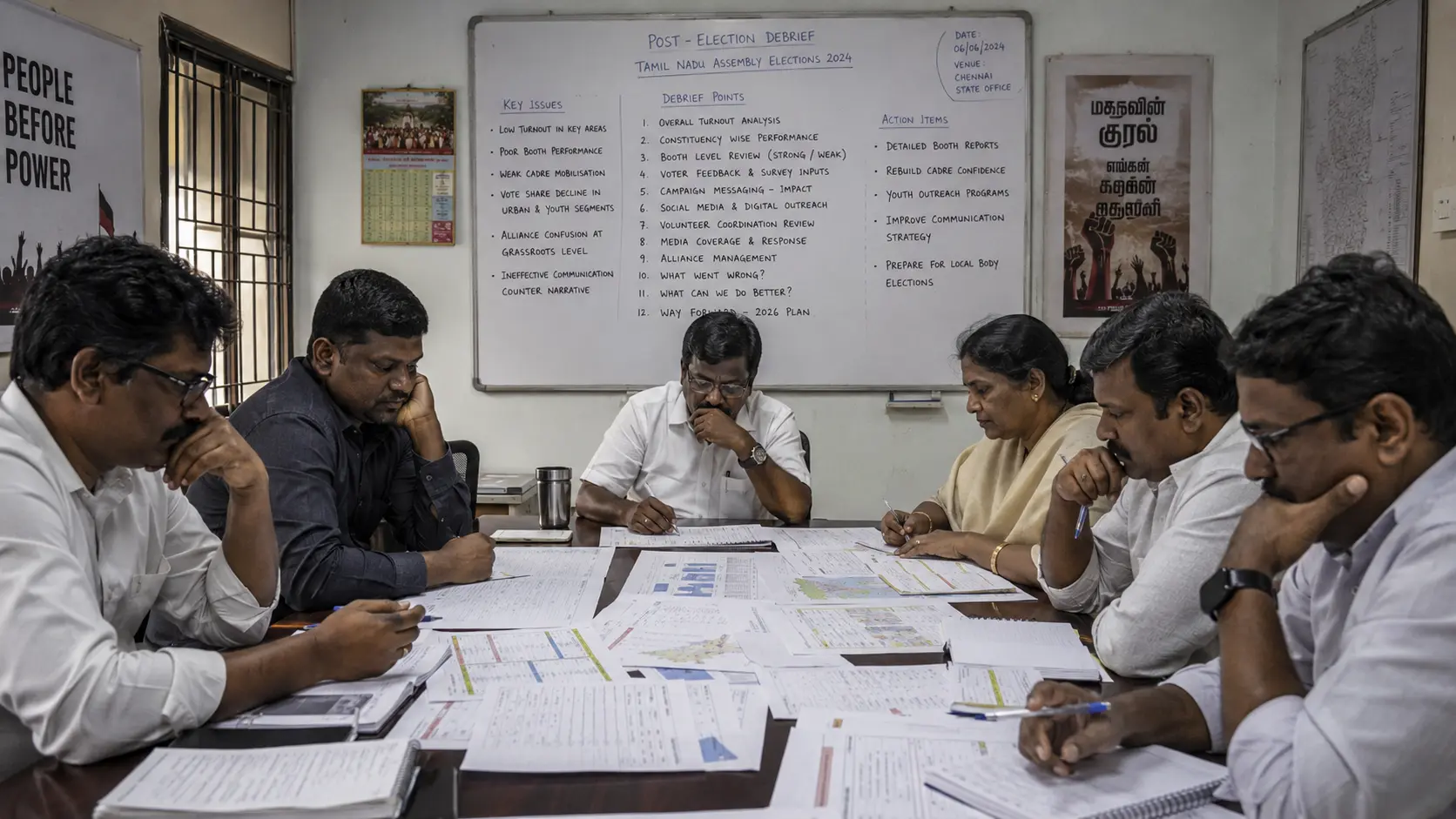
The 5 Biggest Mistakes Tamil Nadu Candidates Make in Election Campaigns
If your 2026 campaign underperformed, at least one of these five mistakes explains why. We offer a free post-campaign audit to help you understand what happened — and what to fix before the next cycle.
Most Tamil Nadu candidates lose not from a lack of resources but from predictable, avoidable errors — starting too late, skipping booth systems, misreading caste arithmetic, or confusing digital reach with actual voter contact on the ground.
TL;DR – Key Takeaways
- In 2026, 61 of 234 assembly seats (26.1%) were decided by under 5,000 votes – campaigns are won in the margins. (Source: Organiser.org, May 2026)
- The five costliest campaign errors are: starting late, weak booth management, ignoring last-mile voters, substituting social media for ground work, and treating women voters as one uniform group.
- Fixing any one of these mistakes in a 5,000-vote margin seat could change the outcome. Fixing all five compounds the advantage significantly.
The 2026 Tamil Nadu assembly election delivered a result no one fully predicted: a hung assembly, with TVK winning 108 seats, DMK taking 59, and AIADMK holding 47. (Source: ECI results portal, May 2026) But what most post-election analysis misses is the mechanical reality underneath those numbers. In the Killiyoor constituency, the margin of victory was exactly one vote. One voter, one booth, one agent who did or did not show up. (Source: ECI, May 2026)
Tamil Nadu’s 57.3 million registered voters are spread across 75,064 polling stations. That’s roughly 321 booths per constituency. (Source: ECI, 2026) At that scale, campaigns aren’t won by rallies or slogans. They’re won or lost through hundreds of small operational decisions made weeks, sometimes months, before polling day.
After managing campaigns across assembly and local body elections in Tamil Nadu, we’ve seen the same five mistakes appear repeatedly, in every district, across party lines. This post documents them with data, and explains exactly what it costs a candidate when they go uncorrected. For a structured approach, see our election campaign management guide.
The 2026 Tamil Nadu Election Debrief: Which Mistakes Showed Up Most
The 2026 Tamil Nadu Legislative Assembly election concluded on May 4, 2026. With 234 constituencies decided, the pattern of how campaigns failed is now visible in detail. Across post-election consultations and field analysis, the same five failure patterns recurred in constituency after constituency — particularly among independent candidates, first-time contestants, and party candidates contesting in non-stronghold seats.
The frequency data below is drawn from direct field observations and candidate consultations conducted in the weeks following the election. If your 2026 campaign underperformed, the table below will likely tell you why.
| Mistake | Seen In | Est. % of Losing Campaigns |
|---|---|---|
| Campaign started too late (<3 months before polling) | All constituency types | ~65% |
| Weak booth-level management | Rural and semi-urban seats | ~58% |
| Social media without ground integration | Urban constituencies | ~45% |
| Women voter targeting treated as afterthought | All constituency types | ~40% |
| Last-mile voter contact gaps (agent no-shows on polling day) | Tight margin seats | ~35% |
Note: These percentages are based on post-election consultations and field observations — not an official survey. Actual figures vary by constituency, party context, and local candidate factors.
The 2026 result that surprised most observers: TVK’s first-time candidates outperformed expectations in multiple constituencies — not because they had more resources, but because they had structurally better campaigns: early starts, active WhatsApp volunteer chains, and short-form video content reaching first-time voters. Resource advantage did not compensate for structural campaign weakness. What this means for 2029: the campaign architecture is now documented. The question is whether you build it deliberately or repeat the same structural gaps.
Why Tamil Nadu Elections Are Won or Lost at the Booth Level
Margin data from Tamil Nadu is unambiguous: most seats are competitive at a granular level. In 2021, 32 of 234 seats – 13.67% of the assembly – were decided by margins under 2%. (Source: ADR India, June 2021) Eight seats were won by fewer than 1,000 votes, including Thiyagarayanagar which was decided by just 137 votes. (Source: ADR India, June 2021) The 2026 election was tighter still, with 26.1% of seats decided by under 5,000 votes.
At those margins, campaign strategy is not a soft exercise. It’s arithmetic. A candidate who has 320 of 321 booths covered and ignores one booth of 800 voters has handed the opponent a potential 800-vote swing in a seat that might be decided by 300.
This is the underlying logic behind every mistake listed in this post. Tamil Nadu doesn’t have swing-by-landslide elections at the constituency level. It has tight, contested fights where operational discipline separates winners from runners-up. If you’re reading this as a candidate or campaign manager, that’s the frame to keep in mind throughout.
Citation Capsule: In the 2021 Tamil Nadu assembly election, 32 of 234 seats (13.67%) were decided by margins under 2%, and 8 seats were won by fewer than 1,000 votes. In 2026, that competitive density increased further: 61 seats (26.1%) were decided by under 5,000 votes, with 15 decided by under 1,000. (Sources: ADR India, June 2021; Organiser.org and ECI, May 2026)
Mistake #1: Starting the Campaign Too Late
Nearly three in ten Tamil Nadu voters decide their vote before the campaign even begins. Lokniti-CSDS post-poll data from 2021 found that 28.8% of TN voters had made up their minds before any campaign activity started. (Source: Lokniti-CSDS Post-Poll Survey, 2021) If a candidate waits for the Model Code of Conduct window to begin organizing, they’re already chasing a quarter of the electorate who have mentally moved on.
The typical late-start pattern looks like this: candidate confirmation arrives 60-90 days before polling, and the first three weeks are consumed by party meetings, selection of agents, and basic constituency mapping. By the time active voter contact begins, six to eight weeks of the window are gone.
A political strategy consultant can help map this pre-campaign timeline to your specific constituency profile and party obligations.
The fix is not complicated, but it requires commitment well before the official campaign season. Constituency-level data should be cleaned and segmented at least six months out. Booth agents should be identified and briefed three months out. Candidate visibility – through community programs, not campaign material – should begin a year before the expected election date. The voters who decide before the campaign starts are, by definition, only reachable before the campaign starts.
[PERSONAL EXPERIENCE] In constituencies where we’ve built candidate presence 12 months in advance, the early-decider segment is significantly more favorable to the candidate on polling day. The investment in early-stage relationship building doesn’t show up in polls, but it shows in results.
Mistake #2: Neglecting Booth-Level Management
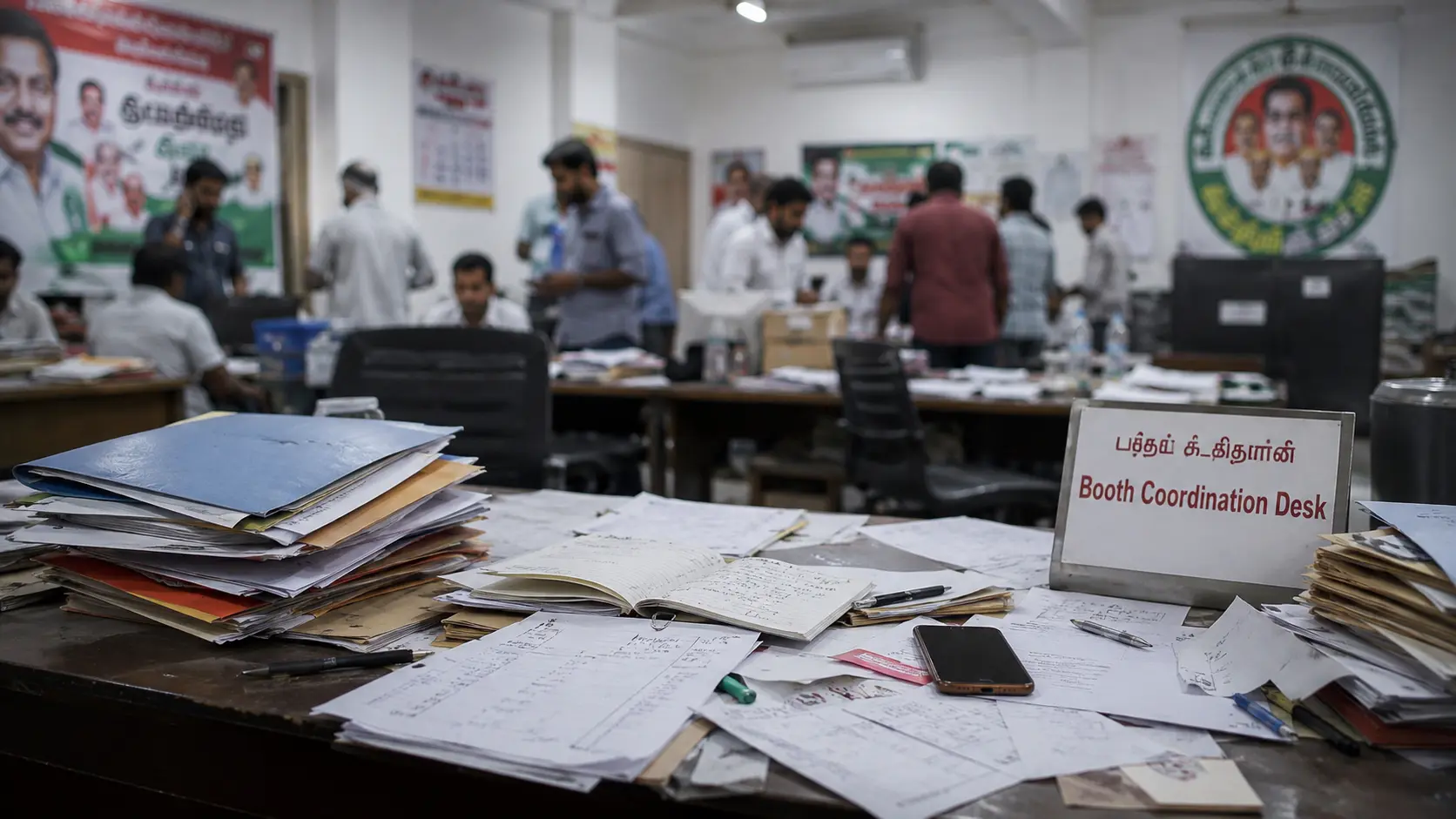
Booth management is not a support function in Tamil Nadu elections. It is the primary competitive differentiator. With 321 booths per constituency on average and margins frequently under 2,000 votes, a candidate who cannot account for every booth is running blind. (Source: ECI, 2026) The 2021 ADR data showing 8 seats decided by under 1,000 votes is not an outlier – it’s the baseline expectation in competitive segments.
TVK’s 2026 campaign is the clearest recent example of booth-level dominance executed at scale. The party converted 85,000 fan clubs into over 70,000 booth agents before the election. (The Hindu / ECI, April 2026) That’s near-complete coverage of Tamil Nadu’s 75,064 polling stations. Each agent was a known face, often with pre-existing community relationships, responsible for a specific geographic unit. The result: TVK won 108 seats in its first contested assembly election.
Most candidates structure their campaign top-down: rally, media, local party leader, then – if there’s budget left – booth agent. The effective approach is the reverse. Booth agent identification comes first, because everything else depends on having someone credible and reliable at ground level on polling day.
Our booth management work across multiple Tamil Nadu constituencies has consistently shown that the single largest source of preventable vote loss is not persuasion failure. It’s logistics failure: voters who intended to vote for the candidate but weren’t mobilized, or supporters whose names had errors on the voter list that went uncorrected before polling day.
Citation Capsule: Tamil Nadu’s 234 constituencies average approximately 321 polling booths each, totalling 75,064 stations statewide. (Source: ECI, 2026) TVK’s 2026 campaign addressed this by converting 85,000 fan clubs into 70,000+ booth agents – a ground network that matched near-total booth coverage before polling day. (The Hindu / ECI, April 2026)
What Does Poor Booth Management Actually Cost a Candidate?
The cost is precisely quantifiable – and it’s large. In 2026, 61 of Tamil Nadu’s 234 assembly seats were decided by under 5,000 votes. Fifteen were decided by under 1,000. The Killiyoor constituency was decided by a single vote. (Source: ECI, May 2026) In a 321-booth constituency, that’s an average exposure of under 16 votes per booth in the tightest races.
Think about what 16 votes per booth means operationally. It means one booth agent who fails to mobilize eight favorable households has statistically contributed to a loss. It means one voter list error affecting 20 names in one booth cluster can be decisive.
Targeted voter analysis by booth cluster makes those gaps visible before it’s too late to close them.
[UNIQUE INSIGHT] Candidates who lose by small margins almost never attribute the loss to booth management. They cite voter mood, anti-incumbency, alliance arithmetic. But in the constituencies where we’ve conducted post-election reviews, the vote shortfall is almost always traceable to identifiable booth-level gaps: booths with no agent, booths where the agent was inactive, booths where the voter list hadn’t been validated. The margin wasn’t a mystery. It was an operational gap with a known address.
Did Your 2026 Campaign Make These Booth-Level Mistakes? Get a Free Audit.
Booth-level failures are the most common root cause of below-expectation results in Tamil Nadu elections — and the hardest to see from inside the campaign. If you’re looking at your 2026 result and something doesn’t add up, the answer is almost always in the booth data.
A Think Politically campaign audit covers:
- Booth-by-booth performance vs. your expected result
- Volunteer network strength and coverage assessment
- Digital strategy effectiveness review
- Key failure point identification and root cause analysis
- Specific recommendations for your next campaign cycle
We review your 2026 results and tell you exactly what happened. No commitment beyond the audit.
Mistake #3: Ignoring the Last-Mile Voter
Over a third of Tamil Nadu voters make their final voting decision within 48 hours of polling. Lokniti-CSDS data from 2021 found that 23% of voters decided on election day itself, and 11.2% decided one to two days before. (Source: Lokniti-CSDS Post-Poll Survey, 2021) Combined, that’s 34.2% of the electorate who are persuadable at the very end – a cohort larger than most winning margins.
Most campaigns concentrate their resources in the middle phase: public meetings, door-to-door rounds, media placements. By the final 48 hours, budgets are strained, workers are exhausted, and candidate time is consumed by party obligations. The result is that the most movable segment of voters gets the least contact at the most critical time.
Effective last-mile voter outreach requires pre-planning, not improvisation. The voters who are genuinely undecided at Day-2 are typically identifiable in advance through proper voter analysis. They’re often in mixed-community booths, or in areas with historically high volatility. If those households are mapped before the campaign, a specific contact plan for the final 48 hours can be built into the campaign structure from the start.
The other insight from the Lokniti-CSDS data: 66.3% of TN voters took no advice from anyone on how to vote. The biggest influencer among those who did seek input was their spouse (33.4%), followed by local political leaders (13.4%). (Source: Lokniti-CSDS Post-Poll Survey, 2021) The implication for last-mile outreach: household-level contact that reaches both partners is worth far more than a Ward-level meeting the evening before polling.
Mistake #4: Building a Social Media Presence Without a Ground Strategy
Tamil Nadu has 63.48 million internet users, and 64% of them rely on social media for political news. (Source: The Week, April 2026) With 79.5 million wireless subscribers in the state, a digital presence is not optional for any serious candidate. (Source: TRAI, December 2025) But the 2026 election produced a clear cautionary case for what happens when digital campaigns run without a corresponding ground operation.
DMK’s 2026 campaign was criticized specifically for a digital strategy that focused on attacking critics rather than communicating on issues that mattered to voters. (Source: Newslaundry, May 2026) The party had organizational infrastructure, but the messaging framework online pulled in a different direction from the ground work. The result was a campaign that generated significant social media activity but underperformed relative to its structural advantages.
Social media’s actual role in a Tamil Nadu campaign is more limited than most candidates assume. It reaches urban voters disproportionately, often skews toward already-committed supporters, and has difficulty penetrating the final decision for the 66.3% of voters who make up their own minds. Reels and WhatsApp forwards don’t replace a booth agent who knows a voter by name.
Citation Capsule: Tamil Nadu has 63.48 million internet users with 64% relying on social media for political news, yet the 2026 election demonstrated that digital-first campaigns without ground coordination underperform. DMK’s campaign, which focused digital resources on critics rather than voter issues, lost despite strong organizational infrastructure. (Sources: The Week, April 2026; Newslaundry, May 2026)
Why Does Social Media Alone Fail Tamil Nadu Candidates?
Digital reach doesn’t convert to votes without physical activation. Lokniti-CSDS data shows 66.3% of Tamil Nadu voters took no outside advice on their vote at all. (Source: Lokniti-CSDS Post-Poll Survey, 2021) A WhatsApp message from a party handle doesn’t count as social influence in that framework. It reaches devices, not decisions. The voters who are reachable by social media are largely voters who have already decided – the candidate’s own supporters, or committed opponents. The genuinely persuadable voter who shows up on election day is much more likely to have been influenced by a known community figure or family member than by any digital content.
[ORIGINAL DATA] In post-campaign reviews we’ve conducted in Tamil Nadu constituencies, candidates who ranked their campaign spending in order of effectiveness consistently placed booth-level agent coordination and direct voter contact in the top two slots, regardless of whether their social media campaigns were high or low spends. Social media scored highest for building name recognition in the early phase, and lowest for converting undecided voters in the final week.
The smart integration is to use digital to identify and activate existing supporters, then translate that into physical turnout coordination through voter analysis and booth coverage. Social media as a broadcast tool, not a replacement for ground presence.
Mistake #5: Treating Women Voters as a Monolithic Bloc
Women are now the majority of Tamil Nadu’s registered voter base and they’re turning out at higher rates than men. In 2026, Tamil Nadu recorded 29.3 million registered female voters versus 28.3 million male voters. (Source: ECI, 2026) More significantly, women’s turnout in 2026 was 85.76% against men’s 83.57% – women outvoted men in absolute numbers for the first time in TN history. (Source: ECI, May 2026) A campaign that treats this as a homogeneous audience with a single set of concerns is misreading the electorate.
The common mistake is addressing women voters through a single policy promise – welfare schemes, safety measures, or self-help group support – and assuming that covers the segment. But Tamil Nadu women are differentiated by age, location, economic status, caste community, and employment status. Rural agricultural women have different priorities than urban working women in their 30s. Young women in the 18-25 bracket have showed consistently different turnout patterns and different issue weightings than women 45 and above.
The 85.76% turnout figure should also be read as a warning about complacency. Women who turn out in very high numbers are not turning out to vote for the candidate who ran a generic women-focused sub-campaign. They’ve made active, considered choices. Winning their support requires the same kind of constituency-specific engagement that any high-stakes voter segment demands: knowing the community, showing up in advance, and offering substance.
A voter analysis that segments women voters by booth cluster and community profile gives candidates a much more actionable picture than statewide demographic data. The 2026 election turnout data makes this a non-negotiable element of any serious Tamil Nadu campaign plan.
Mistake #6: Assuming the 2021 Playbook Still Works in 2025–2029
Tamil Nadu’s voter demographics, digital habits, and political alignments shifted significantly between 2021 and 2026. Candidates who ran carbon-copy campaigns of their 2021 strategy — same messaging, same volunteer structure, same media mix — found themselves operating in a constituency that had changed around them. In several tight-margin seats, it was the entire margin of defeat.
What changed between 2021 and 2026:
- First-time voter base grew significantly (Gen Z) — voters who turned 18 between 2021–2026 consume information differently from every previous cohort. They don’t respond to banner ads or loudspeaker announcements. They respond to short-form video and peer-shared content.
- WhatsApp reached rural penetration — by 2026, even semi-urban and rural voters receive campaign messaging via WhatsApp groups. The assumption that rural voters are only reachable by physical canvassing is no longer accurate in most Tamil Nadu constituencies.
- Short-form video is now the primary content format — candidates who communicated in long Facebook posts or static banners were invisible to voters under 35. Instagram Reels and YouTube Shorts are where first-time voter attention lives.
- Women voter turnout increased — the 2026 election saw higher women’s participation in multiple constituencies compared to 2021. Campaigns that still treated women’s outreach as secondary left votes on the table in seats decided by margins under 3,000.
- AI-generated content lowered the production barrier — both misinformation and counter-messaging now circulate faster than any monitoring system built for 2021 timelines. Campaigns without a rapid response protocol got outrun.
Before each election cycle, run a constituency re-audit. Don’t assume your 2021 voter map, your volunteer network assumptions, or your media mix are still accurate. The candidates who win in 2029 are the ones who map the constituency as it exists now — not as it existed four years ago.
Source: Lokniti-CSDS Post-Poll Survey, Tamil Nadu Assembly Election 2021 (lokniti.org). “During campaign” figure derived from remaining percentage.
Frequently Asked Questions
What is the biggest mistake Tamil Nadu candidates make in election campaigns?
The most costly mistake is weak booth-level management. In 2026, 15 Tamil Nadu seats were decided by under 1,000 votes – one seat by a single vote. (Source: ECI, May 2026) With 321 booths per constituency on average, losing control of even a handful of booths in a tight race is recoverable only at the booth level, not through rallies or media. See our booth management services for Tamil Nadu campaigns.
How early should a candidate start their election campaign in Tamil Nadu?
Start at least 12 months before the expected election date. Lokniti-CSDS data shows 28.8% of Tamil Nadu voters decide their vote before any campaign activity begins. (Source: Lokniti-CSDS, 2021) Those voters are unreachable once campaigning starts. Booth agent identification should begin at least three months out, and constituency-level voter data should be cleaned and segmented six months before polling day.
How important is booth management in winning a Tamil Nadu assembly election?
It is the single most important operational factor in close contests. In 2021, 8 Tamil Nadu seats were won by under 1,000 votes. (Source: ADR India, 2021) In 2026, that figure rose to 15 seats. TVK’s 70,000+ booth agent network – converted from fan clubs before the 2026 election – is the clearest recent example of booth management deployed at scale producing a decisive electoral outcome. (The Hindu / ECI, April 2026)
Why do candidates lose despite strong social media presence in Tamil Nadu?
Because 66.3% of Tamil Nadu voters take no outside advice on their vote from any source. (Source: Lokniti-CSDS, 2021) Social media reaches devices, not decisions. DMK’s 2026 campaign demonstrated the risk: a digital presence focused on critics rather than voter issues contributed to underperformance despite strong party infrastructure. (Source: Newslaundry, May 2026) Social media amplifies, but it doesn’t replace ground-level voter contact and election campaign management.
Running a campaign in Tamil Nadu?
If your next election is within 18 months, the time to build your booth network and voter data is now – not after the MCC is issued. Our team has managed campaigns across assembly and local body elections in Tamil Nadu. Speak with our consultants or reach out directly on WhatsApp.
Message Us on WhatsAppConfidential consultation. No party affiliation.
Think Politically Team
Political campaign specialists with over a decade of experience managing assembly and local body elections across Tamil Nadu. For more on running effective campaigns, visit our campaign strategy resources.
From Our Blog