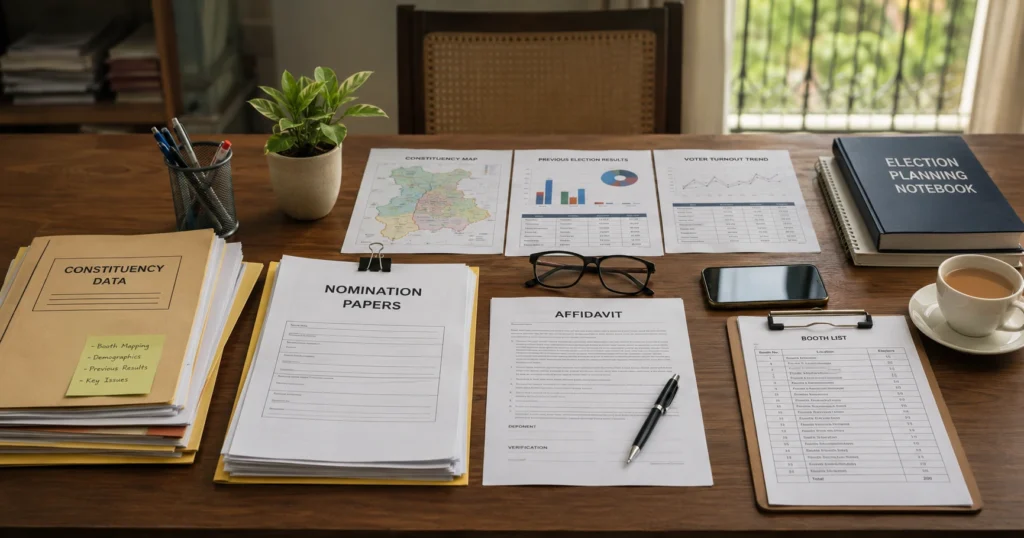
A candidate needs two files ready before filing nomination in India: the legal file the Returning Officer will check — nomination paper, Form 26 affidavit, security deposit, proposer signatures — and the strategic file the law never asks for but elections are decided by. The legal file costs ₹10,000 in deposit for an assembly seat (Representation of the People Act, Section 34) and a few days of paperwork. The strategic file — booth-wise results, voter roll analysis, community mapping — takes six to ten weeks to build. Most first-time candidates perfect the first file and skip the second. This checklist covers both, in the order you should collect them.
Key Takeaways
- The legal file: Form 2B nomination paper, Form 26 affidavit (sworn before a notary or first-class magistrate), ₹10,000 deposit for assembly / ₹25,000 for Lok Sabha — halved for SC/ST candidates (RPA 1951, s.34).
- The strategic file: booth-wise Form 20 results, voter roll audit, booth demographics, community map, and baseline survey — the five layers of a constituency analysis.
- Affidavit defects can get a nomination rejected at scrutiny; strategic gaps get campaigns rejected by voters. Collect both files before, not after, the ticket decision.
- Start the strategic file 6-10 weeks before you expect to file — data collection can’t be compressed into nomination week.
What Does the Law Require You to File at Nomination?
Four things, and the Election Commission of India is strict about all of them: the nomination paper (Form 2B for assembly elections), the Form 26 affidavit, the security deposit, and valid proposer signatures. Under Section 34 of the Representation of the People Act 1951, the deposit is ₹10,000 for an assembly seat and ₹25,000 for a Lok Sabha seat — half for SC/ST candidates (ECI, Contesting for Elections FAQ).
| Requirement | Detail | Common Failure Point |
|---|---|---|
| Form 2B nomination paper | Prescribed nomination form for Vidhan Sabha elections; available from the RO or the ECI SUVIDHA portal | Name/spelling mismatch with the electoral roll |
| Form 26 affidavit | Assets, liabilities, criminal cases, and education of self, spouse, and dependents; sworn before a notary or first-class magistrate | Blank columns — every field must be filled or marked “NIL” |
| Security deposit | ₹10,000 assembly / ₹25,000 Lok Sabha; SC/ST pay half; payable online via SUVIDHA or by treasury challan | Forfeited if you poll under one-sixth of valid votes |
| Proposers | 1 proposer for recognised-party candidates; 10 for independents and unrecognised parties — all registered voters of the constituency | Proposer not on the current roll of that constituency |
Deadlines are absolute. Nominations, including the affidavit, must be complete by 3:00 PM on the last filing day (ECI nomination guidelines), and scrutiny happens the next working day. An affidavit with unexplained blanks is a defect the Returning Officer can treat as substantial — nominations have been rejected for less. Have a lawyer review the full file at least a week before you intend to file.
What Data Should a Candidate Collect Before Filing Nomination?
Beyond the paperwork: five data layers that together answer whether — and how — the seat can be won. India’s electorate votes across 10.51 lakh polling stations averaging 931 voters each (ECI granular data release, December 2024), and the strategic file is built at that booth resolution, not at constituency level.
This is the same five-layer framework we detail in our
constituency analysis in India guide — here’s the pre-nomination version of the checklist:
- Booth-wise results (Form 20) — last two elections, downloaded free from your state CEO’s website. Classify every booth: stronghold, lean, swing, hostile.
- Voter roll audit — the current roll against the last election’s: first-time voters, deletions, migrations. Tamil Nadu’s 2026 Special Intensive Revision settled the state’s roll at 5.67 crore voters (ECI SIR, February 2026); after any revision, old counts are wrong counts.
- Booth demographics — age bands, gender ratio, and household clusters per booth, extracted from the roll and verified in the field.
- Community map — caste, community, and occupation clusters by street. No public dataset exists; this layer is built by trained enumerators.
- Baseline survey — name recognition, party lean, issue salience, switchability. A structured pre-election constituency survey converts the other four layers into a strategy.
According to the Election Commission of India’s December 2024 data release, India’s 97.79 crore electors are distributed across 10.51 lakh polling stations — roughly 931 voters per booth. A pre-nomination data file built at booth level therefore describes a few hundred small electorates, which is what makes it actionable where constituency-level averages are not.

Why Collect the Strategic File Before the Ticket Decision?
Because the strategic file is increasingly what wins the ticket, not just the election. Parties weighing multiple aspirants for one seat now ask for winnability evidence, and the aspirant holding a booth-classified, survey-backed constituency file walks into that meeting with the strongest argument in the room.
There’s a hard deadline hiding here too. Once the election schedule is announced and you’re inside nomination week, field data collection is effectively over — your team is consumed by paperwork, proposers, and scrutiny preparation. The strategic file must be finished before the notification. Our
when to hire an election consultant guide maps this backwards from polling day: data work belongs at D-180 to D-90, nomination paperwork at D-30.
How Long Does Pre-Nomination Data Collection Take — and What Does It Cost?
Six to ten weeks for a typical assembly seat, and the voter-contact layer alone runs ₹4-6 lakh for a standard 1.8 lakh voter constituency before any analysis begins. That buys the 12,000-15,000 verified voter-level records a working segmentation model needs — collected properly, with quality checks, not bought as a stale list.
Budget the two files together. The legal file is fixed-cost and quick; the strategic file is the one that competes for time with everything else. Our
election campaign budget planning guide for MLA candidates shows where data collection sits inside a full ₹40 lakh assembly budget.
The Complete Pre-Nomination Checklist
Everything above, in filing order. Print this, and start from the bottom row — the items with the longest lead time.
Get Your Constituency’s Data File Scoped — Free
Planning to contest the local body polls or the next assembly cycle? Sivakumar and the Think Politically team offer a free 30-minute scoping call for Tamil Nadu aspirants: what data already exists for your seat, what must be built, and whether it can be ready before your nomination window. No obligation.
Frequently Asked Questions
What is the security deposit for contesting an election in India?
Under Section 34 of the Representation of the People Act 1951, the deposit is ₹10,000 for an assembly seat and ₹25,000 for a Lok Sabha seat; SC/ST candidates pay half (₹5,000 and ₹12,500). The deposit is forfeited if you poll one-sixth or less of the valid votes.
What is Form 26 and who must sign it?
Form 26 is the sworn affidavit filed with the nomination paper, declaring assets, liabilities, criminal cases, and educational qualifications for the candidate, spouse, and dependents. It must be sworn before a notary public or first-class magistrate, and every column must be filled — blanks are treated as defects at scrutiny.
How many proposers does a nomination need?
A candidate of a recognised national or state party needs one proposer; independents and candidates of unrecognised parties need ten. All proposers must be registered electors of the constituency being contested — a proposer from the wrong roll is among the most common scrutiny failures.
What strategic data should be ready before the ticket decision?
Five layers: booth-wise Form 20 results from the last two elections, a voter roll audit, booth-level demographics, a field-built community map, and a baseline survey. Together they form the winnability file — with 10.51 lakh booths averaging 931 voters (ECI, 2024), booth-level evidence is what party committees now expect.
Can a nomination be rejected for data errors?
Yes. Returning Officers reject nominations at scrutiny for substantial defects: blank affidavit columns, proposer errors, roll mismatches, or missing deposit proof. Filing closes at 3:00 PM on the final day with scrutiny the next working day — there’s rarely time to cure a defect, so the legal file must be right the first time.
What data must a candidate collect 90 days before polling day?
With only 90 days left, prioritise the strategic layers over exhaustive research: a rapid booth classification from the last two elections’ Form 20 data, a fast voter roll audit, and a compressed baseline survey covering the highest-priority booths first. The full five-layer file is ideal with six to ten weeks of runway; at 90 days you compress the sequence rather than skip layers; the legal file (Form 2B, Form 26, deposit) stays non-negotiable regardless of timeline.
What does candidate election preparation involve in India?
\n Candidate election preparation spans two parallel tracks: the legal file (Form 2B, Form 26 affidavit, security deposit, proposer requirements) that keeps a candidate on the ballot, and the strategic file, booth classification, voter roll audit, community mapping, baseline survey, that gives the candidate a data-backed reason to contest. Preparation that only covers the legal requirements gets a name on the ballot without a plan to win.\n
How do you analyse an opponent’s weak points before filing nomination in India?
\n Opposition weak-point analysis maps the incumbent or rival candidate’s voter base community by community, examines their record or past campaign commitments for unresolved gaps, and assesses their ground team depth across priority booths. The goal is identifying the specific issue territory and voter segments they are most exposed on, so a challenger’s own positioning can occupy that ground credibly from the start rather than discovering it mid-campaign.\n
Build Both Files — In the Right Order
The legal file keeps you on the ballot. The strategic file gives you a reason to be there. One takes days and a lawyer’s checklist; the other takes six to ten weeks of structured fieldwork and analysis. Start the slow one first.
If you’re weighing a seat right now, begin with the free layers this week: download your constituency’s Form 20, pull the current roll, and classify your booths. Then read the full
constituency analysis framework to see what the complete file looks like — and what it takes to build the layers that can’t be downloaded.
Sources: Election Commission of India, “Contesting for Elections” FAQ (Section 34 RPA 1951 deposits; proposer requirements), retrieved 2026-07-07, eci.gov.in/faqs · ECI, Form 2B and Form 26 nomination forms and online SUVIDHA guidelines, retrieved 2026-07-07, eci.gov.in/candidate-nomination · ECI via PIB, “Granular Data of Lok Sabha Elections 2024” (10.51 lakh polling stations; 97.79 crore electors; 931 average electors per station), December 2024, retrieved 2026-07-07, pib.gov.in · ECI, Tamil Nadu Special Intensive Revision, February 2026.
About the author: Sivakumar Devasagayam is Campaign Strategy Lead at Think Politically, a Chennai-based political consulting firm focused on Tamil Nadu state and local elections. He has worked on assembly and Lok Sabha campaigns across Kongu, Delta, and Chennai urban constituencies since 2011.