There is no public dataset that tells you the caste composition of an Indian constituency — let alone a polling booth. The last full caste census India published was in 1931; the 2011 Socio-Economic and Caste Census collected the data but never released it, and the Supreme Court declined to compel publication in December 2021 after the Centre called the data “inaccurate and unusable.” So every composition figure a campaign uses is either an estimate, a state survey aggregate, or something it built itself. This guide explains the data gap, how professional campaigns map community geography legally and ethically, why composition alone predicts less than candidates assume, and what the caste-enumerated Census 2027 will — and won’t — change.
Key Takeaways
- No public booth- or constituency-level caste data exists in India: the last published caste census is 1931; SECC 2011 caste tables were never released (Supreme Court, December 2021).
- Bihar’s 2023 state survey — EBCs 36.01%, OBCs 27%, together 63.13% — shows what surveys reveal, but only at state/district aggregates, not booths.
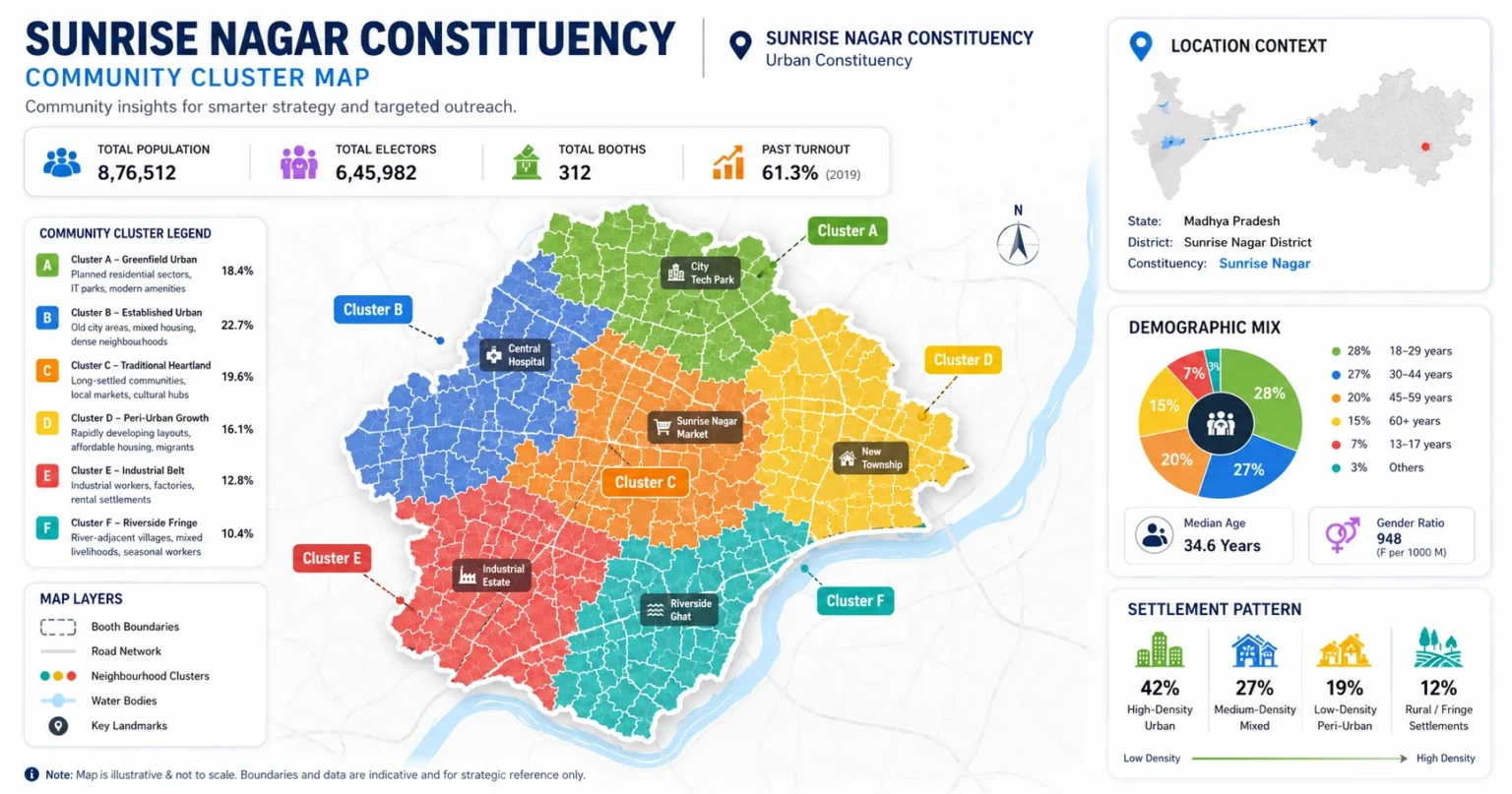
- Campaigns build the missing layer by field enumeration: street-level community clusters mapped onto voter-roll booth boundaries.
- Composition sets the boundaries of what’s possible; booth voting history decides what happens. And under RPA Section 123(3), appealing for votes on caste grounds is a corrupt practice — mapping is for listening, not for appeals.
Why Is There No Public Caste Data for Constituencies?
Because India stopped publishing caste counts in 1931, and every attempt since has stalled before publication. The 2011 Socio-Economic and Caste Census (SECC) enumerated caste nationwide, but the caste tables were never finalised; in December 2021 the Supreme Court accepted the Centre’s affidavit that the data was “inaccurate and unusable” and refused to order its release (Supreme Court of India, SECC matter, December 2021).
States have started filling the vacuum themselves. In October 2023, Bihar released its caste-based survey: Extremely Backward Classes at 36.01%, Other Backward Classes at 27%, the two together making up 63.13% of the state’s population (Government of Bihar, Caste-Based Survey, October 2023). Politically seismic — but for a campaign, still an aggregate. A state percentage says nothing about which streets in your constituency those communities actually live on.
The census decennial cycle now promises change: in April 2025 the Cabinet Committee on Political Affairs approved caste enumeration in Census 2027 — the first since 1931 — with population enumeration scheduled for February 2027 (Census of India 2027 notifications, 2025-26). What that means for campaigns is covered below; the short version is: useful eventually, at aggregates, and not on any campaign’s timeline.
How Do Campaigns Map Caste Composition Without Public Data?
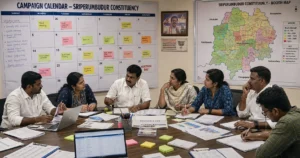
By building it: trained enumerators classify household clusters street by street, using the electoral roll as the sampling frame and local verification as the method. The unit of output is the booth cluster — a group of streets served by one polling station — not the individual voter. Done properly, it’s the same fieldwork discipline as any demographic survey, applied at election-relevant resolution.
The method in practice has three passes. First, desk preparation: booth boundaries extracted from the roll, as described in our
constituency assessment field manual. Second, enumeration walks: teams record the community and occupation character of each street segment, cross-checked with multiple local sources — no single informant’s word stands alone. Third, reconciliation: cluster estimates are sanity-checked against known aggregates (school rolls, SHG membership, places of worship) and flagged where confidence is low.
What about buying a “caste database” from a vendor? Treat every such offer with suspicion. No lawful public source exists for individual-level caste data, so a vendor list is either inferred (unreliable), stale, or collected in ways you don’t want attached to your campaign. Build aggregates; don’t buy individual tags.
Does Caste Composition Predict How a Constituency Votes?
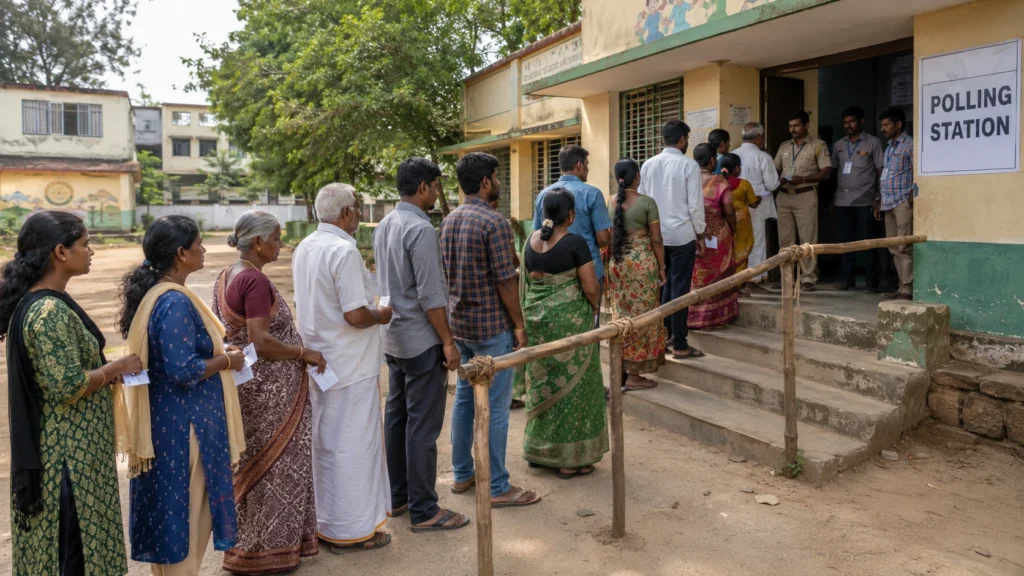
Far less than candidates assume. Most Indian constituencies have no single community with a majority — coalitions decide outcomes, and coalition behaviour shifts between elections. Tamil Nadu’s April 2026 election made the point at scale: turnout jumped from 74.26% to 85.1% and a first-time party won 108 of 234 seats (ECI results, May 2026), redrawing assumptions in constituencies whose composition hadn’t changed at all.
This is why the community map is one layer of five in our
constituency analysis framework, not a standalone product. Composition without booth history is a stereotype with a spreadsheet. Combined with Form 20 classification and a baseline survey, it becomes what it should be: a listening map.
What Is the Legal and Ethical Line?
Clear and worth stating plainly: under Section 123(3) of the Representation of the People Act 1951, appealing for votes on the ground of caste, religion, race, community, or language is a corrupt practice that can void an election. Mapping community geography is lawful and universal in professional campaigns; making caste-based appeals from that map is not.
The legitimate uses are descriptive. Knowing that a booth cluster is dominated by fishing-community households tells you which livelihood grievances to research and which local associations to meet. It shapes representation — candidate outreach that actually reflects who lives in the seat — and it translates a development message into each community’s own priorities. That’s listening infrastructure, and it’s the standard we hold our own
voter analysis work in Tamil Nadu to.
There’s also a data-protection dimension. Keep community data at cluster aggregates, never as tags on named individuals; caste is sensitive information, and a leaked individual-level caste list is both an ethical failure and a campaign scandal waiting to happen.
What Will Census 2027 Change for Campaigns?
Less than the headlines suggest, on campaign timelines. The caste-enumerated census begins population enumeration in February 2027 (Census 2027 schedule, Government of India), with tabulation and publication following over subsequent years — and census releases come as administrative-area aggregates, not booth-level tables. The delayed Tamil Nadu local body polls and any near-term by-elections will be fought entirely on campaign-built data.
When the 2027 tables do arrive, they’ll improve the reconciliation step — better aggregates to sanity-check field estimates against — and they’ll reshape delimitation and reservation debates. What they won’t do is replace enumeration walks. The booth-cluster resolution that campaigns need has never been published by any Indian government, and nothing announced for 2027 changes that.
Map Your Constituency’s Community Geography — Properly
Think Politically builds booth-cluster community maps for Tamil Nadu constituencies as part of the full five-layer assessment — field-enumerated, reconciled, and held to the aggregates-only standard. Book a free 30-minute scoping call and we’ll tell you what your seat’s map would involve.
Frequently Asked Questions
Is caste-wise population data available for constituencies in India?
No. The last published caste census is from 1931, SECC 2011’s caste tables were never released, and state surveys like Bihar’s 2023 exercise publish only state and district aggregates. No government source has ever published caste data at constituency or booth level — campaigns that need it build it through fieldwork.
What did the Bihar caste survey 2023 find?
Released in October 2023, Bihar’s survey counted Extremely Backward Classes at 36.01% and Other Backward Classes at 27% — together 63.13% of the state’s population, with the general category at 15.52%. It reshaped reservation politics nationally, but as a campaign tool it remains an aggregate, not a constituency map.
Will Census 2027 provide constituency-level caste data?
Not at campaign resolution. Census 2027 includes caste enumeration — the first since 1931, with population enumeration from February 2027 — but census publications are administrative-area aggregates released over the following years. Booth-cluster composition, the layer campaigns actually use, will still have to be field-built.
How do campaigns map caste composition legally?
Through street-level field enumeration recorded as booth-cluster aggregates: trained teams classify household clusters using the voter roll as the frame, verify with multiple local sources, and reconcile against known aggregates. Individual-level caste tagging is avoided — both as data-protection practice and because inferred individual tags are unreliable.
Is caste-based campaigning legal in India?
Appealing for votes on the ground of caste is a corrupt practice under Section 123(3) of the Representation of the People Act 1951 and can void an election. Understanding a constituency’s community geography for representation, grievance research, and message translation is lawful — the line sits between listening and appealing.
How do candidates use caste and community data to build a winning vote arithmetic in India?
Community composition tells a campaign who lives where; it does not tell them who will vote for whom. Candidates layer the field-built community map against booth-wise past results and current scheme-perception data to identify which community clusters are persuadable, rather than assuming a group votes as a bloc. The vote arithmetic comes from combining these layers, not from composition percentages alone.
What is a caste composition and scheme-penetration survey for constituency planning?
It is a field survey layer that measures two things together: which community clusters are concentrated in which booths, and how aware and satisfied those clusters are with government schemes they are eligible for. Run separately, either input is incomplete, composition without scheme sentiment does not explain movement, and scheme sentiment without composition cannot be targeted. Combined, they show a campaign where perception is shifting and among whom.
Composition Is the Map, Not the Verdict
The caste composition of a constituency is the most requested and most misunderstood number in Indian campaign planning. It can’t be downloaded, it doesn’t predict outcomes on its own, and it carries legal and ethical obligations. Built properly — field-enumerated, cluster-level, crossed with booth history — it becomes something better than a prediction: a map of where to listen.
Start where the data is free: classify your booths from Form 20 using the
assessment field manual, and put the community layer in its place among the five layers of the
pre-nomination data checklist. The percentages matter — but only after the walking is done.
Sources: Supreme Court of India / press reporting, SECC 2011 caste data matter (Centre’s “inaccurate and unusable” affidavit; release not compelled), December 2021, retrieved 2026-07-07 · Government of Bihar, Caste-Based Survey findings (EBC 36.01%, OBC 27%, general 15.52%), released 2 October 2023, retrieved 2026-07-07 · Government of India, Census 2027 notifications (caste enumeration approved 30 April 2025; population enumeration February 2027; scheme approved December 2025), retrieved 2026-07-07 · ECI, Tamil Nadu assembly election results (85.1% turnout; 2021: 74.26%), May 2026 · Representation of the People Act 1951, Section 123(3).
About the author: Sivakumar Devasagayam is Campaign Strategy Lead at Think Politically, a Chennai-based political consulting firm focused on Tamil Nadu state and local elections. He has worked on assembly and Lok Sabha campaigns across Kongu, Delta, and Chennai urban constituencies since 2011.