The short answer: hire an election consultant 12 to 18 months before polling day, and never later than 90 days out if you want strategy rather than triage. The winners already work this way. In February 2020, the DMK signed IPAC roughly 14 months before the April 2021 Tamil Nadu assembly election (Business Standard, February 2020) – and swept the state. Most first-time candidates do the opposite: they call a consultant after the schedule is announced, when the voter roll work that decides elections can no longer be done. This guide lays out the full hiring timeline, from D-365 to polling day, so you know exactly where your seat stands today.
If you’re contesting in this state, start with what a political consultant in Tamil Nadu actually does at each stage.
Key Takeaways
- Ideal hiring window: D-365 to D-180 (12-18 months before polling day). IPAC signed the DMK 14 months out for 2021 (Business Standard, 2020).
- D-90 is the minimum viable window – the last point where voter data collection, baseline surveys, and booth planning can all still be completed.
- After D-60, consultants can only run triage: message discipline and polling-day logistics, not research-led strategy.
- Hiring earlier usually costs less per month, because compressed engagements carry rush premiums and larger field teams.
When Should a Candidate Hire a Political Consultant in India?
A candidate should hire a political consultant in India 12 to 18 months before the expected polling date. That’s not an agency sales line – it’s how the professional end of the market already operates. India’s election economy reached an estimated ₹1.35 lakh crore in the 2024 general election, per the Centre for Media Studies (CMS, 2024), and the campaigns absorbing that spend most effectively are the ones that started earliest.
Citation Capsule: The optimal window to hire an election consultant in India is 12-18 months before polling day, with 90 days as the minimum viable engagement. The DMK signed IPAC in February 2020, roughly 14 months before the April 2021 Tamil Nadu election it went on to win (Business Standard, February 2020).
Why so early? Because the highest-value consulting work is sequential and can’t be compressed. Voter roll analysis feeds the baseline survey. The survey feeds segmentation. Segmentation feeds your narrative, your alliance posture, and your booth plan. Each stage takes weeks. Skip a stage and everything downstream becomes guesswork.
There’s also a quieter reason: candidate selection itself. Parties increasingly use pre-election constituency data to decide tickets. If you’re still seeking a ticket, a consultant engaged early helps you build the winnability case you’ll present to the party – a completely different service from campaign management, and one that only exists before the ticket is decided.
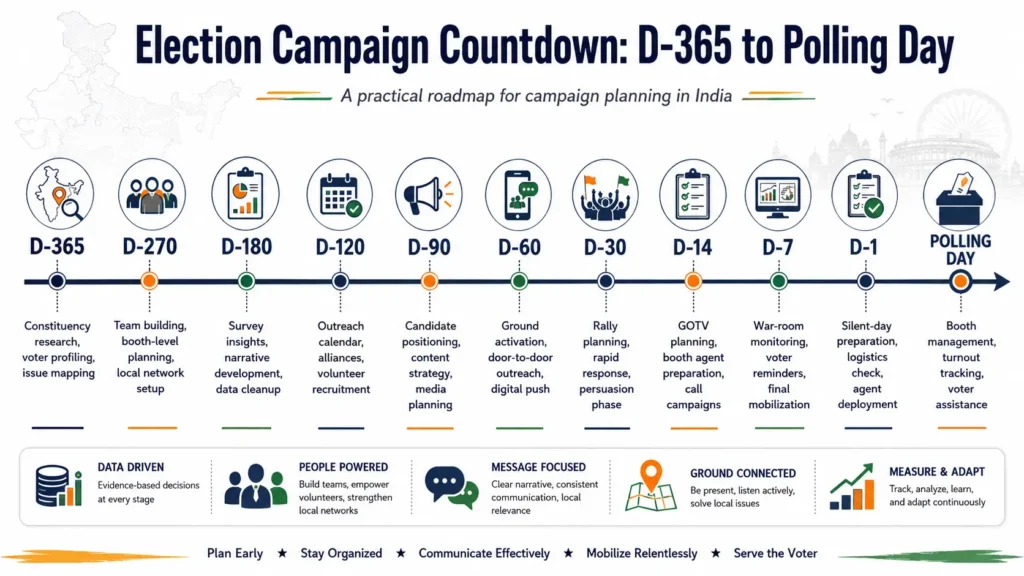
What Does the Hiring Timeline Look Like From D-365 to Polling Day?
Campaign professionals count backwards from polling day – “D-day” – rather than forwards from today. As of 2026, with the Tamil Nadu assembly election held on 23 April 2026 (ECI, 2026) and rural local body polls pending after delimitation, every aspirant sits somewhere on this countdown whether they know it or not. Here’s what each window allows.
| Window | What a Consultant Can Still Do | Engagement Type |
|---|---|---|
| D-365 to D-181 | Full constituency assessment, ticket/winnability case, voter data infrastructure, narrative built from scratch | Ideal – full strategy |
| D-180 to D-121 | Baseline survey, complete segmentation, cadre and booth committee building, sustained media presence | Strong – full strategy |
| D-120 to D-91 | Compressed research cycle, prioritised booth clusters, accelerated content calendar | Workable – prioritised strategy |
| D-90 | Last entry point where survey, segmentation, and booth planning all still fit before the schedule announcement | Minimum viable window |
| D-60 to D-31 | Message discipline, media response, booth logistics – no time for original research | Triage only |
| D-30 to D-0 | Polling-day operations, GOTV, counting-day preparation | Damage control |
The engagement type also determines who you actually get. Our guide to political strategist roles, fees, and hiring in Tamil Nadu breaks down which specialist – strategist, data analyst, or ground coordinator – leads at each stage.
Why Is D-90 the Critical Cut-Off?
Ninety days is the shortest period in which the three non-negotiable foundations of a data-led campaign can still be built in sequence: voter data, a baseline survey, and a booth plan. That’s why we anchor our own intake on a D-90 assessment – it’s the last point where we can honestly promise strategy rather than firefighting.
Run the arithmetic yourself. Six to eight weeks of data work, two to three weeks of survey fieldwork and analysis, two weeks to translate findings into booth assignments and a message architecture. That’s eleven to thirteen weeks end to end. Start at D-90 and you finish just as the ECI schedule lands and the Model Code of Conduct kicks in. Start at D-60 and the sequence physically doesn’t fit.
There’s a legal dimension too. Once the schedule is announced, expenditure attribution rules tighten. Work commissioned early – research, data infrastructure, brand building – is typically structured as pre-campaign activity, reviewed with counsel, well before the candidate’s ₹40 lakh assembly spending cap (ECI Notification, January 2022) becomes the operative constraint.
What Can a Consultant Still Do at D-60 or Later?
Plenty of candidates will read this at D-50 and wince. Honest answer: a good consultant can still add value late, but the service changes from strategy to triage – and you should pay for it accordingly.
At D-60 to D-31, the realistic deliverables are message discipline (one narrative, repeated everywhere, no freelancing by local leaders), rapid media and social response, booth agent logistics, and a polling-day operations plan. What’s off the table: original research, voter segmentation, narrative repositioning, and alliance strategy. Anyone promising you those at D-45 is selling a template.
Should you still hire someone at D-40? Usually yes – disciplined execution beats improvised execution even without research underneath it. Just scope the contract as execution support, price it that way, and treat any “guaranteed strategy” claims at that stage as the red flag they are.
How Does Hiring Timing Affect What You Pay?
Timing moves price in both directions. A single-constituency engagement in India runs ₹50 lakh to ₹5 crore depending on competitiveness and scope, as we detail in our 2026 election consulting fee guide. Where you land inside that range depends heavily on when you sign.
Early engagements spread cost over more months, staff a smaller steady-state team, and buy research once instead of twice. Late engagements pay rush premiums: bigger field teams doing in three weeks what a lean team does in ten, senior strategists pulled across multiple emergency seats, and duplicated vendor costs because there’s no time to negotiate. The paradox candidates miss is that a D-300 engagement often has a lower total cost than a D-60 engagement with weaker outcomes.
Timing also changes fee structure. Early contracts support milestone-based payment tied to deliverables – survey completed, segmentation delivered, booth plan signed off. Late contracts are almost always flat retainers, because there’s nothing measurable to milestone. For the full tier-by-tier breakdown, see our
political consulting cost India resource page.
What Should You Have Ready Before the First Consultant Call?
You’ll get a sharper scoping conversation – and a sharper quote – if you arrive prepared. Credible firms will assess your seat before quoting; help them do it fast.
- Your target seat and status – Confirmed ticket, seeking ticket, or evaluating between constituencies. Each is a different engagement.
- Your election and its realistic date – Local body, assembly, or Lok Sabha. Count your D-days from the likely polling date, not the announcement date.
- What ground infrastructure already exists – Party cadre strength, booth committees, prior canvassing data, if any.
- Your last election’s result sheet – Booth-wise results for the seat across the last two elections, if you can get them.
- A budget range, not a number – You’re buying scope. The range determines which tier of engagement is even on the table.
One more thing: ask every firm the timing question in reverse. “What would you refuse to promise me at this point in the calendar?” A firm with a real methodology has a clear answer. A template shop promises everything at any date.
Frequently Asked Questions
When should a candidate hire a political consultant in India?
Ideally 12-18 months before polling day, and no later than 90 days out for strategy-led work. The DMK signed IPAC in February 2020 for the April 2021 Tamil Nadu election – about 14 months ahead (Business Standard, 2020). After D-90, engagements shift from research-led strategy to execution triage.
Is 90 days really enough time to run a campaign?
Ninety days is the minimum viable window, not the comfortable one. Voter data collection takes 6-8 weeks for a typical 1.8 lakh voter assembly constituency, followed by 2-3 weeks of survey work and 2 weeks of booth planning. That sequence barely fits inside 90 days – which is exactly why it’s the cut-off.
Is it ever too early to hire an election consultant?
Rarely. Beyond 24 months out, a full campaign team is premature, but a constituency assessment and data foundation are not – parties themselves use this data to allocate tickets. Early aspirants typically start with a limited scoping engagement rather than a full retainer, then scale up as the cycle approaches.
What does late hiring cost compared to early hiring?
Late engagements usually cost more per month for less value. Compressed timelines need larger field teams, carry rush premiums, and duplicate vendor spend. A single-constituency engagement runs ₹50 lakh to ₹5 crore overall; early starters land lower in that range with stronger deliverables because research is bought once, at a sustainable pace.
Can a consultant help if the election schedule is already announced?
Yes, but only with execution: message discipline, media response, booth agent logistics, and polling-day operations. Original research and repositioning are off the table once the Model Code of Conduct is in force and the candidate’s ₹40 lakh assembly spending cap (ECI, 2022) governs attribution. Scope and price the contract as execution support.
What is the most effective way to plan an election campaign 90 days before polling day?
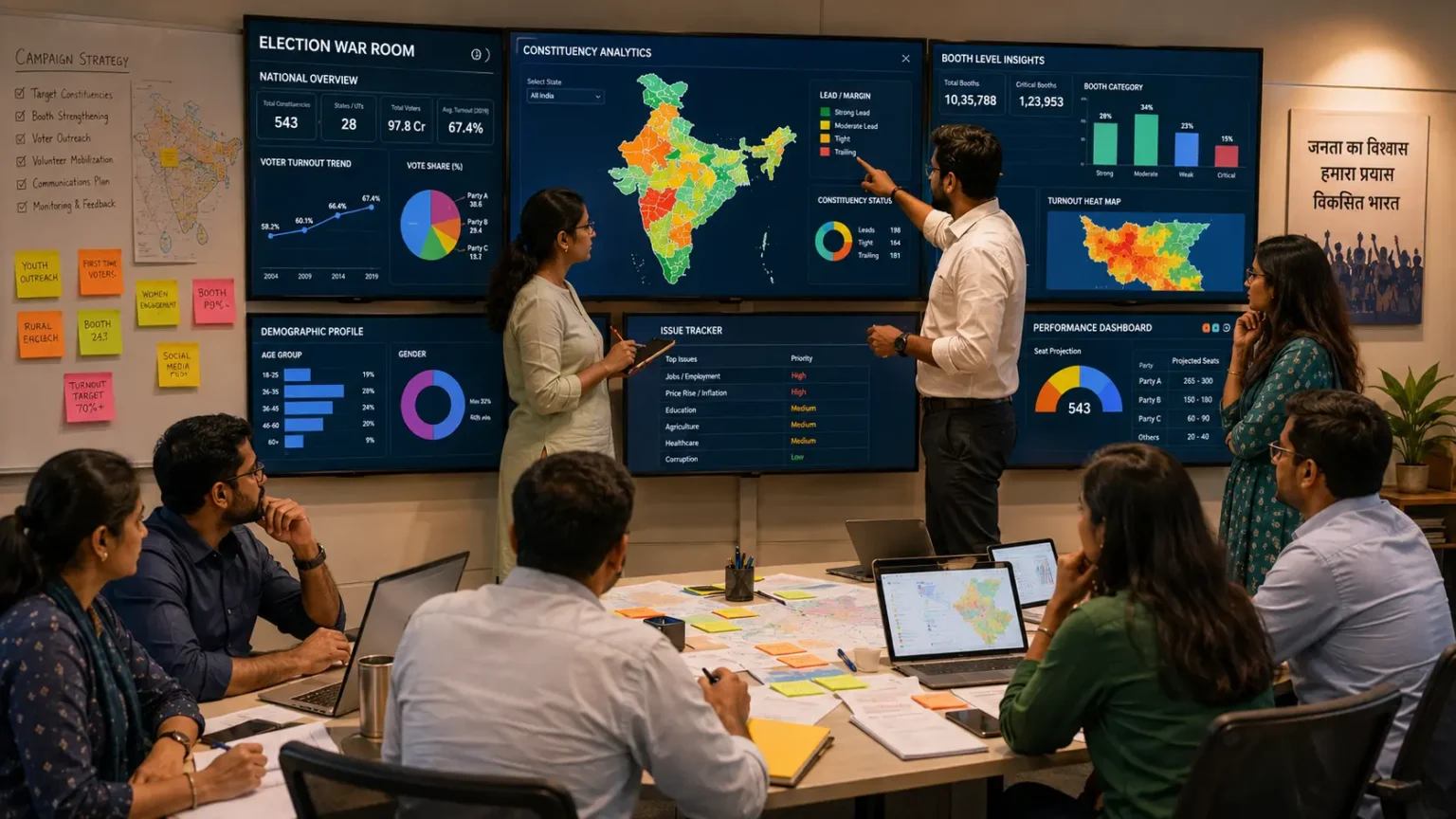
With 90 days, sequence tightly rather than trying to do everything: 2-3 weeks for a rapid constituency baseline and voter data audit, 2-3 weeks for booth infrastructure and volunteer training, and the remaining weeks for active canvassing, digital execution, and war-room-led polling-day preparation. There is no room left for open-ended research, every week has to produce a decision the campaign acts on.
What is the ideal frequency of doorstep voter contact in the final 30 days before an Indian election?
At minimum two full contact rounds: an early round to confirm supporter status and surface undecided voters, and a final-week round focused on turnout, confirming the household knows their polling station and has a plan to vote. Priority swing booths often get a third targeted round in between, aimed specifically at voters flagged undecided in the first pass.
What should you ask before hiring an election consultant for your assembly campaign?
\n Ask for specific past constituency work comparable to yours, not just headline wins; ask how they measure progress mid-campaign rather than only at the result; ask who on their team actually executes field operations versus who designs strategy; and ask what a scoped, non-retainer engagement would look like if you’re not ready for a full commitment. A consultant who can’t answer these concretely is a weaker bet than one who can.\n
What is an election advisor in India?
\n An election advisor in India provides strategic guidance to a candidate or party, positioning, messaging, key decision support, generally without directly running the ground and digital execution machinery a full-service consultant or campaign manager would handle. The terms \”advisor\” and \”consultant\” are used loosely and inconsistently across the industry, so it’s worth clarifying exact scope with any specific firm or individual rather than assuming from the title.\n
How do you hire an election consultant?
\n Start 9-18 months before polling day where possible, shortlist based on comparable constituency experience rather than headline reputation alone, and clarify scope, full-cycle retainer versus a specific deliverable like constituency assessment or opposition research, before signing. Treat the first conversation as a scoping call: a consultant worth hiring should be able to speak concretely about your specific constituency, not just general campaign principles.\n
Count Backwards From Polling Day, Then Decide
The question isn’t really “when should I hire an election consultant?” It’s “how many D-days do I have left, and what can still be built in that window?” At D-300, everything is possible. At D-90, the essentials still fit – barely. At D-45, you’re buying execution, and you should neither expect nor pay for strategy.
Tamil Nadu’s next cycle is already forming. Rural local body polls are pending post-delimitation, urban local bodies follow, and the aspirants who’ll contest in 2029 and 2031 are – whether they realise it or not – already inside their D-window. The candidates who treat the countdown seriously will hire while research is still possible. The rest will call at D-50 and ask to skip the data part.
Work out your own polling-day math first. If you haven’t mapped the seat yet, start with a full constituency analysis. Then talk to a firm that will tell you honestly what’s still achievable – and what isn’t.
Find Out Where Your Seat Sits on the D-Day Countdown
Not sure whether you’re early, on time, or already late? Sivakumar and the Think Politically team offer a free 30-minute D-90 scoping call for Tamil Nadu candidates. We’ll map your constituency against the countdown, tell you what’s still buildable in your window, and give you an honest scope – no obligation, no templated pitch.
Sources: Business Standard, “DMK teams up with Prashant Kishor’s I-PAC for 2021 TN polls,” February 2020, retrieved 2026-07-07, business-standard.com · Centre for Media Studies via ADR, “2024 LS polls pegged as costliest ever, expenditure may touch Rs 1.35 lakh crore,” April 2024, retrieved 2026-07-07, adrindia.org · Election Commission of India, candidate expenditure limit notification, January 2022 · ECI, General Election to the Legislative Assembly of Tamil Nadu 2026, eci.gov.in.
About the author: Sivakumar Devasagayam is Campaign Strategy Lead at Think Politically, a Chennai-based political consulting firm focused on Tamil Nadu state and local elections. He has worked on assembly and Lok Sabha campaigns across Kongu, Delta, and Chennai urban constituencies since 2011.