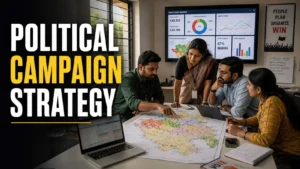
An election campaign budget in India must do two jobs at once: fund a competitive field operation and maintain records that can withstand Election Commission scrutiny. This 2026 guide explains the difference between a candidate expenditure ceiling and a party campaign budget, then provides a practical allocation framework for Assembly and Lok Sabha campaigns. It covers total campaign planning—not the price of hiring an adviser. For retainers and engagement models, use our separate guide to political consultant fees in India.
Key Takeaways
- Start with the applicable ECI candidate ceiling, then create separate, documented ledgers for candidate, party and authorised third-party expenditure.
- A workable budget allocates money by campaign objective: voter contact, media, logistics, research, compliance and contingency.
- Do not treat the legal ceiling as a recommended spending target. The right plan depends on electorate size, geography, booth count and existing organisation.
- Record approvals, invoices and payment trails from day one; reconstructing accounts during the final week creates unnecessary compliance risk.
What Is an Election Campaign Budget in India?
An election campaign budget is a documented plan for how money, people and materials will be deployed from preparation through polling day. It is broader than a vendor quote. A complete budget covers research, field teams, voter contact, creative production, advertising, travel, events, printing, technology, legal review, accounting and polling-day logistics.
The first distinction is attribution. Candidate expenditure, party expenditure and spending by other authorised entities are not interchangeable categories. Their treatment can depend on who authorised the activity, who paid for it and whose campaign benefited. This guide is a planning framework, not legal advice; appoint an election-expenditure professional to review the current notification and your exact structure.
What Are the ECI Candidate Spending Limits?
The expenditure ceilings commonly used for current planning are ₹40 lakh for an Assembly candidate and ₹95 lakh for a Lok Sabha candidate in the higher-limit states and union territories, following the Election Commission revision announced in January 2022. Some jurisdictions have lower ceilings, so confirm the notification that applies to the specific election and constituency rather than copying a national template.
Compliance checkpoint: verify the current ceiling when the election is notified, open the required campaign account, preserve bills and vouchers, and reconcile the shadow observation register with your own ledger throughout the campaign.
A party may operate at a scale far above one candidate’s ceiling, but that does not mean every party-paid activity is automatically excluded from a candidate’s account. Attribution depends on the facts and applicable instructions. Document the purpose, authorisation and beneficiary of each material expense.
How Should a 2026 Campaign Budget Be Allocated?
Use percentages before committing rupee amounts. This keeps the plan useful across election tiers and forces the campaign to connect every expense to an operational outcome.
| Budget category | Planning range | What it covers |
|---|---|---|
| Ground organisation and voter contact | 30–40% | Booth teams, canvassing materials, volunteer support and field reporting |
| Media and communication | 20–30% | Creative, approved advertising, local media, digital distribution and monitoring |
| Events and candidate movement | 10–15% | Meetings, permitted venues, sound, travel and route logistics |
| Research, data and technology | 10–15% | Baseline research, voter data preparation, dashboards and reporting tools |
| Compliance and administration | 5–10% | Accounting, permissions, documentation, legal review and payment controls |
| Contingency | 5–10% | Approved responses to schedule, weather, logistics or communication changes |
These are planning ranges, not permission to exceed a statutory ceiling. If one category expands, another must contract. Campaign leadership should approve changes through a written change-control process rather than informal cash decisions.
How Does Budget Planning Change by Election Tier?
Assembly constituency
An Assembly budget is usually booth-intensive. Ground organisation, door-to-door contact and local-language communication take priority. Build the model from the number of booths, the campaign window and the number of voters requiring repeated contact. Tamil Nadu candidates who need a seat-specific worksheet should use the Tamil Nadu MLA campaign budget framework.
Lok Sabha constituency
A parliamentary campaign spans multiple Assembly segments and needs stronger coordination, travel and reporting controls. Allocate by segment first, then reserve a central amount for constituency-wide research, creative, media monitoring and the command team. A single undifferentiated media pool makes it difficult to see which segments are under-resourced.
Party or multi-seat campaign
A party-level budget needs a shared-services layer: research, central creative, media buying, data infrastructure, legal review and regional management. Separate those common costs from candidate-specific activity. The allocation method should be explicit so local teams know what the centre provides and what they must fund and record.
What Should Be Included in a Campaign Budget Workbook?
- Assumptions sheet: election tier, constituency, booth count, campaign dates, ceiling and approval authority.
- Line-item budget: quantity, unit cost, planned total, owner, due date and expenditure category.
- Commitments register: purchase orders and contracts that have been approved but not yet paid.
- Actuals ledger: invoice number, vendor, payment method, date, beneficiary and supporting document.
- Variance dashboard: planned versus committed versus paid amounts by category and campaign phase.
- Permissions tracker: event, vehicle, advertising and other approvals linked to the relevant expense.
Assign one budget owner and one compliance owner. They should reconcile daily during the notified campaign period. A strategist may recommend resource shifts, but the accounting owner must confirm attribution and available headroom before money is committed.
Which Budget Mistakes Create the Most Risk?
- Starting with media: buying reach before booth priorities and voter segments are defined usually produces waste.
- Ignoring committed costs: an unpaid signed order is still a real obligation and can make the remaining balance look larger than it is.
- Mixing candidate and party records: unclear attribution makes reconciliation harder and increases compliance exposure.
- Using round-number cash estimates: budgets need quantities, rates, owners and evidence—not a list of guesses.
- Leaving no contingency: campaigns then raid compliance, field or research budgets when schedules change.
Frequently Asked Questions About India Election Budgets
Is the ECI spending limit the total cost of an election campaign?
No. It is a ceiling on expenditure attributable to an individual candidate under the applicable rules. Parties and other entities may incur separate expenditure, but attribution and reporting still depend on the facts. Obtain election-law and accounting advice for the specific campaign.
How much should an Assembly candidate budget?
There is no responsible universal amount. Begin with the applicable legal ceiling, then model quantities for the constituency’s booths, electorate, geography, campaign duration and existing volunteer organisation. The operational plan determines the budget—not the reverse.
Are political consultant fees part of this budget?
They may be a line item, but this page does not estimate professional retainers. Fee treatment depends on who contracts, pays and benefits from the work. See the political consulting fee guide for pricing models, then have the proposed contract reviewed for expenditure attribution.
How often should campaign accounts be reviewed?
Review commitments and actual payments at least daily during the active election period. Campaign leadership should receive a short variance report showing remaining headroom, overdue documents and any expense awaiting attribution review.
Build the Budget Before Buying Campaign Activity
A defensible election budget is an operating system: it translates strategy into quantities, assigns owners and leaves an evidence trail. Confirm the current ECI rules, establish the ledgers, allocate by voter-contact objective and approve changes through one accountable process. That discipline protects both campaign performance and compliance.
Need a constituency budget and execution plan?
Think Politically can scope booth operations, voter contact, reporting and campaign resource requirements for Tamil Nadu candidates.