- Sunil Kanugolu has worked four different Tamil Nadu election cycles for four different political camps: BJP (2014, national), DMK (2015-2019), AIADMK (2021), and Congress (2026).
- He did not run DMK’s winning 2021 Tamil Nadu campaign — that was Prashant Kishor’s IPAC, engaged directly after Kanugolu had already moved to AIADMK for that cycle. AIADMK lost.
- His most decisive career win to date is Congress’s 2023 Karnataka victory (135 of 224 seats), which established his reputation independent of IPAC.
- His defining approach across every campaign is the same: booth-level data systems and cadre accountability loops over personality-led messaging.
Few political strategists in India have worked as many sides of the same state’s politics as Sunil Kanugolu has in Tamil Nadu. Over four consecutive election cycles, he has been engaged by DMK, then AIADMK, then Congress — a career arc that makes him one of the few operators with direct, on-the-ground experience of how each of Tamil Nadu’s major political camps runs a campaign.
That range is also why his record gets misreported. He is frequently — and incorrectly — credited with running DMK’s landmark 2021 Tamil Nadu win, a campaign that was actually built by Prashant Kishor’s IPAC after Kanugolu had already moved on. This page sets out his real, sourced career timeline in Tamil Nadu, and what it means for candidates evaluating campaign strategists in 2026 and beyond.
Who Is Sunil Kanugolu?
Sunil Kanugolu is an Indian political strategist who first gained prominence working alongside Prashant Kishor on Narendra Modi’s 2014 Lok Sabha campaign. He is credited with designing MK Stalin’s 2015 “Namakku Naame” (“We, Ourselves”) campaign for the DMK, which foregrounded Tamil identity as a central electoral theme, and continued as a DMK strategist through the 2016 assembly and 2019 Lok Sabha elections.
Unlike Kishor, who is a public, media-facing figure, Kanugolu operates almost entirely behind the scenes and rarely gives interviews. Since leaving DMK’s orbit, he has worked for AIADMK (2021 Tamil Nadu), then joined the Indian National Congress in 2022 as head of campaign strategy, leading Congress’s decisive 2023 Karnataka win and playing a key role in Telangana. He currently holds a cabinet-rank chief advisor position in Karnataka’s Congress government, alongside continued national campaign work — including Tamil Nadu’s 2026 election, where he worked for Congress.
Strategist note: What distinguishes Kanugolu from most political consultants is his consistent method across very different clients: booth-level data infrastructure and cadre reporting discipline, not personality-driven messaging. He has applied broadly the same operational playbook for DMK, AIADMK, and Congress alike.
For a broader overview of where Kanugolu fits among the top practitioners in India, see our guide on top political strategists in India (2026 edition).
What Was Sunil Kanugolu’s Actual Role in Tamil Nadu Elections?
This is the point most coverage of Kanugolu gets wrong, so it’s worth being precise. His Tamil Nadu track record runs across three different parties, in this order:
- DMK, 2015-2019: Credited with the “Namakku Naame” campaign design for Stalin in 2015, and continued as a DMK strategist through the 2016 assembly election and the 2019 Lok Sabha election.
- AIADMK, 2021: By the 2021 Tamil Nadu assembly election, Kanugolu had moved to AIADMK, engaged to help rebuild the public image of then-Chief Minister Edappadi K. Palaniswami (EPS), including work around the MGR centenary celebrations. AIADMK lost the 2021 election, taking 66 of 234 seats against DMK’s 133.
- Congress, 2026: Now a member of the AICC rather than an external consultant, Kanugolu worked Tamil Nadu’s 2026 assembly election for Congress — his fourth consecutive TN cycle with a fourth different party (BJP 2014, DMK 2016, AIADMK 2021, Congress 2026). Congress’s alliance role in that election was limited (5 seats in the resulting hung assembly, which TVK entered as the largest party); Tamil Nadu was one state among several Kanugolu was working that cycle, alongside his primary role advising Karnataka’s Congress government.
DMK’s actual 2021 Tamil Nadu campaign — the 133-seat win frequently misattributed to Kanugolu — was run by Prashant Kishor’s IPAC, engaged by DMK directly for that cycle. For the full story of that campaign, see our detailed breakdown of IPAC Tamil Nadu 2021: strategy, fees, and how DMK won 133 seats.
Sunil Kanugolu vs Prashant Kishor: How Do Their Approaches Differ?
The two are frequently discussed together because Kanugolu began his career working under Kishor, and both are known for full-cycle, data-heavy campaign operations rather than pure media consulting. But their current track records and working styles have diverged significantly.
| Dimension | Prashant Kishor | Sunil Kanugolu |
|---|---|---|
| Primary strength | Strategic narrative & leader positioning | Ground operations & booth-level data systems |
| Working style | Media-facing, visible, advisory; now runs his own party (Jan Suraaj) | Operational, backend, rarely gives interviews |
| Tamil Nadu track record | DMK 2021 (via IPAC) — won, 133 seats | DMK 2015-2019, AIADMK 2021 (lost), Congress 2026 |
| Other key campaigns | Bihar 2015, Punjab 2017, West Bengal 2021 | Karnataka 2023 (Congress win), Telangana 2023 |
| Current role | Founder, Jan Suraaj Party (Bihar) | AICC member; cabinet-rank chief advisor, Karnataka |
For Tamil Nadu candidates, the practical read is: neither figure has a personal, unqualified “TN win” on their own record in the way media shorthand sometimes implies — Kishor’s TN win was as IPAC’s principal on the DMK 2021 contract; Kanugolu’s TN history spans a winning DMK stretch (2015-2019), a losing AIADMK cycle (2021), and a limited-outcome Congress cycle (2026).
What Defines Sunil Kanugolu’s Campaign Approach?
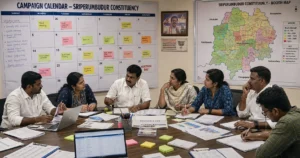
Across his DMK, AIADMK, and Congress engagements, reporting consistently describes the same operational signature: extended pre-election survey work (an estimated 18 months of constituency-level surveying preceded the Karnataka 2023 campaign), booth-level data modelling to identify winnable segments, and cadre reporting structures that feed real-time information back to a central team rather than relying on post-election analysis.
Strategist note: This is a genuinely portable methodology — it doesn’t depend on which party is doing the hiring, which is consistent with Kanugolu having applied it successfully for DMK, and unsuccessfully for AIADMK against a well-organised opponent using a similar model.
1. Pre-Poll Micro-Segmentation
Rather than treating a constituency as one bloc, this approach profiles voters at the household level — first-time voters, urban swing segments, and sub-caste groups — and tailors outreach content accordingly instead of a single broadcast message.
2. Real-Time Cadre Feedback Loops
Booth-level volunteers file regular field reports rather than waiting for a post-election review. Resources get redirected within days when a constituency shows softening support, not after the campaign has already ended.
3. Data-Led Resource Allocation
Campaign spend and volunteer time get concentrated where the data shows the highest marginal return — close-margin seats and under-covered wards — rather than spread evenly or driven by traditional local political relationships.
What Can Tamil Nadu Candidates Learn From This Approach?
Most TN MLA candidates spend the large majority of their campaign budget on rallies, banners, and broadcast advertising. The data-first model that recurs across Kanugolu’s campaigns inverts this: ground infrastructure and cadre activation come first, visibility spending comes second. Here’s how to apply the underlying principles at constituency scale, independent of which strategist or firm you work with:
Principle 1: Map Before You Spend
Before booking a single rally, build a booth-level map. For each of your constituency’s polling booths, identify: the previous election’s margin, caste composition of enrolled voters, and the top local grievance (water, roads, employment, local candidate). This determines where to concentrate door-to-door contact and where rallies add minimal value.
Principle 2: Build Accountability Into Your Cadre
Deploying volunteers isn’t enough without reporting systems attached. A booth volunteer who submits a regular contact-count report is far more likely to actually complete their target than one who isn’t tracked. A simple WhatsApp group reporting to a ward coordinator is enough to build this loop at MLA scale.
Principle 3: Find the Gaps Your Opponent Isn’t Covering
Identify your opponent’s weakest wards — where their local organisation is thin — and disproportionately saturate them with ground contact in the final weeks. This is a lower cost-per-vote strategy than trying to out-spend an incumbent everywhere at once.
If you’re planning your next Tamil Nadu campaign and want to apply this framework to your specific constituency, our team at ThinkPolitically runs exactly this kind of ground-operation design. Learn more about our election campaign management services for Tamil Nadu.
Sunil Kanugolu’s Path From DMK to Congress
Kanugolu joined the Indian National Congress in 2022 as head of campaign strategy and a member of the party’s Task Force 2024. His first major test in the new role was Congress’s 2023 Karnataka assembly campaign — a decisive win, 135 of 224 seats, built on an estimated 18 months of pre-election constituency survey work. He was also credited with a central strategic role in Congress’s Telangana win the same year.
Kanugolu currently holds a cabinet-rank chief advisor position in Karnataka’s Congress government, alongside continued campaign work for the party nationally — including Tamil Nadu’s 2026 election. His firm has also drawn scrutiny: in December 2022, Telangana police raided the Hyderabad office of Mindshare Analytics (the firm associated with Kanugolu) over allegations connected to social media posts targeting the then-BRS state government, a matter reported at the time but not established as a settled legal finding here.
Planning Your Next Tamil Nadu Campaign?
ThinkPolitically applies the same booth-level data methodology to MLA, MP, and local body campaigns across Tamil Nadu — constituency mapping, cadre activation systems, and opposition-gap targeting, independent of which party or strategist you’re comparing us against.
Frequently Asked Questions
Who is Sunil Kanugolu?
Sunil Kanugolu is an Indian political strategist who began his career working with Prashant Kishor on the 2014 Modi Lok Sabha campaign. In Tamil Nadu, he has worked for DMK (2015-2019), AIADMK (2021), and Congress (2026). Nationally, he is best known for leading Congress’s decisive 2023 Karnataka win, and currently holds a cabinet-rank chief advisor position in Karnataka’s Congress government.
Did Sunil Kanugolu run DMK’s 2021 Tamil Nadu campaign?
No — this is a common misattribution. DMK’s 2021 Tamil Nadu campaign (133 of 234 seats) was run by Prashant Kishor’s IPAC, engaged by DMK directly for that cycle. By 2021, Kanugolu had moved to AIADMK, working to rebuild then-Chief Minister Edappadi K. Palaniswami’s public image; AIADMK lost that election with 66 seats. Kanugolu’s real DMK history was earlier — the 2015 “Namakku Naame” campaign through the 2016 and 2019 elections.
What is the connection between Sunil Kanugolu and Prashant Kishor?
Kanugolu began his political consulting career working alongside Kishor on the 2014 Modi Lok Sabha campaign. The two are not currently affiliated — Kishor now runs his own party, Jan Suraaj, in Bihar, while Kanugolu works for the Indian National Congress.
What has Sunil Kanugolu done in Tamil Nadu since 2021?
After his 2021 AIADMK engagement, Kanugolu joined Congress in 2022. He returned to Tamil Nadu politics for the 2026 assembly election as part of Congress’s campaign — his fourth consecutive TN cycle with a fourth different party. His primary national role since 2023 has been advising Karnataka’s Congress government.
Can a smaller Tamil Nadu candidate afford Kanugolu-style campaign management?
The underlying methodology — booth mapping, cadre accountability loops, and opposition-gap targeting — is scalable and doesn’t require a national firm’s budget. Local agencies like ThinkPolitically apply the same principles at MLA and local body scale, with costs calibrated to constituency size. Contact us for a constituency-specific assessment.
Conclusion
Sunil Kanugolu’s real Tamil Nadu record is more interesting than the shorthand version usually repeated about him. He has worked inside DMK, AIADMK, and Congress in successive Tamil Nadu election cycles — winning with DMK in the 2010s, losing with AIADMK in 2021, and returning with Congress in 2026 — which gives him a rare, direct view of how each major camp in Tamil Nadu politics actually runs a ground campaign.
For Tamil Nadu candidates evaluating strategists, the takeaway isn’t “hire whoever is attached to the last big win” — it’s the underlying method that recurs across his engagements regardless of outcome: map your constituency at booth level, build cadre accountability, and find the gaps your opponent isn’t covering.
→ Read next: Top Political Strategists in India 2026: Who’s Running India’s Campaigns?
Sources
- The Federal, “DMK ropes in Prashant Kishor’s I-PAC ahead of 2021 polls in Tamil Nadu” — confirms IPAC, not Kanugolu, was engaged by DMK for the 2021 campaign.
- The Quint, “Unveiling Makeover of DMK, AIADMK This 2021 Elections in Tamil Nadu” — reporting on Kanugolu’s 2021 AIADMK engagement via his firm, and IPAC’s parallel DMK engagement.
- IBTimes, “AIADMK hires Sunil Kanugolu as new campaign strategist ahead of 2021 State elections.”
- The News Minute, reporting on Kanugolu’s cabinet-rank advisor role in Karnataka’s Congress government.
- Deccan Herald / The Week / Business Standard, reporting on Kanugolu’s role in Congress’s 2023 Karnataka and Telangana campaigns.
- The South First, “Tamil Nadu 2026: It’s no longer a battle of political parties but a war of poll strategists” — on Kanugolu’s fourth consecutive Tamil Nadu cycle, this time with Congress.
- Election Commission of India, Tamil Nadu Legislative Assembly Election 2021 — Final Results, https://eci.gov.in/statistical-report/statistical-reports/
- Election Commission of India, Karnataka Legislative Assembly Election 2023 — Final Results, https://eci.gov.in/statistical-report/statistical-reports/