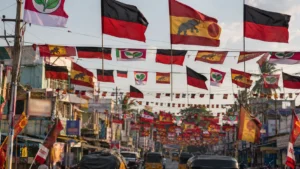
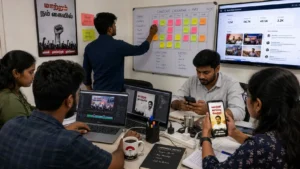
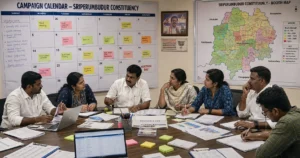
What Is an Election War Room?
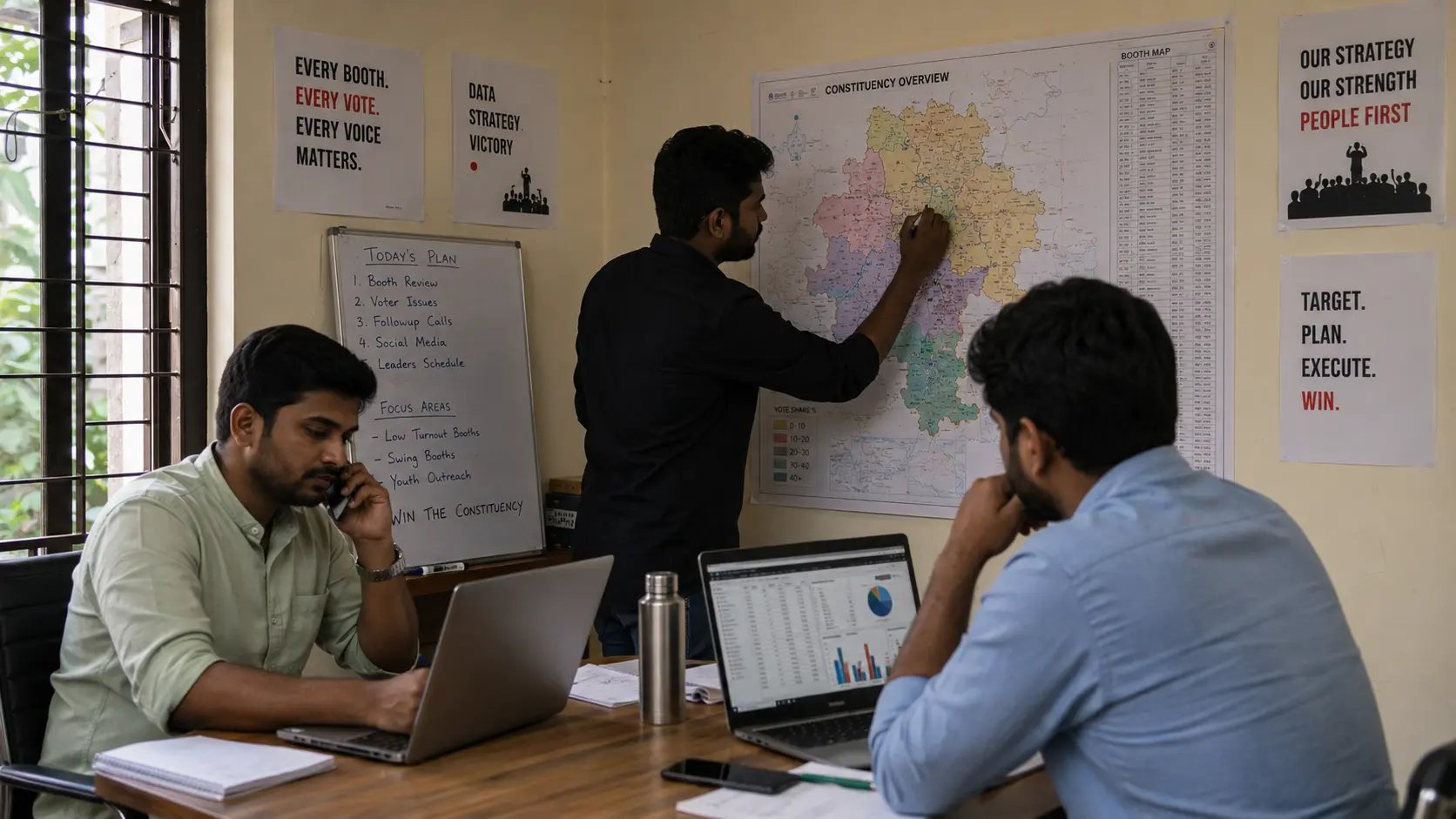
An election war room is a centralised real-time command centre that coordinates a campaign during the final weeks and on polling day itself. It brings together a data analyst tracking booth-level voter data, a communications lead monitoring opposition activity and social media, field coordinators in contact with booth agents across constituencies, and a campaign director who makes rapid decisions based on live reports. In India, state-level war rooms typically run around the clock for the last 10–14 days of a campaign and through the full polling day. A well-run war room can redirect canvassing teams to weak booths, suppress rumours before they spread, respond to opposition moves in hours rather than days, and maximise polling-day turnout through real-time transport coordination. Think Politically runs election war rooms for Tamil Nadu candidates at all levels, from assembly to corporation ward, with dedicated field communication tools and live reporting dashboards.
Think Politically provides full election war room management for candidates across Tamil Nadu’s 38 districts.
What Is a Political War Room? Inside India’s Real-Time Election Command Centres
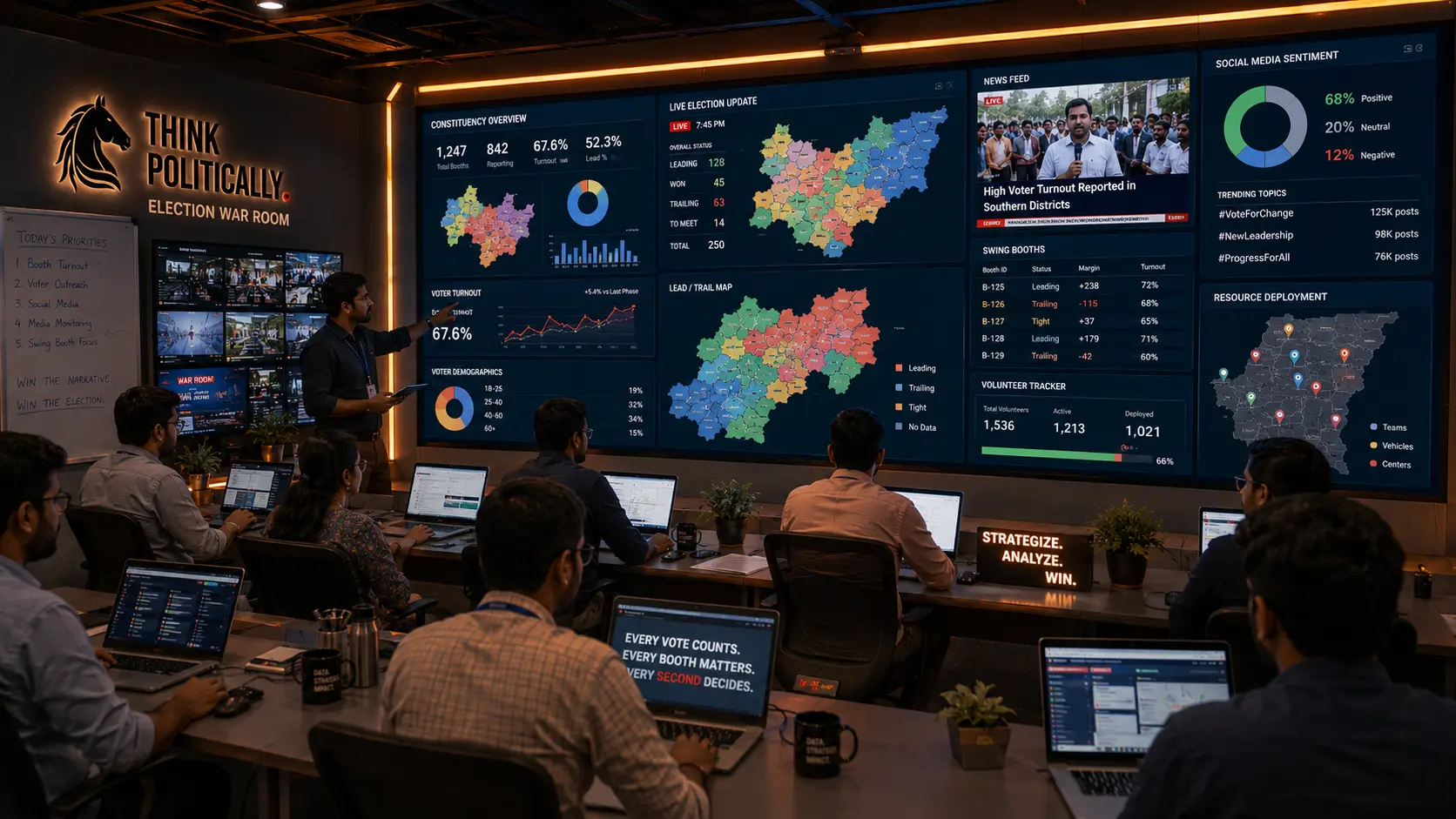
A political war room is the real-time command centre of an election campaign — tracking field reports, monitoring media, coordinating rapid response, and making daily decisions on resource deployment across booths and constituencies throughout the campaign cycle.
BJP’s election war room at its Ashok Road headquarters in Delhi employed over 100 data professionals during the 2024 Lok Sabha campaign (Pulitzer Center / Digital Witness Lab, 2024). These analysts worked in real time, processing booth-level voter data from across India, coordinating AI-powered calling campaigns — over 50 million AI-generated voice calls were placed before polling day began — and directing the party’s 6 million-plus booth workers through the Saral app. Indian political parties spent approximately US$50 million on AI-generated content alone for the 2024 election cycle (Netmission, 2025).
The political war room is no longer a metaphor. It’s a physical and digital infrastructure that separates campaigns that respond to events in real time from campaigns that find out what happened on the news. This guide explains exactly what a political war room is, how India’s top campaigns run them, and how to build one scaled to your constituency or state campaign.
Key Takeaways
- BJP’s 2024 war room deployed 100+ data analysts and placed 50 million+ AI voice calls before polling day (Pulitzer Center, 2024).
- The Saral app — BJP’s campaign coordination tool — had 2.9 million+ Google Play downloads and targeted 6 million daily booth-level contacts.
- Indian parties spent ~US$50 million on AI-generated content during the 2024 election cycle (Netmission, 2025).
- A constituency-level war room doesn’t require big technology — it requires one coordinator, one shared dashboard, and a reliable reporting chain from every booth.
What Is a Political War Room, and Why Does It Matter?
A political war room is a centralised campaign command centre where data analysts, communications staff, and field coordinators work together to make real-time decisions during an election campaign. The name comes from military operations rooms, where commanders monitor multiple fronts simultaneously and redirect resources as situations change. In politics, the “fronts” are constituencies, booths, media cycles, and opposition activity.
The core function of a war room is information consolidation. Without a war room, a campaign’s intelligence is scattered: the Booth President in one area knows his booths are behind on canvassing but can’t escalate; the communications team responds to opposition attacks a day late; the candidate shows up to an area where support has collapsed without knowing it. With a war room, all of this information flows into one place, in real time, and decisions get made before problems become crises.
For Tamil Nadu campaigns specifically, the value of a war room is amplified by the state’s complexity. With 234 assembly constituencies, 88,000+ polling booths, and highly competitive multi-party contests, a campaign without real-time data visibility is flying blind. Our political war room service is built specifically for Tamil Nadu’s constituency dynamics.
How Does BJP’s National War Room Actually Work?
The scale of BJP’s 2024 operation gave India’s political community a clear picture of what a fully resourced party war room looks like. The Pulitzer Center’s Digital Witness Lab documented the operation in detail. At the centre was the Saral app — Sangathan Reporting and Analysis — which by polling time had over 2.9 million Google Play downloads and served as the primary communication and data-collection tool for the party’s booth-level network.
The Saral app collected an unusually detailed voter profile for each registered voter: mobile number, home address, age, gender, religion, caste, social category (SC/ST/OBC), voter ID number, and photographs (Rest of World, 2024). This individual-level data enabled the war room to segment voters at booth level and design hyper-targeted WhatsApp and AI calling campaigns for each segment. The goal was 60 lakh (6 million) daily booth-level contacts through a combination of AI calls, WhatsApp messages, and in-person visits.
What Does a War Room Track on a Daily Basis?
The specific metrics tracked by a political war room depend on campaign stage and scale, but every effective war room maintains a daily dashboard covering at least these six indicators:
- Booth coverage percentage: What proportion of each booth’s voter list has been contacted by door-to-door canvassers? Any booth below 50% with 20 days remaining is a red flag requiring immediate reinforcement.
- Confirmed supporter count vs target: The campaign’s total confirmed votes across all booths vs the win threshold. Updated daily from Booth President reports.
- Opposition campaign activity: Where is the opposing candidate’s team canvassing, holding events, and running paid ads? This is tracked via party volunteers and open social media monitoring.
- Media sentiment: Are local Tamil Nadu media outlets running positive or negative stories about the candidate? What are opposition parties saying publicly? Rapid response is coordinated from the war room.
- WhatsApp message reach: Have daily talking points from the command group been redistributed by Booth Presidents? How many end-group members did the daily message reach? This is tracked by sampling a random 5% of Booth President groups.
- Polling day pace (on election day): What percentage of confirmed supporters have voted by 9 AM, 12 PM, 3 PM? Booths where supporter turnout is low receive immediate phone calls and personal visits from mobilisation teams.
The most common war room failure in Tamil Nadu campaigns isn’t a technology failure — it’s a reporting failure. Booth Presidents stop reporting accurate numbers under pressure, either because they’re embarrassed by slow progress or because they’re capturing data on paper and not transmitting it. The fix is to build reporting into the daily rhythm before problems appear: a 9 PM WhatsApp check-in from every Booth President, every day, no exceptions. When a booth misses two consecutive check-ins, the Constituency Coordinator calls directly. The data pipeline must be treated as sacred infrastructure.
How to Build a War Room for a Tamil Nadu Constituency Campaign
Not every campaign needs 100 data analysts and a custom app. A constituency-level war room for a Tamil Nadu assembly seat can be built with five components:
Component 1 — The Coordinator
One person whose full-time job during campaign season is running the war room. This person manages all reporting chains, maintains the master dashboard, identifies problems, and escalates to the candidate or campaign manager. This is not a volunteer role — it requires someone who understands data, is available from 7 AM to 10 PM daily, and has the authority to redirect field resources.
Component 2 — The Master Dashboard
A shared Google Sheet or Airtable database with one row per polling booth. Columns: Booth President name, total registered voters, canvassing coverage %, confirmed supporters count, last report date, red/yellow/green status. Updated daily. Visible to the candidate, campaign manager, and constituency coordinator at all times.
Component 3 — The Reporting Chain
One WhatsApp group for all Booth Presidents only. Daily check-in at 9 PM: each Booth President sends four numbers — doors knocked today, confirmed supporters added today, cumulative coverage %, and one issue raised by voters. No long messages, no discussions. Pure data, every night.
Component 4 — Rapid Response Protocol
When the opposition makes a damaging claim or a negative news story breaks, the war room has a 2-hour response window. Coordinator drafts a factual response, campaign manager approves, communications team formats it for Tamil WhatsApp and social media, and Booth Presidents distribute it simultaneously. No improvised responses from individual workers.
Component 5 — Polling Day Operations Centre
On election day, the war room converts to a real-time turnout tracker. Each Booth President reports voting percentage among confirmed supporters at 9 AM, 12 PM, and 3 PM. Any booth where confirmed supporter turnout is below 60% by noon gets a dedicated mobilisation team dispatched within the hour. Our election campaign management service runs this entire polling day operation for clients.
AI and Technology in India’s 2024 War Rooms: What Tamil Nadu Campaigns Can Learn
Over 50 million AI-generated voice calls were made before the 2024 election began, mimicking politicians’ voices in regional languages (PBS NewsHour / Netmission, 2025). BJP used the government-built Bhashini AI tool to translate Modi speeches into 8 regional languages including Tamil, Telugu, and Kannada — scaling targeted communication across linguistic boundaries without requiring native speakers for each language. Varahe Analytics and Association of Billion Minds deployed thousands of employees for data collection and survey operations (Pulitzer Center, 2024).
For Tamil Nadu constituency campaigns, the relevant technology lessons are simpler: use voter data analysis to identify your highest-priority contact targets before canvassing begins; use AI-assisted content tools to produce Tamil-language WhatsApp messages and social content at scale; and use real-time polling from political survey services to track sentiment changes in the final 30 days before polling.
Technology doesn’t win elections in Tamil Nadu — people do. But technology makes your people dramatically more effective when it feeds them the right information at the right time.
Frequently Asked Questions: Political War Room India
What is a political war room?
A political war room is a centralised campaign command centre where data analysts, communications staff, and field coordinators work together in real time during an election. It tracks booth-level voter data, monitors opposition activity, coordinates rapid response to news events, and directs field teams based on live intelligence.
How does BJP’s war room work in Indian elections?
BJP’s Delhi war room employs 100+ data professionals using the Saral app (2.9 million downloads) to collect individual voter profiles at booth level. It coordinated 50 million+ AI voice calls pre-2024 and translates messaging into 8 languages via Bhashini AI, targeting 6 million daily booth contacts (Pulitzer Center / Rest of World, 2024).
Do smaller parties need a war room for Tamil Nadu elections?
Yes — scaled to the campaign. A constituency-level war room can be one coordinator with a laptop, a live Google Sheet tracking booth progress, and WhatsApp reporting from all Booth Presidents. What matters is having a single point where all field intelligence flows and decisions get made.
What data does a political war room track?
Voter contact rates by booth, confirmed supporter counts vs targets, canvassing coverage %, opposition campaign activity, media sentiment, WhatsApp message reach, and on polling day — real-time voting pace by booth. All data feeds a shared dashboard updated at least daily.
How much does a political war room cost in India?
A constituency-level war room costs Rs 5–15 lakh for a 60-day campaign. A state-level war room monitoring multiple constituencies runs Rs 1–5 crore depending on team size, technology, and the number of seats being tracked simultaneously.
How do political parties set up a war room during elections?
Parties set up war rooms in phases: intelligence infrastructure first (booth-level data systems), then people (coordinators, data analysts, communications staff assigned to specific roles), then technology and reporting tools last. National parties build dedicated apps and multi-language AI calling systems; state and constituency-level war rooms typically run on WhatsApp reporting chains and shared tracking sheets, scaled to the campaign’s size and budget.
What are political war room operations?
War room operations are the day-to-day functions that keep a campaign’s command centre running: collecting field and booth-level data, monitoring opposition activity and media sentiment, triaging incoming reports into action or no-action, coordinating rapid response to news events or attacks, and on polling day, tracking real-time turnout and directing last-mile mobilisation.
What decisions are made inside a political war room during an active election campaign?
A war room makes resourcing and response decisions: which booths get reinforced with additional volunteers based on incoming turnout or sentiment data, how to respond to a breaking news event or opposition move within the ECI’s response window, and where to redirect the candidate’s limited time in the campaign’s final days. These are operational calls made continuously, not a single strategic plan set once and left unchanged.
What is a political command centre?
A political command centre is another term for the war room, the single point where field, digital, media, and data inputs converge so leadership can make coordinated decisions rather than each function operating in isolation. The two terms are used interchangeably depending on the campaign’s internal vocabulary.
What does ‘war room politics’ mean?
‘War room politics’ refers to the operational, data-driven side of campaign decision-making, resource allocation, rapid response, real-time monitoring, as distinct from public-facing political rhetoric or ideology. It describes the internal machinery that determines how a campaign actually runs day to day, not the content of a candidate’s public messaging.
Ready to Run a Smarter Campaign with a Dedicated War Room?
Think Politically’s war room service gives Tamil Nadu candidates real-time visibility across every booth in their constituency — daily dashboards, polling day operations, rapid response coordination, and field intelligence analysis. Let’s talk about what your campaign needs.
Speak with our war room team on WhatsApp
We’ll walk you through how a constituency-level war room works for your specific seat.
💬 WhatsApp Us NowSources: Pulitzer Center / Digital Witness Lab (2024), Data Collection App at the Heart of BJP’s Campaign (pulitzercenter.org); Rest of World (2024), BJP’s Saral App (restofworld.org); Netmission (2025), The Digital Election (netmission.asia); PBS NewsHour (2024), India’s Latest Election Embraced AI Technology.
From Our Blog
How Do You Measure War Room Effectiveness During a Campaign?
A war room is only as useful as the decisions it produces. The clearest measure of effectiveness isn’t the technology you’re using — it’s the cadence and accuracy of decision-making under pressure. Three indicators tell you if your war room is working:
Response Time to Field Escalations
In a functioning war room, a field escalation (booth agent reporting a problem) should reach a decision-maker and get a response directive within 20 minutes during active campaign hours. In Tamil Nadu’s multi-constituency environments, where 234 assembly contests run simultaneously, delays longer than 30 minutes mean problems compound. Track your average escalation response time as a daily metric.
Booth-Level Turnout Prediction Accuracy
On polling day, your war room should be tracking hourly turnout by booth. By 1 PM, you should be able to predict final turnout within ±5 percentage points for each booth cluster. Tamil Nadu’s 2026 election saw 85.1% overall turnout (Election Commission of India, May 2026) — campaigns with structured war rooms were identifying which booths were underperforming by 11 AM and deploying transport resources accordingly. Campaigns without real-time tracking only noticed the gaps after polls closed.
Opposition Intelligence Coverage
Your war room should track opposition campaign activity — their booth deployments, their messaging shifts, their media buys — on a daily basis. Intelligence gaps create surprises. In Tamil Nadu’s competitive political environment, with 4,023 candidates contesting in 2026 (ECI), even a candidate with strong party backing can be caught unprepared by a well-organised local opponent’s final-week push.
War rooms that measure these three indicators and build feedback loops around them consistently outperform those that treat the war room as a coordination tool rather than an analytical engine.
For step-by-step guidance on building a war room from scratch, see our complete guide: Election War Room Setup for Tamil Nadu Candidates →
Related service: Election War Room Management by Think Politically →