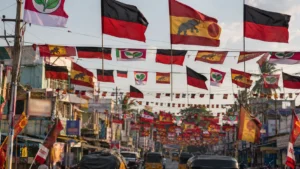
How Do You Build a Winning Chennai Ward Election Strategy?
A Chennai ward campaign should be planned as a compact local election, not a smaller assembly campaign. Greater Chennai Corporation has 200 wards across 15 zones, with one councillor representing each ward. Start by mapping every polling station, street, apartment cluster, informal settlement, market, resident association, and recurring civic issue. Then calculate the vote target, assign local coordinators, build Tamil-first and neighbourhood-specific communication, and track voter contact and unresolved issues through a ward command system. Candidate visibility matters, but repeated doorstep contact, credible responses on roads, drainage, water, waste, safety, and ward services, and reliable polling-day organisation usually create the operational advantage.
What should the first 90 days include?
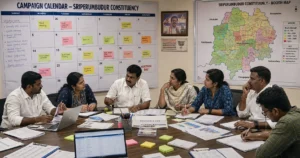
Days 1–30: verify the ward map, electoral roll, past results, local organisations, and priority issues. Days 31–60: recruit street and booth owners, test messages, structure WhatsApp reporting, and begin recorded voter contact. Days 61–90: intensify persuasion, revisit undecided households, close volunteer gaps, rehearse the war room, and finalise lawful turnout and incident-response procedures.
Which digital tools are useful?
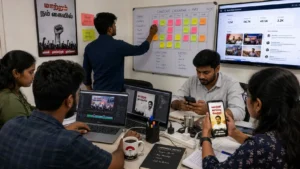
Use a ward and booth tracker, structured field-reporting form, issue log, volunteer roster, content calendar, media-monitoring queue, and leadership dashboard. WhatsApp can move information quickly, but decisions, deadlines, permissions, and campaign-owned data should remain in a controlled system that can be audited and exported.
Administrative reference: Greater Chennai Corporation describes the city as 15 zones and 200 wards. Election rules, nomination requirements, and expenditure limits should be checked against the current Tamil Nadu State Election Commission notification for the relevant election.
Chennai Corporation Election Strategy for GCC Ward Candidates
Think Politically plans Chennai corporation election campaigns for GCC ward candidates who need ward targeting, apartment-block outreach, WhatsApp volunteer networks, and polling-day execution built around urban turnout realities. If you are contesting a Greater Chennai Corporation ward in the next cycle, the campaign cannot be copied from an assembly or panchayat playbook. Chennai wards need a tighter, building-level strategy.
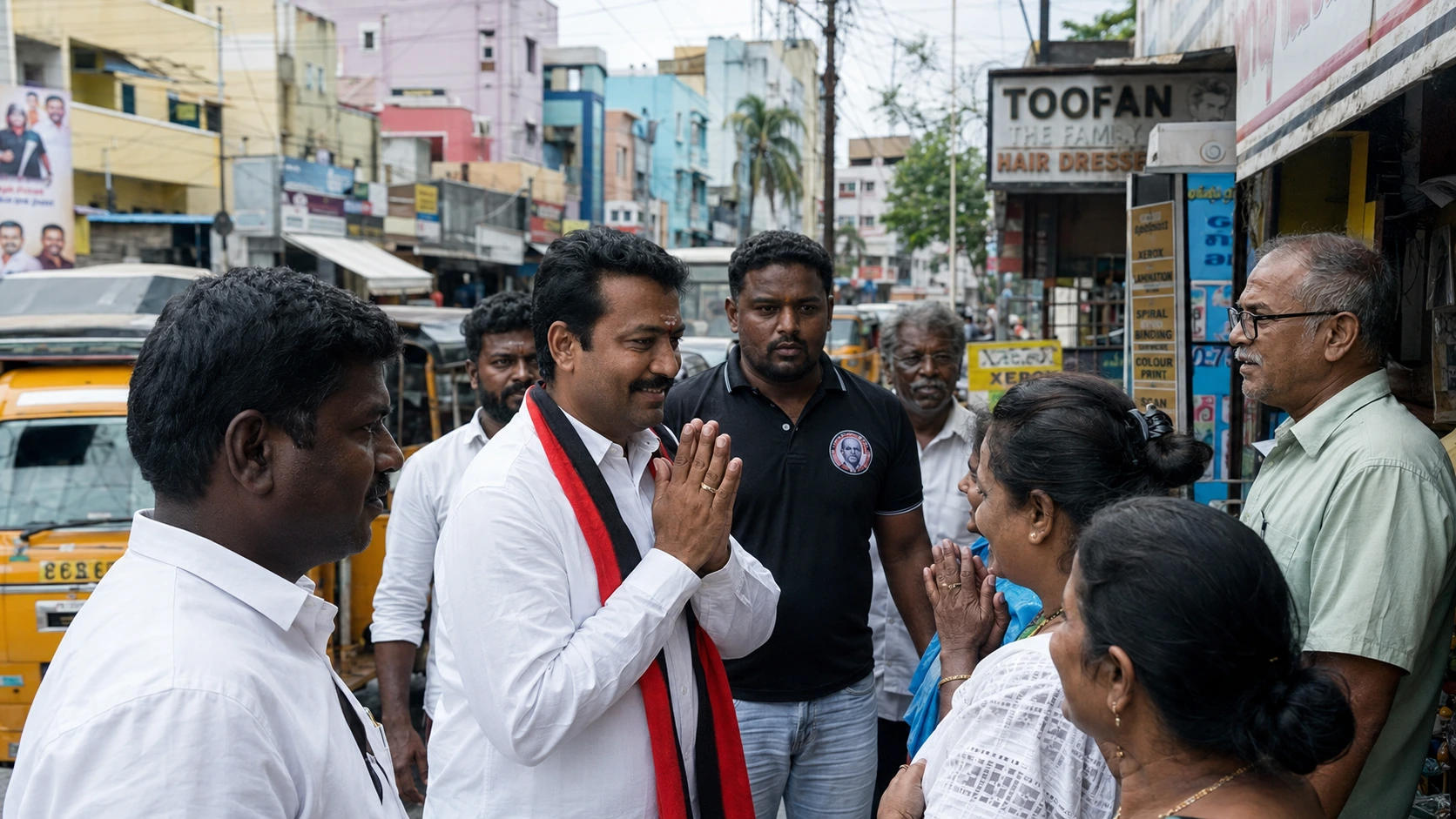
In February 2022, DMK won 153 of 200 Greater Chennai Corporation wards outright, and its Secular Progressive Alliance (SPA) swept 178 wards, or 89% of the council, in total (Wikipedia / Citizen Matters, 2022). AIADMK won just 15 wards; BJP managed a single seat in the city. That dominance means challengers, independents, and even party-backed candidates need sharper ward-level positioning before they spend on canvassing or digital media.
Winning a GCC ward seat is different from any other Tamil Nadu election. Apartment complexes can hold hundreds of voters who never open their doors to canvassers. Voter turnout is structurally lower than rural constituencies. Caste arithmetic is compressed by migration, and local issues such as flooding, waste collection, roads, and water supply decide credibility faster than party slogans. This page explains the strategy and shows how a campaign consultant should build the operation.
Planning a Chennai corporation campaign?
Get a ward-level campaign assessment covering voter clusters, apartment access, digital presence, and polling-day readiness.
Key Takeaways
- GCC has 200 wards; DMK won 153 outright and the SPA alliance won 178 (89%) in 2022 (Wikipedia / Citizen Matters, 2022).
- Chennai Central recorded only 53.96% voter turnout in the 2024 Lok Sabha election — Chennai urban voters turn out at significantly lower rates than rural Tamil Nadu.
- Ward-level issues (flooding, garbage, roads) dominate Chennai voter decisions more than party alignment in corporation contests.
- Apartment RWA engagement is the highest-leverage canvassing activity in Chennai — one RWA meeting can reach 200–2,000 voters in a single session.
Why Chennai Corporation Campaigns Need a Specialist Consultant
A GCC ward usually has 15,000–25,000 voters, while a Tamil Nadu assembly constituency often has more than 200,000 voters. That scale difference changes the consultant’s job. In a Chennai ward, the winning campaign is built around micro-clusters: apartment associations, street-level civic complaints, WhatsApp volunteer chains, low-turnout booth lists, and local issue proof that residents can verify within a few minutes.
| Campaign factor | Assembly / panchayat habit | GCC ward requirement |
|---|---|---|
| Primary canvassing unit | Village, street, booth cluster | Apartment block, RWA, street segment |
| Voter contact | Door-to-door and rallies | RWA meetings, evening canvassing, WhatsApp follow-up |
| Digital role | Support channel | Core channel for under-40 and gated-community voters |
| Polling-day risk | Transport and booth coverage | Low-turnout recovery before work and after office hours |
A consultant who has only run larger constituency campaigns can waste a ward budget on broad messaging. A Chennai-specific consultant should start with a ward audit, identify reachable apartment and street clusters, set a 90-day ground calendar, and connect the election war room, WhatsApp political network, and booth teams into one reporting loop.
How Is a Chennai GCC Ward Election Different from Other Tamil Nadu Contests?
Campaigning for a GCC ward seat requires a fundamentally different approach from a rural panchayat or an assembly constituency campaign. Chennai’s urban environment changes nearly every strategic variable: the voter density, the issues that matter, the canvassing method, the media consumption habits, and even the timing of when voters are accessible at home.
Chennai Central returned just 53.96% voter turnout in the 2024 Lok Sabha election (ECI / Wikipedia, 2024) — compared to the statewide average of 69.72% and the rural high of 81.20% in Dharmapuri. Urban Chennai voters turn out at lower rates. This actually changes the campaign calculus: instead of needing to out-turnout your opponent, you need to identify the minority of voters who will definitely vote and make sure every one of them is mobilised. Depth beats breadth in low-turnout urban contests.
The key differences from rural Tamil Nadu campaigns:
- Apartment buildings dominate large portions of Chennai wards, concentrating hundreds of voters in single structures with security gates and intercoms — standard door-to-door canvassing is impossible without a plan adapted for vertical housing.
- Floating voters are more common. Chennai voters are more likely to split their vote between parties at different election levels and are more likely to base their decision on the individual candidate’s local record rather than party allegiance.
- Digital media reaches voters more effectively than in rural districts. Facebook, YouTube, and Instagram penetration is significantly higher in Chennai, and many voters follow local ward-level political accounts. A consistent digital presence matters more here than in rural Tamil Nadu.
- Working-hour access is limited. Most Chennai residents work formal jobs. Evening canvassing (6–9 PM) and Saturday mornings are the primary windows for voter contact. Midday canvassing misses most of the voter base at home.
What Issues Actually Win Chennai Corporation Elections?
Every candidate running for a GCC ward seat should be able to name, without hesitation, the top three infrastructure and service delivery problems in their specific ward — and have a specific, credible plan for each. Chennai voters don’t reward vague development promises. They reward candidates who understand the exact texture of the problem on their street.
The dominant issues across Chennai wards, consistently cited in resident surveys and media coverage:
Flooding and Stormwater Drainage
Chennai’s flooding problem — exposed dramatically by the 2015 floods and recurring during monsoon seasons — remains the top voter concern in low-lying wards across north Chennai, the Cooum belt, and coastal areas. A GCC candidate who can name the specific stormwater drains that are blocked in their ward, who the responsible agency is, and what they’ve already petitioned about it, establishes instant credibility with residents who have suffered through annual waterlogging.
Solid Waste and Garbage Collection
Irregular garbage collection timing, overflowing bins at street corners, and inadequate segregation infrastructure are near-universal complaints across Chennai wards. This is an operational issue under direct GCC control — which makes it a campaign promise a councillor can actually keep. Candidates who’ve already filed RTI requests about their ward’s collection schedule or who’ve organised community cleanup drives have visible evidence of action.
Road Maintenance and Footpaths
Broken roads, missing footpath slabs, potholes repaired with temporary patches that break apart in the next monsoon, and narrowing of roads by encroachments are consistently cited across Chennai wards. The visibility of road quality — voters see it every day — makes this a high-salience issue even in affluent areas. Candidate accountability on road maintenance is trackable and remembered.
Campaign Insight: In Chennai GCC wards with significant apartment blocks (particularly in Adyar, Anna Nagar, and T. Nagar belt), the Resident Welfare Association is often the single most influential civic body in a ward — more so than political party structures. A candidate endorsed by the RWA president of a 300-flat apartment building has effectively secured an organised voter bloc that will not only vote but will also remind neighbours on polling day. Invest time in RWA relationships before the campaign formally begins.
Ward-Level Canvassing Strategy for Chennai’s Urban Environment
Standard rural canvassing doesn’t work in Chennai’s high-density urban wards. Adapt your approach to the built environment.
Apartment Block Strategy
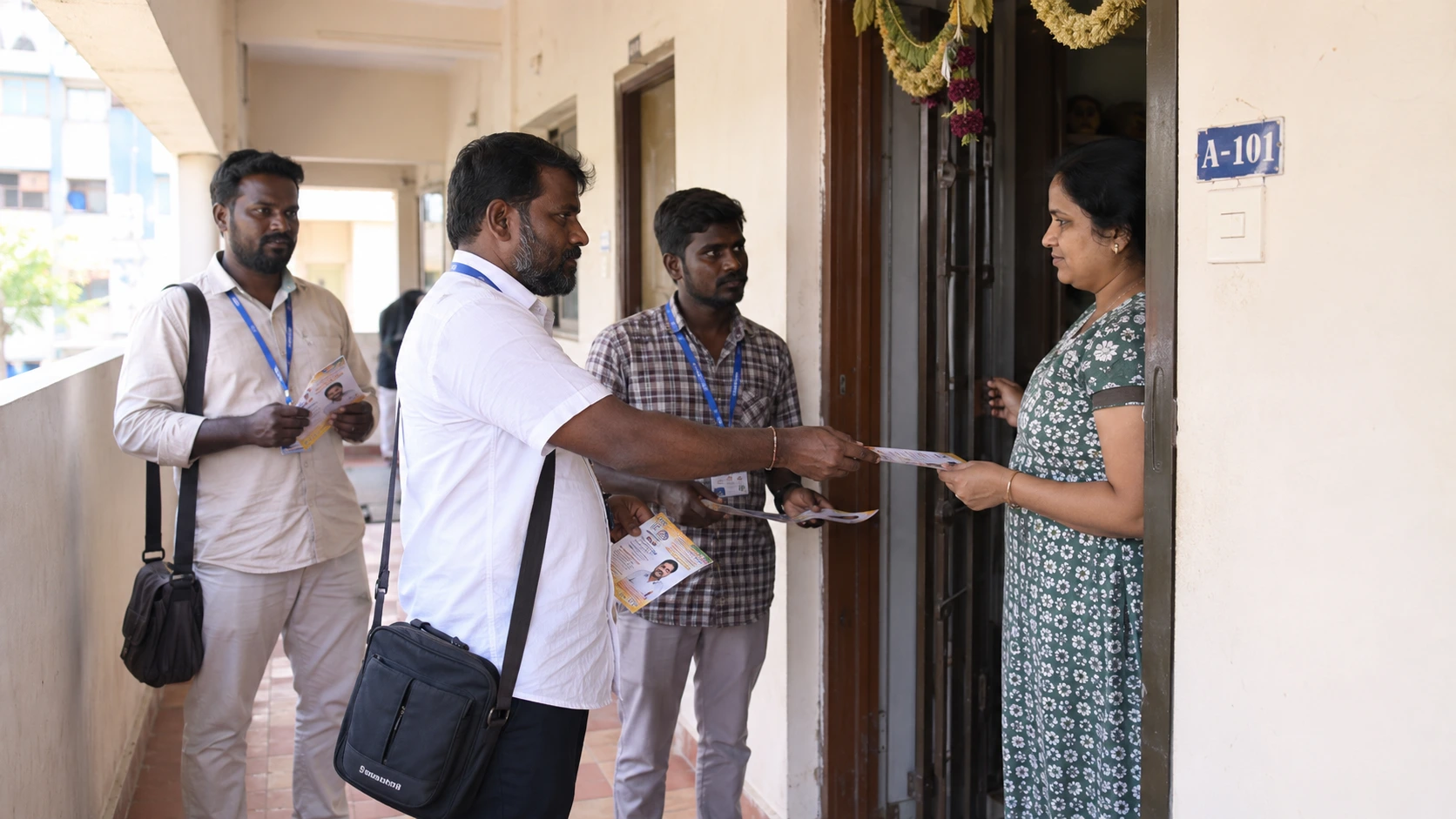
Apartment blocks in Chennai GCC wards can concentrate 200–2,000 voters in a single building. The access challenge is real — most have security gates and intercoms. The solution is the RWA channel. Request permission from the Resident Welfare Association to address residents at their next monthly meeting. Prepare a 10-minute structured presentation: what’s the top ward problem, what specifically will you do about it, and what’s your track record of civic engagement. Allow 15–20 minutes for questions. This single session is worth 3 days of individual door-knocking in efficiency terms.
If the RWA won’t grant a meeting before election announcement, attend their meeting as an observer. Help them resolve a current problem — a broken streetlight, an overflowing bin — before asking for campaign access. Service precedes access in urban Chennai politics.
Street-Level Canvassing (Ground Floor Residences)
For independent houses, tenement blocks, and ground-floor residences, deploy your door-to-door canvassing teams during evening hours (6–9 PM) on weekdays and Saturday mornings (8–11 AM). Assign specific streets to specific canvassers — no overlapping, no gaps. Each canvasser covers 15–20 households per 2-hour session in Chennai’s residential areas.
Digital Canvassing for Hard-to-Reach Voters
Many Chennai voters — particularly those working long hours, those in gated buildings without RWA access, and young professionals — are more easily reached through digital channels than at the door. A ward-level Facebook group, a YouTube channel of ward walkthrough videos, and targeted Facebook ads within a 1km radius of the ward boundary are effective supplements to physical canvassing. Our political branding team designs digital identities specifically for GCC ward candidates.
Polling Day Operations in Urban Chennai: Winning the Turnout Battle
Chennai urban turnout is structurally lower than rural Tamil Nadu. This means the candidate who mobilises their confirmed supporters most effectively wins — not the candidate with the most recognisable name. A reliable confirmed-supporter tracking system and a morning-of-polling mobilisation call are the difference between 47% and 58% supporter turnout on election day.
Three polling day tactics specific to Chennai’s urban context:
- Pre-dawn WhatsApp reminder: Send a personal-sounding voice note from the candidate at 6:30 AM to all ward WhatsApp groups. Tone: grateful, urgent, personal. “Today is the day. Please vote before you leave for work. Polling opens at 7 AM. Your vote is my strength.” Voice notes are opened and listened to at 3–5× the rate of text messages in Tamil Nadu’s digital culture.
- Corporate-hour voting window: Many Chennai voters in formal employment can vote before 9 AM or after 5 PM but not during working hours. Position polling day messaging around these windows specifically. “Vote before you reach your office” is a more actionable message for a Chennai IT-sector voter than a generic polling day reminder.
- Transport for elderly voters: In Chennai apartment blocks and older residential areas, elderly residents often rely on family members who may be at work. Pre-arrange auto-rickshaw transport funded by the campaign, specifically for elderly confirmed supporters who lack independent transport. This is legal, logistically simple, and can shift 30–80 votes per ward in tightly contested seats.
The full polling day operation — tracking, mobilisation, and booth-level monitoring — is the final function of the booth management system built over the preceding campaign period. If the booth management structure is solid, polling day is execution, not improvisation.
Frequently Asked Questions: Corporation Election Strategy Chennai
How many wards does the Greater Chennai Corporation have?
The GCC has 200 wards, making it one of the largest urban local bodies by ward count in South India. The 2022 election was held on 19 February 2022. Each ward elects one councillor representing 10,000–30,000 residents depending on the ward’s geography and density.
What are the most important issues in Chennai Corporation elections?
Chennai voters consistently prioritise: flooding and stormwater drainage, solid waste and garbage collection frequency, road maintenance in residential areas, drinking water supply, and streetlight coverage. Candidates with a credible track record or specific plan on 1–2 of these issues win the issue argument decisively.
How is urban voter behaviour different in Chennai vs rural Tamil Nadu?
Chennai voters turn out at lower rates (Chennai Central: 53.96% in 2024), split votes more readily across party lines, are more responsive to digital content, and base corporation election decisions more on individual candidate record than party loyalty. Urban canvassing must adapt to apartment buildings and working-hour access constraints.
How do I reach apartment block voters in Chennai GCC elections?
Engage Resident Welfare Associations (RWAs) directly — request permission to address residents at their next monthly meeting. One RWA meeting can reach 200–2,000 voters in a single session. If access is denied, attend as an observer and help resolve a current building or street-level issue before requesting campaign access.
When should I hire a consultant for a Chennai corporation election?
Start 6–9 months before the election announcement if possible. That gives enough time for a ward audit, voter list cleanup, RWA relationship-building, WhatsApp volunteer recruitment, and early digital presence. A late sprint can still improve messaging and turnout operations, but it cannot replace months of trust-building.
Do you work with independent candidates contesting GCC wards?
Yes. We work with party-backed candidates and independents. Independent candidates need stronger local issue ownership, sharper booth prioritisation, and a more disciplined voter-contact calendar because they cannot rely on party symbol recall alone.
Running for a GCC Ward Seat? Let’s Plan Your Campaign.
If you’re planning a GCC ward campaign, the earlier you start, the stronger your ward audit data becomes. The best campaigns begin 6–9 months before election day, not six weeks before nomination. Think Politically advises candidates across Chennai’s 200 GCC wards, from ward mapping and RWA engagement to digital canvassing, polling-day command, and crisis response.
What we build for Chennai corporation candidates:
- Ward audit: voter data mapping, demographic breakdown, civic issue mapping, and booth-level strength assessment.
- Campaign calendar: 90-day execution plan with daily ground, digital, and volunteer tasks.
- Apartment-block outreach: RWA meeting strategy and high-rise canvassing protocol for gated clusters.
- WhatsApp network setup: street-level and building-level volunteer chains with reporting discipline.
- Digital presence: local Facebook, YouTube Shorts, Instagram, and issue-led creative for under-35 voters.
- Polling-day command: booth-wise briefing, low-turnout recovery, and morning/evening voter mobilisation.
Get a free 30-minute Chennai ward campaign assessment
Tell us your ward number and current campaign stage. We’ll tell you what your ward needs and whether Think Politically is the right fit.
Sources: Wikipedia / Citizen Matters (2022), 2022 Tamil Nadu Local Elections (wikipedia.org); Chennai GCC Elections Data 2022 — Open City India (data.opencity.in); ECI / Wikipedia (2024), 2024 Indian General Election in Tamil Nadu (wikipedia.org).