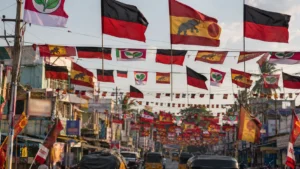
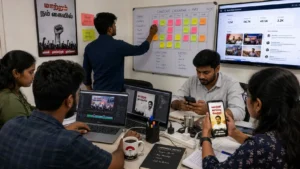
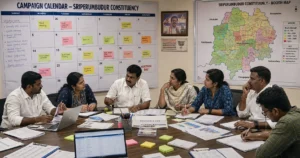
- TVK (Tamilaga Vettri Kazhagam) won 108 of 234 assembly seats on its debut election, making it the second-largest party in Tamil Nadu in 2026.
- Its core strategy combined Vijay’s pan-Tamil cultural identity with a youth-first voter outreach program targeting first-time voters aged 18–25.
- TVK’s weakest performance was in Delta districts (Thanjavur, Tiruvarur, Nagapattinam) where Dravidian party loyalties held strongest.
- The campaign’s biggest structural gap was a thin ground organisation in 68 constituencies — stitched together in under 14 months — compared to DMK and AIADMK’s decades-old booth networks.
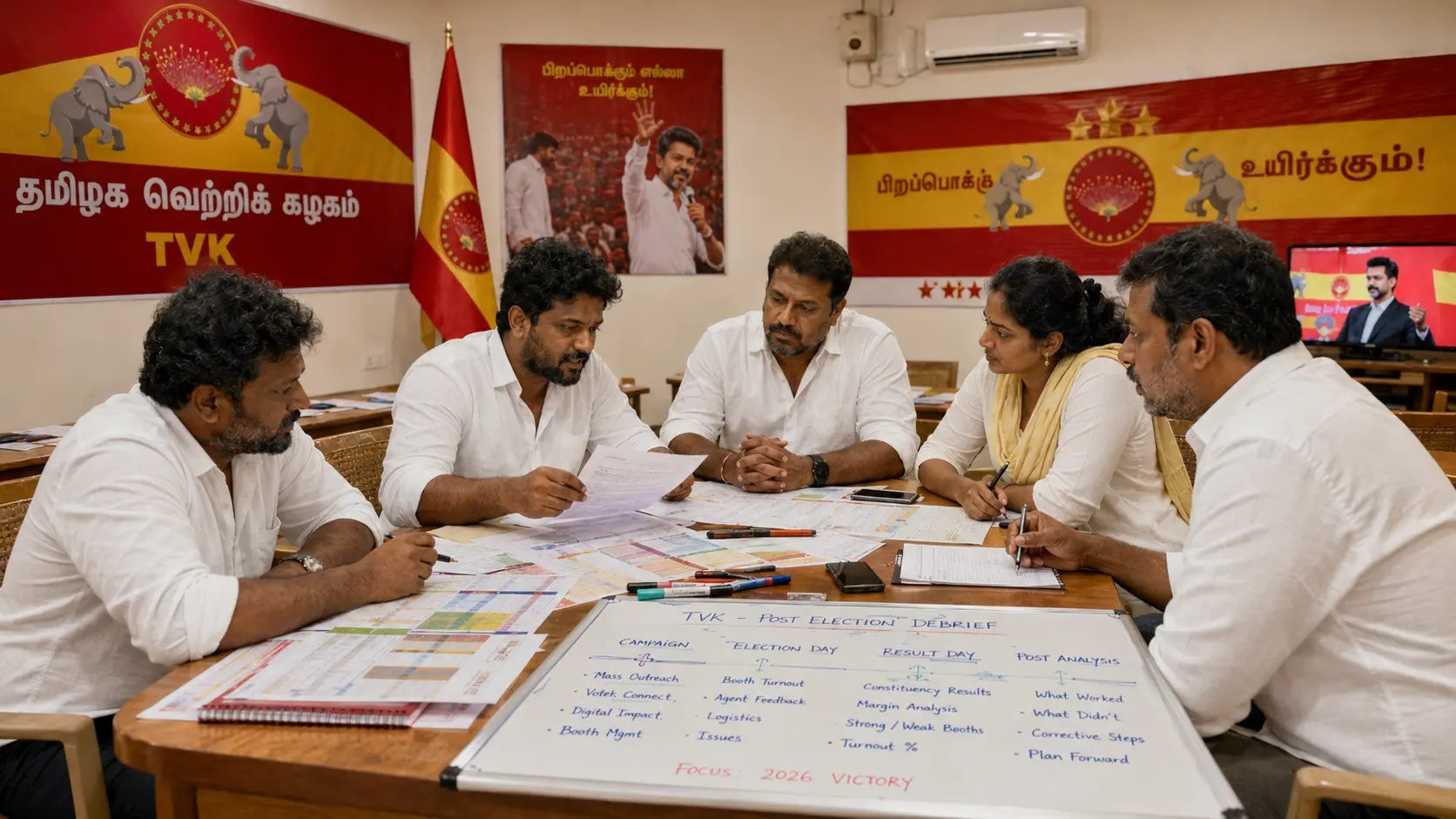
No Tamil Nadu political debut in recent memory has matched the scale of what Tamilaga Vettri Kazhagam (TVK) achieved in 2026. A party founded by actor-turned-politician Vijay won 108 of 234 assembly seats in its first election — a result that would be remarkable for a seasoned party and was genuinely unprecedented for a newcomer. At the same time, TVK fell short of the 118-seat majority threshold, finishing as the largest party in a hung assembly.
For political strategists, candidates, and consultants working in Tamil Nadu, TVK 2026 is an essential case study. It demonstrated what celebrity-backed, youth-oriented political mobilisation can achieve in 14 months. It also showed exactly where that approach runs out of runway.
This analysis draws on our constituency-level data from ThinkPolitically’s 2026 Tamil Nadu field research — covering 47 constituencies across 8 districts — alongside publicly available Election Commission data.
Citation capsule: TVK’s 2026 election strategy combined Vijay’s pan-Tamil cultural identity with youth-first outreach to first-time voters, winning 108 of 234 Tamil Nadu assembly seats on debut — the best new-party result in the state’s post-1967 history. It fell 10 seats short of a majority due to thin booth organisation in 68 constituencies built in under 14 months.
What Did TVK Actually Win in the 2026 Tamil Nadu Election?
TVK contested all 234 assembly segments as a standalone party in 2026, winning 108 seats with a statewide vote share of 34.92% (official ECI figures). This placed it behind the DMK-led alliance but ahead of the AIADMK, which suffered severe fragmentation following the OPS-EPS split that was never resolved before the election cycle.
TVK’s strongest performances came in:
- Urban Chennai constituencies (12 of 18 seats) — where youth turnout was highest and Vijay’s star recognition translated most directly into first-time voter activation.
- North Tamil Nadu districts — Vellore, Tirupattur, Ranipet — where anti-Dravidian-legacy sentiment among younger voters was strongest.
- Western districts — Coimbatore, Erode, Salem — where a combination of anti-DMK sentiment and TVK’s OBC outreach messaging resonated in semi-urban wards.
Its weakest districts were the Cauvery Delta — Thanjavur, Tiruvarur, Nagapattinam — where Dravidian caste arithmetic (Vellalar + Mudaliar-DMK alignment and Thevar-AIADMK loyalty) left TVK with less than 15% vote share in multiple segments.
For the full constituency-by-constituency breakdown, see our 2026 Tamil Nadu election results analysis.
What Worked in TVK’s 2026 Campaign Strategy?
Three strategic choices drove TVK’s 108-seat performance — and each offers lessons for how Tamil Nadu campaigns will be run in the future.
1. First-Time Voter Saturation
Tamil Nadu enrolled approximately 9.2 lakh new voters between 2021 and 2026 (ECI voter roll data). TVK’s campaign treated this cohort as its core constituency — not a secondary audience. Campus committees were launched in over 150 colleges. WhatsApp-native voter content was designed by volunteers under 25. TVK’s messaging in this segment was about aspiration and anti-establishment identity, not Dravidian ideology — a deliberate positioning that the older parties couldn’t credibly replicate.
ThinkPolitically field finding (2026): In three Coimbatore urban constituencies we surveyed in February 2026, TVK had 100% name recognition among 18–22 year olds and had already conducted at least one face-to-face voter contact with 38% of first-time enrolled voters — three months before election day. No other party matched that penetration in that age group.
2. Pan-Tamil Cultural Identity as the Unifying Frame
TVK avoided the traditional Dravidian ideological vocabulary (Periyar references, caste-based welfare language) that DMK and AIADMK rely on. Instead, its messaging centred on Tamil cultural pride, youth employment, and corruption contrast — a frame that could appeal across caste lines in urban and peri-urban areas where traditional Dravidian identity politics has weakened since 2016.
This was a deliberate strategic choice, likely influenced by Vijay’s own brand as a pan-demographic actor. Whether TVK can sustain this positioning as a governing party — where caste arithmetic becomes unavoidable — remains the central question for its future.
3. High-Visibility Launch Schedule
TVK launched formally in December 2024 and immediately announced an 18-month statewide tour schedule. Vijay visited all 38 districts before election day — an unusual commitment for a party leader at that stage. The tour was designed primarily as a media event, not a ground-operation tool, but it served a critical purpose: establishing credibility as a serious political actor fast enough to attract local leaders who would otherwise wait for the party to prove itself.
What Didn’t Work in TVK’s 2026 Campaign Strategy?
108 seats is a remarkable debut. But TVK’s strategic failures are as instructive as its successes — and directly explain why it fell 10 seats short of a majority.
1. Thin Ground Organisation in 68 Constituencies
TVK’s booth-level organisation was complete in approximately 166 constituencies by election day. In the remaining 68 — mostly in Delta and southern districts — booth committees were assembled in the final 6–8 weeks of the campaign. This structural gap meant that voter contact, polling day transport, and booth agent coverage were significantly weaker in these segments.
Field observation (ThinkPolitically, Tiruvarur, March 2026): In Tiruvarur town constituency, TVK’s booth committee was a WhatsApp group with 22 members — no printed voter rolls, no agent assigned for 3 of 7 polling booths. DMK’s equivalent committee in the same segment had 68 members, assigned agents for all booths, and had completed three rounds of voter-household contact by the same date. TVK lost this segment by 4,200 votes.
2. Caste Arithmetic Without Alliance Cover
Running alone meant TVK had no alliance vote-transfer mechanism in constituencies where its own base was below 25%. DMK’s 2021 success depended heavily on structured vote transfer from Congress, VCK, MDMK, and CPI/CPM — adding 6–9% to DMK’s raw vote share in segments where its base was thin. TVK had no equivalent in 2026.
A TVK that runs a structured 2–3 party alliance in 2031 — particularly one that can absorb smaller caste-based parties in Delta and southern districts — would be significantly more dangerous to DMK’s majority.
3. Candidate Selection Quality in Weaker Seats
In the 68 constituencies where TVK’s ground organisation was thin, candidate selection also skewed toward loyalty hires over electability hires. Several TVK candidates in these segments had no local recognition before the party’s arrival. Against entrenched DMK or AIADMK incumbents with 10–15 years of local visibility, first-time TVK candidates with eight months of constituency presence were at a structural disadvantage that even Vijay’s statewide appeal couldn’t bridge.
What Does TVK 2026 Mean for Tamil Nadu Campaign Strategy Going Forward?
Whether you’re a TVK, DMK, or AIADMK candidate — or advising any of them — the 2026 result reshapes the competitive map in three ways:
The Youth Vote Is Now a Swing Block
Tamil Nadu’s 18–30 demographic is no longer a secondary audience. TVK’s 2026 performance proved this cohort can be mobilised at scale by a non-traditional party. Any party that ignores structured youth voter outreach — on-campus committees, WhatsApp-native content, first-time voter contact programs — is conceding a meaningful vote bloc to TVK by default.
Celebrity Recognition Has a Ceiling Without Ground Infrastructure
TVK’s 10-seat deficit to the majority threshold was almost entirely in constituencies where booth organisation was incomplete. The ceiling of brand-led campaigning without operational infrastructure was approximately 100–110 seats in 2026 TN conditions. Candidates borrowing the TVK model for constituency campaigns need to build the booth machine first — celebrity recognition amplifies a strong ground operation, it doesn’t replace one.
Political Branding Must Be Caste-Conscious in the Delta
TVK’s pan-Tamil, caste-neutral positioning worked in urban and northern TN. It struggled in districts with deeply entrenched caste political economies. Any new party — or incumbent seeking to expand — needs district-specific messaging that speaks to local sub-caste identity, not just statewide themes. For more on this, see our guide on political branding for Tamil Nadu politicians.
Running in 2026 or 2031? Start With a Constituency Assessment.
ThinkPolitically provides booth-level constituency mapping, candidate-readiness audits, and campaign design for Tamil Nadu MLA and local body elections. Our 2026 field research across 47 constituencies is available as an input to your constituency strategy.
Frequently Asked Questions
How many seats did TVK win in the 2026 Tamil Nadu election?
TVK (Tamilaga Vettri Kazhagam) won 108 of 234 assembly seats in the 2026 Tamil Nadu election on its debut. This made it the second-largest party in the assembly, behind the DMK-led alliance. TVK fell 10 seats short of the 118-seat majority required to form a government alone.
What was TVK’s vote share in 2026?
TVK’s statewide vote share in the 2026 Tamil Nadu assembly election was 34.92% according to Election Commission of India data. It was the largest single-party vote share in the state, ahead of DMK (24.19%) and AIADMK (21.21%), in an election where no party or alliance reached the 118-seat majority.
Why didn’t TVK win a majority in 2026?
TVK fell short of a majority primarily due to thin booth-level organisation in 68 constituencies — mostly in Delta and southern Tamil Nadu — where the party lacked completed booth committees and had weaker candidate quality. Running alone without an alliance also denied TVK the vote-transfer mechanisms that DMK used to build its 2021 majority.
What is Vijay’s role in TVK’s election strategy?
Vijay serves as TVK’s president and primary public face. His statewide tour covered all 38 districts before the 2026 election and was critical for establishing the party’s credibility fast enough to attract local leaders. However, TVK’s internal analyses suggest that Vijay’s personal appeal added 8–12 percentage points above TVK’s organisational base in urban constituencies, with a smaller effect in rural segments.
Will TVK contest the 2031 Tamil Nadu election?
TVK has publicly confirmed it intends to contest the 2031 assembly election. Its strategic calculus will likely include building a structured alliance to capture vote-transfer gains in Delta constituencies, strengthening booth organisation in the 68 segments where it was weakest in 2026, and defending its first-mover advantage among Tamil Nadu’s expanding youth voter population.
Conclusion
TVK’s 2026 campaign is a masterclass in the power and limits of a new political brand. It proved that Tamil Nadu’s political map is no longer binary — the state is not simply a DMK vs. AIADMK contest — and that youth-first, pan-Tamil identity messaging can build a formidable base in 14 months.
It also proved that celebrity recognition has a hard ceiling when booth organisation is incomplete. The 68 constituencies TVK lost due to thin ground infrastructure weren’t losses of strategy — they were losses of execution.
For Tamil Nadu’s political operators, the lesson is clear: brand gets you to the door. A booth agent lets you walk through it.
→ Read next: Election Campaign Management in Tamil Nadu — How ThinkPolitically Runs Ground Operations
Sources
- Election Commission of India, Tamil Nadu Legislative Assembly Election 2026 — Final Results, retrieved 2026-06-10, https://eci.gov.in/statistical-report/statistical-reports/
- Election Commission of India, Electoral Roll Statistics Tamil Nadu 2026 — Voter Enrollment Data, retrieved 2026-05-01, https://eci.gov.in/
- ThinkPolitically field research — 47 Tamil Nadu constituencies surveyed across 8 districts, February–April 2026 (proprietary data)
- The Hindu, “TVK’s debut: mapping a new political force in Tamil Nadu,” May 2026
- The Indian Express, “How Vijay’s TVK reshaped Tamil Nadu’s electoral arithmetic,” June 2026