{“@context”:”https://schema.org”,”@graph”:[{“@type”:”Article”,”@id”:”https://thinkpolitically.com/blog/how-to-win-panchayat-election-tamil-nadu/#article”,”headline”:”How to Win Panchayat Election in Tamil Nadu: A Complete Guide”,”description”:”Tamil Nadu’s 2022 panchayat elections saw 84.73% voter turnout. Learn how to win panchayat elections in Tamil Nadu with ward strategy, voter outreach, and booth-level planning.”,”datePublished”:”2026-05-22″,”dateModified”:”2026-05-22″,”author”:{“@type”:”Organization”,”name”:”Think Politically”,”url”:”https://thinkpolitically.com”},”publisher”:{“@type”:”Organization”,”name”:”Think Politically”,”url”:”https://thinkpolitically.com”,”logo”:{“@type”:”ImageObject”,”url”:”https://thinkpolitically.com/wp-content/uploads/2026/05/logo.webp”}},”mainEntityOfPage”:”https://thinkpolitically.com/blog/how-to-win-panchayat-election-tamil-nadu/”},{“@type”:”FAQPage”,”@id”:”https://thinkpolitically.com/blog/how-to-win-panchayat-election-tamil-nadu/#faq”,”mainEntity”:[{“@type”:”Question”,”name”:”How many voters are there in a typical Tamil Nadu village panchayat?”,”acceptedAnswer”:{“@type”:”Answer”,”text”:”Tamil Nadu has 12,620 village panchayats. Voter counts vary significantly by geography — coastal and agricultural panchayats in delta districts average 2,000–4,000 voters, while smaller hill or tribal panchayats may have 300–800 registered voters. Each panchayat typically has 9–15 wards depending on population.”}},{“@type”:”Question”,”name”:”What is the winning margin in most Tamil Nadu panchayat elections?”,”acceptedAnswer”:{“@type”:”Answer”,”text”:”Panchayat ward elections in Tamil Nadu are often decided by margins of 50–300 votes. In the 2022 local body elections with 84.73% average turnout, many individual ward contests were separated by fewer than 100 votes. This makes 100% booth coverage and strong polling day mobilisation absolutely critical.”}},{“@type”:”Question”,”name”:”Do caste dynamics affect Tamil Nadu panchayat elections?”,”acceptedAnswer”:{“@type”:”Answer”,”text”:”Yes. Caste remains a significant factor in Tamil Nadu village panchayat politics, particularly in rural districts. The dominant caste community in a ward typically influences the election outcome. Successful candidates must either belong to the dominant community, build a cross-caste coalition, or address an issue strong enough to override caste-based voting patterns.”}},{“@type”:”Question”,”name”:”How important is the local issue in a Tamil Nadu panchayat campaign?”,”acceptedAnswer”:{“@type”:”Answer”,”text”:”Local issues are the primary voting factor in panchayat elections. Voters choose based on who they believe will fix the road, clear the drainage, or bring electricity to their street — not on national political alignments. A candidate who can credibly commit to two or three specific, visible infrastructure improvements wins trust faster than any party branding.”}},{“@type”:”Question”,”name”:”How do I build a network across all wards in my panchayat?”,”acceptedAnswer”:{“@type”:”Answer”,”text”:”Appoint one Ward Representative for each of your panchayat’s 9–15 wards. Each representative manages a WhatsApp group of 30–80 active supporters in their ward, conducts weekly voter contact (in person or by phone), and reports weekly voter sentiment back to you. This network is your early warning system and your polling day mobilisation engine.”}}]},{“@type”:”BreadcrumbList”,”@id”:”https://thinkpolitically.com/blog/how-to-win-panchayat-election-tamil-nadu/#breadcrumb”,”itemListElement”:[{“@type”:”ListItem”,”position”:1,”name”:”Home”,”item”:”https://thinkpolitically.com/”},{“@type”:”ListItem”,”position”:2,”name”:”Blog”,”item”:”https://thinkpolitically.com/blog/”},{“@type”:”ListItem”,”position”:3,”name”:”How to Win Panchayat Election Tamil Nadu”,”item”:”https://thinkpolitically.com/blog/how-to-win-panchayat-election-tamil-nadu/”}]}]}
Winning a Tamil Nadu panchayat election requires ward-level voter mapping, targeted community outreach 30–45 days before polling, caste-coalition building, and a polling-day mobilisation plan for every micro-segment in your ward. With wards typically covering 500–1,500 voters, face-to-face canvassing beats mass media in every rural panchayat contest.
How to Win a Panchayat Election in Tamil Nadu: Strategy, Voter Outreach, and Booth-Level Planning
Tamil Nadu’s 2022 urban and local body elections recorded an average voter turnout of 84.73% — 32 of 38 districts crossed the 80% mark, surpassing even the previous turnout record of 78% set in 2011 (Tamil Nadu State Election Commission / Wikipedia, 2022). Tamil Nadu’s 2022 local body elections recorded turnout of 74.68% in town panchayats and 68.22% in municipalities (Tamil Nadu State Election Commission, 2022). At this turnout level, winning a panchayat ward isn’t about getting your supporters to the polls — it’s about knowing exactly who your supporters are and making sure every single one of them votes before the booth closes.
Tamil Nadu has 12,620 village panchayats across 385 panchayat union blocks and 30 districts (Tamil Nadu Rural Development & Panchayat Raj Dept., Government of Tamil Nadu) — in addition to 25 municipal corporations, 148 municipalities, and 561 town panchayats (Wikipedia / Tamil Nadu State Election Commission, 2022). Each level has its own election cycle and its own campaign dynamics. This guide focuses on village panchayat and town panchayat elections — the most numerous, most competitive, and most deeply local of Tamil Nadu’s election contests.
Key Takeaways
- Tamil Nadu’s 2022 local body elections recorded 84.73% average voter turnout — margins of 50–300 votes decide most ward contests at this participation level.
- The state has 12,620 village panchayats; each typically has 9–15 wards contested separately (Tamil Nadu State Election Commission, 2022).
- Caste, local infrastructure issues, and personal reputation are the three dominant factors in village panchayat outcomes — national party alignment is secondary.
- Winning requires 100% voter list coverage, a ward-level representative network, and a polling-day mobilisation plan with named transport for elderly and working voters.
What Makes Panchayat Elections Different from Assembly Elections in Tamil Nadu?
The 2022 Tamil Nadu local body elections contested 12,819 total seats across all urban local body categories — 1,373 municipal corporation wards, 3,842 municipality wards, and 7,604 town panchayat wards (Wikipedia, 2022). Village panchayat seats were contested separately. The scale is immense, but the individual contests are intimate. This is what makes panchayat campaigns unique.
In an assembly election, a candidate is competing across an entire constituency of 1.5–2.5 lakh voters. In a panchayat ward election, you may be competing across 500–2,000 registered voters in a single village or urban cluster. Every voter knows who you are, or will by polling day. Your reputation precedes you. Your family history is known. The people you’ve helped — and the people you’ve ignored — all remember. This hyper-local context changes everything about campaign strategy.
Three factors dominate Tamil Nadu panchayat outcomes in ways that don’t apply as strongly to assembly campaigns:
- Personal reputation: Has the candidate served the community before? Attended funerals and weddings? Helped with government paperwork? These small acts of service compound into a reputation that no campaign advertisement can replicate.
- Local issues: Is the drainage blocked? Are streetlights broken? Has the drinking water supply been unreliable for two years? The candidate who makes a specific, credible commitment to the top 2–3 visible local problems wins the issue argument.
- Caste dynamics: In rural Tamil Nadu, the dominant caste community in each ward is a structural factor that shapes the voter base of every candidate. Cross-caste coalition building is possible — and often essential — but it requires deliberate outreach strategy.
How to Map Your Panchayat Ward Before Campaigning Begins
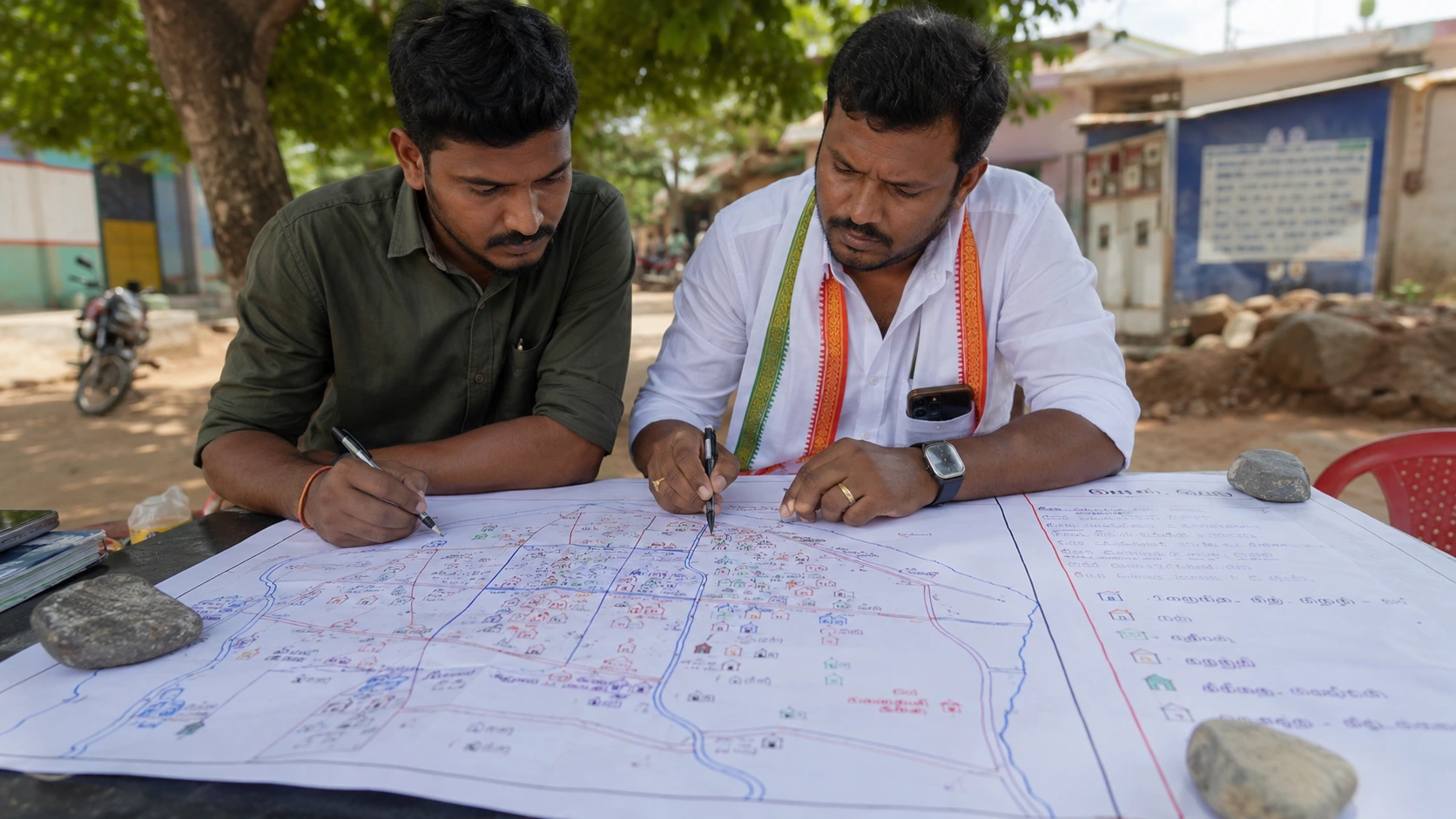
Before any door-knocking, before any public meeting, before any WhatsApp group — you need a complete picture of your ward. This mapping exercise takes 3–5 days and forms the foundation of every subsequent campaign decision.
Step 1 — Obtain the Complete Voter List
The voter list (Electoral Roll) for your panchayat ward is available from the Tamil Nadu State Election Commission. Download it as a PDF or request it in Excel format from your local Block Development Office. Import it into a Google Sheet. This becomes your master canvassing document — every voter, tracked by contact status.
Step 2 — Street-by-Street Household Mapping
Walk every street in your ward with a trusted local supporter. Note which households are accessible (ground floor, gated apartment access, etc.), which are consistently occupied during morning vs evening hours, and which are known supporters of opposition candidates. Mark the voter list accordingly. This takes a full day in most wards but saves weeks of wasted canvassing effort later.
Step 3 — Community Group Identification
Map the key social groups in your ward: religious congregation groups, caste association networks, women’s self-help groups (SHGs), farmers’ cooperative members, and traders’ associations. These groups have existing communication networks and trusted leaders. A single SHG president who endorses you can influence 30–80 women voters whose trust she’s already earned.
Step 4 — Opposition Strength Assessment
Understand where your opponents are strong before you spend resources in those areas. A ward section that is 85% confirmed opposition votes is not worth 30 canvassing hours — those hours are better spent on soft supporters elsewhere. Our political survey services can conduct a ward-level voter sentiment assessment in 5–7 days, giving you a data-based map of where your support currently stands.
Ward-Level Voter Outreach: What Actually Works in Rural Tamil Nadu
Panchayat election campaigns in Tamil Nadu run on personal contact, not advertising. Here’s what moves votes at the ward level:
Door-to-Door Canvassing (Highest Impact)
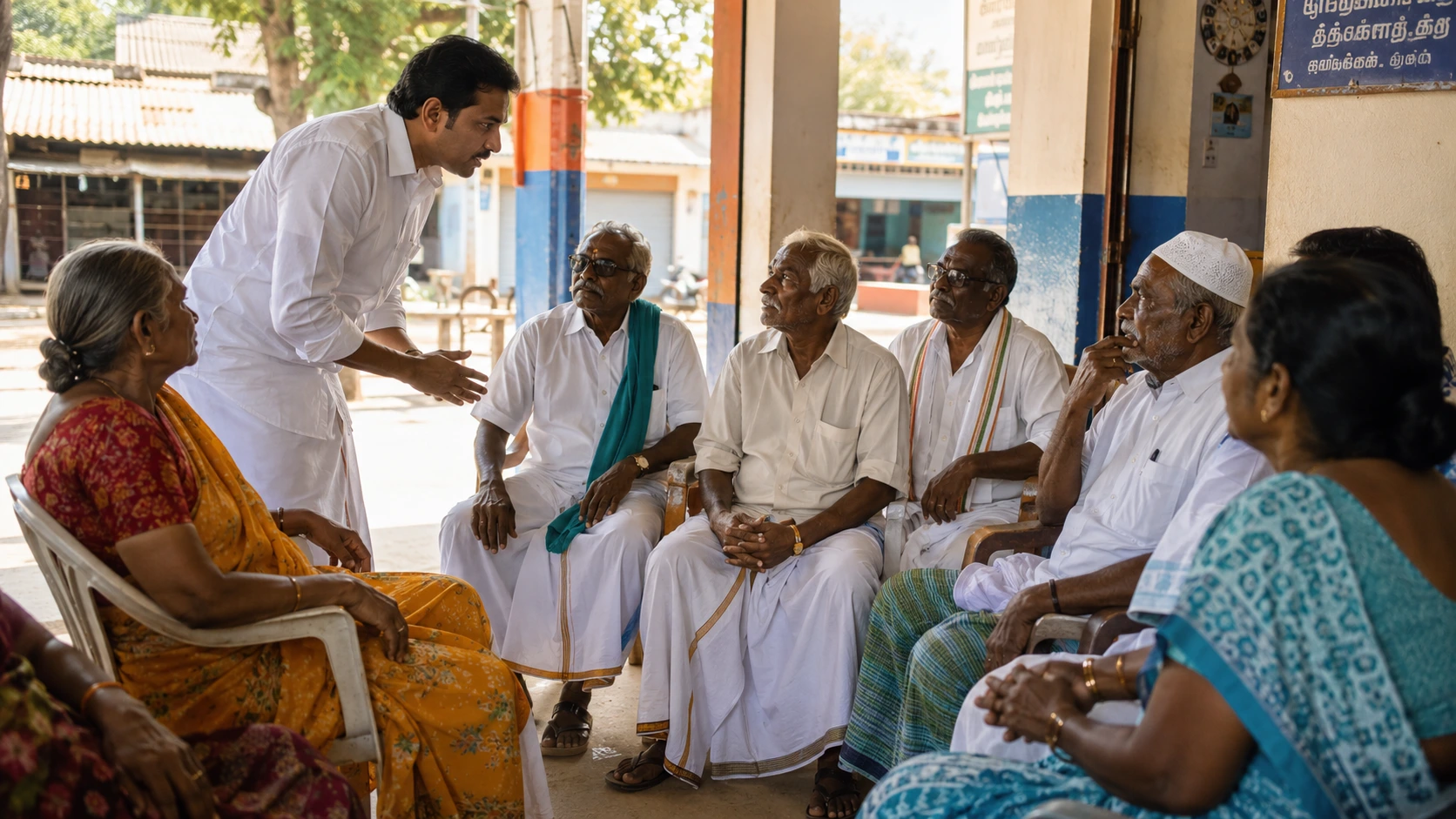
Visit every household in your ward at least once, ideally twice. The first visit identifies voter sentiment. The second visit, 2–3 weeks later, focuses on soft supporters and undecideds. Personal canvassing by the candidate themselves — not just by supporters — moves voters in a way that proxy canvassing can’t replicate in small panchayat contests where voters know who visited and who didn’t.
On the doorstep, lead with one local issue specific to that household’s street. Don’t deliver a campaign speech — have a conversation. Ask what the voter’s biggest frustration is. Listen. Commit to one specific, deliverable action if elected. Write it down in front of them. This visible commitment-making is more persuasive than any brochure. For full canvassing frameworks, see our guide to booth management in Tamil Nadu.
Women’s SHG Meetings (High Reach, Low Cost)
Tamil Nadu’s Self-Help Group network is one of the most active in India. Most village panchayats have multiple active SHGs meeting weekly or fortnightly. Attending two or three SHG meetings as a guest — listening to their concerns, answering their questions, and making specific commitments — gives a candidate access to a concentrated, organised voter bloc that is deeply influential within its community network.
Women’s SHGs are particularly valuable in Tamil Nadu panchayat campaigns because SHG members vote at significantly higher rates than the general population — 94% vs 82.5% for non-SHG women in a peer-reviewed study across Indian states (World Development, IFPRI, PMC, 2019). Group solidarity and peer accountability around civic participation mean that if the SHG president endorses a candidate, her members follow through at the polling booth at rates that rival the best-run party booth operations.
Community Events and Religious Functions
A candidate’s visible presence at temple festivals, local marriages, funeral functions, and community improvement events builds the personal reputation that wins panchayat elections over time. These aren’t “campaign events” — they’re community membership. Showing up consistently for two years before an election is the most effective long-term panchayat campaign strategy. If you’re starting from scratch, prioritise community events in the 90 days before the election in areas where your presence is least established.
Caste, Coalition, and Cross-Community Outreach in Tamil Nadu Panchayat Politics
Caste dynamics are a structural reality of Tamil Nadu panchayat politics. The dominant caste community in each ward — whether Thevar, Gounder, Nadar, Dalit communities, or others depending on the district — typically provides a base of support for candidates from that community. But in most Tamil Nadu panchayat wards, no single caste commands an outright majority of votes. Winning requires building a cross-caste coalition.
Cross-caste coalition building works through three channels:
- Issue-based appeal: A candidate who clearly owns a universally felt local problem — broken drainage that affects every household regardless of caste — builds a cross-community following around the issue rather than identity.
- Respected intermediaries: Identify 2–3 respected community figures from communities outside your own caste base. These may be schoolteachers, retired government officers, or long-serving SHG leaders. Their endorsement signals to their community that you’re a candidate for all voters, not only your own.
- Visible service history: If you’ve helped voters from other communities with government applications, documentation, or problem-solving in the years before the election, those voters remember. Service transcends caste in ways that campaign speeches don’t.
Our political strategy consulting team has mapped caste dynamics and coalition strategies for panchayat campaigns across Tamil Nadu’s 38 districts. Coalition strategy is designed district-by-district — what works in Tirunelveli doesn’t necessarily apply to Dharmapuri.
Polling Day Strategy: Mobilising Your Votes When It Counts
At 84.73% turnout, nearly everyone votes in Tamil Nadu panchayat elections. Your job on polling day is to make sure your confirmed supporters vote before your opponents’ mobilisation teams do. This means you need a real plan — not just “remind people to vote.”
Build a polling day operation with three elements:
- Transport coordination: Elderly voters, working-age voters who start shifts early, and mothers of young children are statistically the most likely to miss voting despite being confirmed supporters. On polling day, assign one supporter per 15–20 such voters to provide motorcycle or auto-rickshaw transport to the polling booth in the morning hours. Arrange this specifically, by name, at least 3 days before polling.
- Booth-level tracking: Station one supporter at or near the polling booth entrance (within legal distance). Their job is to cross-reference the voter list against who has voted by 9 AM, 12 PM, and 3 PM, and to report to you via WhatsApp. Confirmed supporters who haven’t voted by 1 PM get a personal phone call.
- Last-mile reminders: Between 7 AM and noon, your ward WhatsApp groups send three simple messages: “Polling is open. Please vote before going to work.” / “Reminder: polling booth closes at 5 PM. Please bring your voter ID.” / “If you need a ride to the booth, call [number] before 2 PM.”
This kind of systematic polling day operation — combined with the booth management infrastructure built over the preceding 45 days — is what converts a campaign with strong support into an actual win. Many Tamil Nadu panchayat campaigns lose not because they lacked supporters but because their supporters didn’t get to the booth.
Frequently Asked Questions: Panchayat Election Tamil Nadu
How many voters are there in a typical Tamil Nadu village panchayat?
Tamil Nadu has 12,620 village panchayats. Voter counts vary — coastal and agricultural panchayats average 2,000–4,000 voters; smaller hill panchayats may have 300–800. Each panchayat typically has 9–15 wards depending on population (Tamil Nadu State Election Commission, 2022).
What is the winning margin in most Tamil Nadu panchayat elections?
With 84.73% average turnout in 2022, most individual ward contests were separated by 50–300 votes. This makes 100% voter list coverage and strong polling day mobilisation absolutely critical — margins this tight are won or lost in the final hours of polling day.
Do caste dynamics affect Tamil Nadu panchayat elections?
Yes. Caste is a significant factor in rural panchayat politics, particularly in districts like Tirunelveli, Madurai, Ramanathapuram, and Salem. Successful candidates must either belong to the dominant community, build a cross-caste coalition, or address issues strong enough to override identity-based voting patterns.
How important is the local issue in a Tamil Nadu panchayat campaign?
Local issues are the primary voting factor. Voters choose based on who will fix visible local infrastructure problems — broken roads, drainage, streetlights, water supply. A candidate who makes specific, credible commitments to 2–3 visible problems wins the issue argument regardless of party affiliation.
How do I build a network across all wards in my panchayat?
Appoint one Ward Representative per ward (9–15 total). Each manages a WhatsApp group of 30–80 active supporters, conducts weekly voter contact, and reports weekly sentiment back to you. This network is your early warning system and your polling day mobilisation engine.
Planning a Panchayat Campaign in Tamil Nadu? Let’s Talk.
Think Politically advises candidates at every level — from individual panchayat wards to multi-constituency assembly campaigns. If you’re preparing for the next local body election cycle, we can help you build your ward map, develop your coalition strategy, and run your ground operations. Reach out today.
Get a free panchayat campaign consultation on WhatsApp
Tell us your ward and district — we’ll outline a strategy specific to your contest.
Sources: Tamil Nadu State Election Commission / Wikipedia (2022), 2022 Tamil Nadu Local Elections (wikipedia.org); DD News / Newsonair (2022), Tamil Nadu Records Voter Turnout of 5.75 Crore (newsonair.gov.in); Wikipedia, Local Elections in Tamil Nadu (wikipedia.org).
From Our Blog
Frequently Asked Questions
How do you win a panchayat election in Tamil Nadu?
Winning a Tamil Nadu panchayat election requires three things: comprehensive voter list verification (ward-level, not just gram panchayat), personal outreach to every household in the ward at least twice before election day, and a small but disciplined polling-day team to maximise turnout from your support base. Caste composition and family-network endorsements typically determine 60–70% of the vote in rural wards.
What is the voter turnout in Tamil Nadu panchayat elections?
Tamil Nadu panchayat elections consistently record 70–80% turnout, higher than assembly elections. Women’s participation is especially strong in village panchayat elections. This means thin margins — winning margins of under 50 votes are common — and last-mile voter mobilisation on polling day is often decisive.
How much does it cost to contest a panchayat election in Tamil Nadu?
ECI expenditure limits for gram panchayat ward member elections in Tamil Nadu are set at ₹10,000–₹20,000 depending on ward size. Actual campaign expenses including canvassing, voter outreach materials, and agent costs typically run ₹30,000–₹1,50,000 for competitive wards. Candidates must maintain an expense register and submit accounts to the Returning Officer within 30 days of the election.