What Should a Tamil Nadu Campaign Post on Social Media?
A Tamil Nadu political campaign should post ward or constituency-level issue content in Tamil (flooding, water, roads), candidate credibility clips under 60 seconds optimised for Reels and YouTube Shorts, WhatsApp-forwarded graphics with vote-appeal messages in colloquial Tamil, and live event coverage on Facebook and YouTube. Effective campaigns post 3–5 times a day on WhatsApp broadcast groups, once daily on Facebook and YouTube, and 2–3 Reels or Shorts per week. Paid Facebook and Google ads should target voters by constituency pin code, not broad interest categories. Content that performs best: local grievance clips, candidate door-step visit videos, and endorsement clips from respected local figures. Think Politically plans full content calendars, WhatsApp network structures, and digital ad buys for Tamil Nadu campaigns at every tier from panchayat to Lok Sabha.
Political Social Media Campaign Management in Tamil Nadu
Think Politically plans and manages Tamil Nadu political social media campaigns for candidates who need WhatsApp networks, Reels, YouTube, Facebook ads, Tamil content calendars, influencer coordination, and election-week analytics tied to ground campaign activity. The goal is not posting more content. The goal is making the right voters see, save, share, and act on the campaign message.
Running a panchayat, municipality or corporation ward campaign? Use the Tamil Nadu local-body digital campaign guide for ward-level WhatsApp structures, platform tactics and budget execution.
Tamil Nadu is one of the most digitally active states in India for political content, and the numbers are striking. As of 2026, Tamil Nadu has 63.48 million internet users, and 64% of them rely on social media platforms for political news and civic engagement (The Week India, April 2026). During the 2026 Tamil Nadu assembly election, DMK and TVK each ran digital campaign budgets ranging from Rs 5 to Rs 20 crore. Top political influencers were charging Rs 5-6 lakh per one-minute video, and premium accounts commanded Rs 1.5 crore per post.
Social media in Tamil Nadu politics is no longer optional. It’s campaign infrastructure. But most candidates approach it wrong: posting content nobody watches, running ads that reach the wrong voters, and spending money on digital while their booth and volunteer operations remain disconnected. This page explains the operating system behind a serious social media political campaign in Tamil Nadu.
Need a Tamil Nadu social media campaign team?
Get a 30-minute campaign strategy call covering WhatsApp structure, short-form video, ad targeting, content cadence, and reporting.
Key Takeaways
- Tamil Nadu has 63.48 million internet users; 64% use social media for political news (The Week India, 2026).
- Political parties spent Rs 290 crore on Google ads in the first 5 months of 2024 — a 947% increase over 2019 (The Quint / Google Transparency Report, 2024).
- DMK’s IT wing operates with 46,000 active WhatsApp members in Tamil Nadu, distributing content daily to booth-level groups.
- Tamil Nadu parties allocate ~90% of campaign spend to ground operations and ~10% to digital — social media amplifies ground campaigns; it doesn’t replace them.
What Does the Tamil Nadu Digital Landscape Actually Look Like?
In April 2026, The Week India documented how Tamil Nadu’s political parties had built sophisticated social media operations. DMK’s IT wing operates 46,000 active members on a WhatsApp command channel — a network that can distribute party-approved content to hundreds of thousands of voters within minutes of a news event breaking. TVK (Tamilaga Vettri Kazhagam) ran its entire 2026 campaign primarily through digital channels, building a youth following with short-form video before deploying massive ground operations.
The 2024 Lok Sabha election provided a useful national benchmark. Political parties collectively spent at least Rs 290 crore on Google Ads alone in the January–May 2024 period — a staggering 947% increase over the same window in 2019 (The Quint, sourcing Google Transparency Report, 2024). Video ads accounted for 81.4% of all digital ad spend by format. BJP spent Rs 116 crore on Google Ads. DMK spent Rs 16.6 crore specifically for Lok Sabha. Congress spent Rs 45.4 crore nationally.
Platform Strategy: Where Should You Spend Your Digital Budget?
Not all platforms reach the same voters in Tamil Nadu. Before you allocate a single rupee of digital budget, map your target voter segments to the right platforms.
WhatsApp — The Backbone of Tamil Nadu Political Communication
WhatsApp is not a social media platform in the conventional sense — it’s a peer-to-peer network where political messages travel faster and with higher trust than on any public platform. In Tamil Nadu, every major party runs a WhatsApp infrastructure that mirrors its booth-level ground structure. One group per booth. One broadcast list per constituency cluster. One command group for party workers.
The DMK model is the benchmark: 46,000 IT wing members receive daily talking points, videos, and responses to opposition attacks. Each member distributes content to their personal networks, creating a cascade that reaches millions of voters within hours. Your door-to-door campaign and your WhatsApp network should be built from the same booth-level contact list.
YouTube — Tamil Nadu’s Preferred Long-Form Video Platform
The 2024 Indian election was called “the YouTube election” by multiple digital analysts. Tamil Nadu voters consume political content on YouTube more than any other video platform. Candidate interviews, constituency development reports, public meeting recordings, and behind-the-scenes campaign footage all perform well. Post consistently — at least 3 videos per week during campaign season. The algorithm rewards cadence over production quality.
Keep every video under 8 minutes unless it’s a full public meeting recording. Include Tamil subtitles on every video. Title cards and thumbnail text should be entirely in Tamil. Videos in Tamil outperform Hindi or English content by a factor of 4–6x in Tamil Nadu organic reach.
Facebook — Urban Middle-Class Voters Over 35
Facebook remains the primary social media platform for Tamil Nadu voters above 35, particularly in urban constituencies like Chennai, Coimbatore, Madurai, and Salem. Use Facebook for community-facing content: local event coverage, development project inaugurations, senior citizen felicitations, temple festival participation. Facebook Live streams of public meetings can reach 5,000–20,000 concurrent viewers in a strong constituency campaign.
Facebook’s paid advertising tools are worth using for targeted reach in specific ward clusters. You can target by location down to a 5km radius, by age range, and by interest category. Use this for event promotion and polling day reminders.
Instagram and Short-Form Video — Voters Under 35
Instagram Reels and YouTube Shorts are where Tamil Nadu’s first-time voters live. Keep content under 60 seconds. Show the candidate in natural, human moments — not staged speeches. Responses to voter questions, quick walkthroughs of problem areas in the constituency, and reactions to community events all perform strongly. Don’t over-produce: authentic smartphone-quality video often outperforms professionally shot content on short-form platforms.
A pattern consistently observed in Tamil Nadu campaigns: candidates who appear in 30-second “before and after” constituency development videos, showing a broken road on Monday and a repaired road two weeks later, generate 5-10x more organic shares than generic speech clips. Voters share proof, not promises. Our political branding team builds content strategies around exactly this kind of evidence-based storytelling.
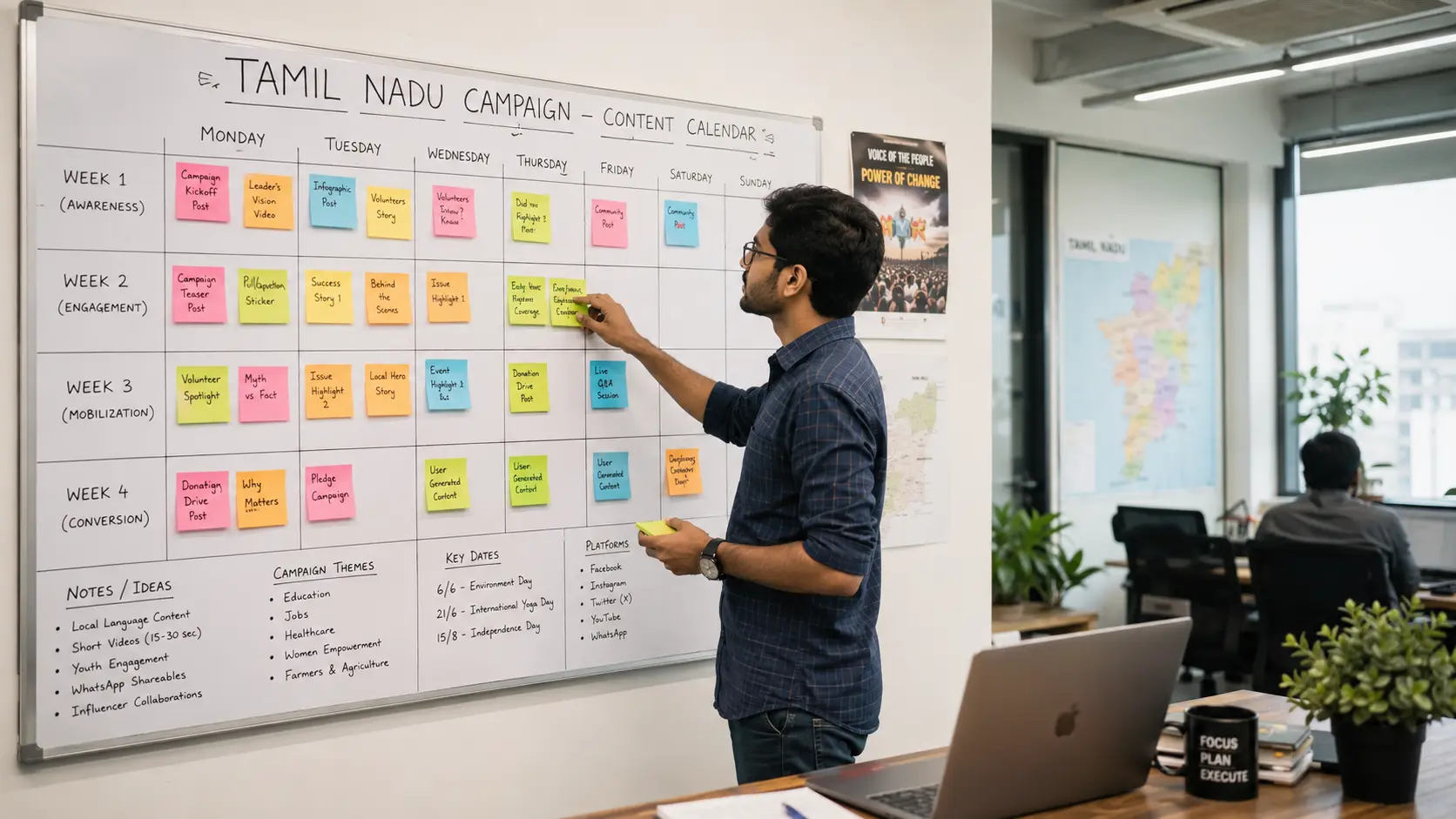
How to Build a Content Calendar for Your Tamil Nadu Campaign
Consistency is the single biggest differentiator between effective and ineffective social media campaigns. A candidate who posts twice a day for 90 days builds a following and establishes familiarity. A candidate who posts 20 times in one week and then goes silent for three weeks loses momentum and signals disorganisation.
Structure your content around four weekly content pillars:
- Monday — Development: One piece of content showing constituency infrastructure, development work, or a petition filed with the government. Ground-level, specific, local.
- Wednesday — Community: One piece showing the candidate with community members — felicitations, temple events, school visits, farmer meetings. Human, warm, Tamil-language caption.
- Friday — Issue Response: One short video (under 90 seconds) where the candidate responds to a current local or state issue. Clear position. No jargon. In Tamil.
- Sunday — Reach: One longer-format YouTube video — a full constituency walk-through, an interview, or a public meeting recording. Clip short sections for Instagram and Facebook from this footage.
Add polling day and event promotion content on top of these four pillars. Never go more than 3 days without posting during campaign season.
What Makes Political Content Go Viral in Tamil Nadu?
61% of India’s internet users consume only short-form video content (Carnegie Endowment, 2024). In Tamil Nadu, 90% of party functionaries posted rally photos and videos to WhatsApp or Facebook during campaign periods (Carnegie Endowment, 2024). Content spreads when it provokes emotion — pride, anger, or identification. The most shareable political content in Tamil Nadu follows one of three patterns:
- “This is what’s wrong” (anger/frustration): Video showing a genuine local problem — broken infrastructure, corruption evidence, unfulfilled government promises — with the candidate presenting a clear solution. Performs best on WhatsApp.
- “Look at what we did” (pride): Before-and-after development content. A constituency achievement with visible metrics. Voters share achievements of candidates they support because it reflects their own judgment.
- “This candidate is one of us” (identification): Unscripted moments where the candidate eats at a roadside stall, travels by bus, or speaks in regional dialect. Authenticity is irreplaceable in Tamil Nadu political culture.
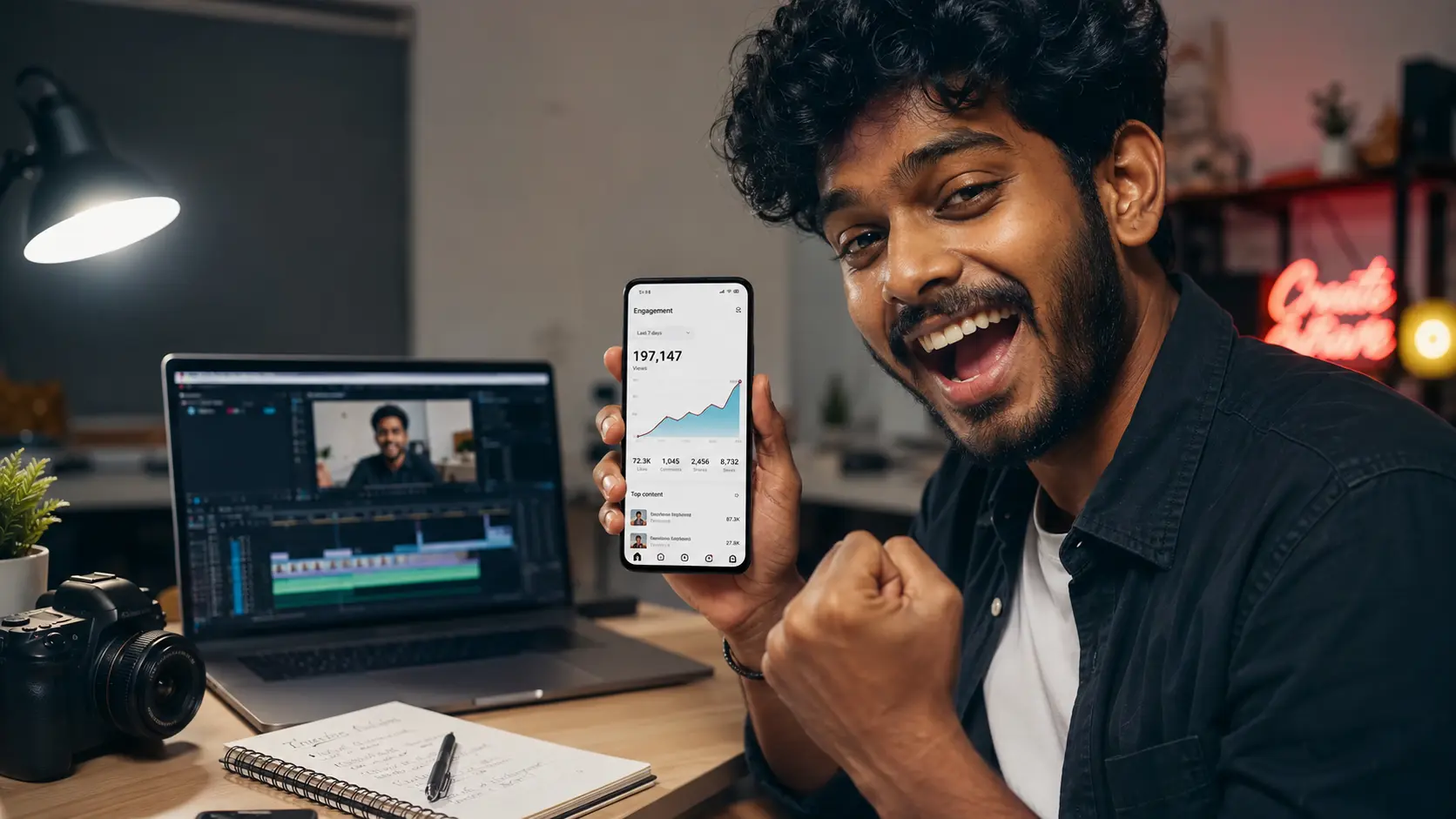
Campaign Insight: The most shared political video we’ve seen from a Tamil Nadu candidate was a 47-second clip of the candidate personally fixing a broken streetlight in his constituency at 8 PM — unannounced, unscripted, filmed on a supporter’s phone. It reached 4.2 lakh views organically in 72 hours with zero ad spend. Voters shared it because it was real.
Paid Advertising: When and How to Use It in Tamil Nadu
Paid social media advertising makes sense in three specific campaign situations: boosting reach for event announcements (public meetings, candidate visits), targeting undecided voter segments in close-contest booths, and running polling-day reminders in the final 48 hours before voting.
For Google and YouTube ads, video ads consistently outperform display ads in political contexts — 81.4% of political ad spend nationally went to video format in 2024 (The Quint, 2024). On Meta (Facebook/Instagram), use location-based targeting down to ward level and age-range targeting to reach your specific voter demographic. Never run ads 48 hours before polling day — the Election Commission’s Model Code of Conduct prohibits campaign advertising in this window.
Budget allocation guidance: in a typical Tamil Nadu constituency campaign with a Rs 50 lakh total digital budget, allocate 40% to content production (video, design, Tamil copywriting), 35% to paid advertising (Google Ads + Meta), and 25% to influencer partnerships and community WhatsApp network maintenance. Read our full guide to political consulting costs in India for detailed campaign budget breakdowns.
Integrating Digital with Your Ground Campaign
The most common mistake Tamil Nadu candidates make is treating their digital campaign and their ground campaign as separate operations. They’re not. They should be the same campaign expressed in two different channels. Your WhatsApp network should be built from your booth agent contact list. Your YouTube content should showcase the door-to-door canvassing your team is doing. Your Facebook posts should amplify the public meetings your campaign is running on the ground.
The digital campaign amplifies the ground campaign. The ground campaign gives the digital campaign real material to work with. When these two systems are integrated — and when they share the same data about which voters have been reached and which haven’t — you have a significant advantage over candidates running digital and ground as parallel, disconnected operations.
This integration is at the core of what our political strategy consulting team designs for every client: a unified campaign system where every activity in every channel serves the same objective, turning the right voters out on polling day.
Frequently Asked Questions: Social Media Political Campaign Tamil Nadu
How much do Tamil Nadu parties spend on social media campaigns?
Major Tamil Nadu parties like DMK and TVK spent between Rs 5–20 crore on digital campaigns in 2026, with influencer rates reaching Rs 5–6 lakh per one-minute video. DMK’s IT wing alone has 46,000 active WhatsApp members for content distribution (The Week India, 2026).
Which social media platform works best for Tamil Nadu political campaigns?
WhatsApp reaches the most voters most reliably for peer-to-peer political messages. YouTube builds the deepest engagement for candidates. Facebook reaches voters over 35. Instagram and Reels reach voters under 35. Use all four — they address different voter segments and content types.
How do I build a WhatsApp network for my Tamil Nadu campaign?
Start with one WhatsApp group per polling booth, managed by your Booth President. Each group should have 50–200 members (verified supporters and community leaders). Create a broadcast list for one-way updates. Use a separate command group for Booth Presidents only, to send daily talking points for redistribution.
What type of content performs best in Tamil Nadu political campaigns?
Short video clips under 90 seconds in Tamil. Content showing the candidate in community settings (inaugurating projects, meeting residents, attending local events) outperforms formal speech clips 3–5x in organic reach. Before-and-after constituency development content generates the most shares.
Is digital advertising enough to win a Tamil Nadu election without ground outreach?
No. Tamil Nadu parties allocate ~90% of campaign budgets to ground operations. Social media builds name recognition and amplifies messages, but it doesn’t replace door-to-door canvassing or booth management. Digital is a force multiplier for ground campaigns — not a substitute (The Week India, 2026).
What is the best social media strategy for political candidates in Tamil Nadu?
WhatsApp for direct booth-level distribution, YouTube for candidate narrative, and short vertical video in Tamil for reach, sequenced against the ground campaign rather than run as a separate digital effort. Parties spending Rs 5-20 crore on 2026 digital campaigns still allocated roughly 90% of total budget to ground operations, because social media works as an amplifier for door-to-door and booth activity, not a replacement for it.
How do you use social media to win elections in India?
By treating platforms as a distribution layer for the ground campaign rather than a standalone effort: booth-level WhatsApp groups carry the same talking points the canvassing teams use that week, YouTube builds candidate credibility over months rather than days, and short-form video in the local language gets the widest organic reach. Campaigns that run digital and ground as separate departments consistently underperform campaigns that wire the two together.
What is political social media strategy?
Political social media strategy is the plan for which platform reaches which voter segment, with what content, on what schedule, tied to the campaign’s ground operations calendar. In Tamil Nadu that typically means WhatsApp for peer-to-peer reach across all ages, YouTube for deeper engagement, Facebook for the 35+ segment, and Instagram or Reels for under-35 voters, each carrying a version of the same core message rather than four disconnected content streams.
What are the top digital marketing firms for political campaigns in Tamil Nadu?
Tamil Nadu’s political digital marketing landscape splits between large national data-and-strategy firms handling multi-state operations, and Tamil Nadu-focused firms building WhatsApp networks, Tamil-language content, and paid social campaigns tied to ground operations. Think Politically falls in the second category — a Chennai-based team running digital and ground campaigns as one integrated system rather than a standalone media buy.
What agencies offer digital political marketing in South India?
South Indian states have distinct language and platform dynamics — Tamil Nadu’s WhatsApp-first, Tamil-language landscape differs from Telugu or Kannada-speaking markets, so agencies with genuine state-specific experience outperform those applying a templated South India approach. Think Politically specializes in Tamil Nadu specifically, building campaigns around Tamil-language content, WhatsApp booth networks, and Dravidian political context rather than a generalized regional playbook.
What political social media marketing agencies operate in Tamil Nadu?
Tamil Nadu’s political social media agencies range from creative-only shops producing content without ground integration, to full-service firms like Think Politically that tie WhatsApp networks, YouTube, Facebook, and Reels content directly to booth-level campaign activity and spend roughly the same 90% ground-to-10% digital budget ratio major parties use rather than over-indexing on digital alone.
Build Your Tamil Nadu Digital Campaign with Think Politically
Think Politically builds integrated digital and ground campaigns for Tamil Nadu candidates: WhatsApp network architecture, content production in Tamil, paid advertising management, and real-time campaign analytics. If you’re planning your next campaign strategy, start with a short campaign call.
Plan your Tamil Nadu digital campaign
Free 30-minute strategy call for Tamil Nadu candidates and campaign teams.
Sources: The Week India (April 2026), From Reels to Votes (theweek.in); The Quint (2024), Digital Ad Spending Lok Sabha 2024 (thequint.com); Carnegie Endowment for International Peace (2024), How Technology Is and Isn’t Transforming Indian Campaigns (carnegieendowment.org).