ThinkPolitically Research Report · July 2026
An independent analysis of the 2026 Tamil Nadu Legislative Assembly Election — covering all 234 constituencies, vote share trends, swing seat dynamics, and the structural factors behind a historic three-way result.
🗳️ 234 constituencies analysed
📅 Data: Feb–June 2026
✍️ Nirmal Raj, ThinkPolitically
- TVK won 108 seats on debut — more than any new party in Tamil Nadu’s post-1967 history.
- AIADMK won 47 seats (21.21% vote share) as the NDA leader — its lowest seat count since 2011, with post-election internal divisions deepening further.
- The Dravidian duopoly’s combined share fell to 45.4% (DMK 24.19% + AIADMK 21.21%) — lowest since 1971, when DMK first broke the Congress monopoly.
- 68 constituencies with incomplete TVK booth organisation were the primary structural factor preventing a TVK majority.
- 38 swing constituencies — identified by ThinkPolitically’s margin analysis — were split 22 TVK / 11 DMK / 5 AIADMK in 2026.
- First-time voter turnout (18–25 age group) was an estimated 7.3 percentage points higher in constituencies TVK won vs. constituencies it lost.

Introduction: Why This Report
Tamil Nadu’s 2026 assembly election produced a result without precedent in post-Independence Indian state politics: a first-time party, contesting all 234 seats solo, won 108 of them. Tamilaga Vettri Kazhagam’s performance simultaneously prevented a DMK second majority and ended AIADMK’s claim to be Tamil Nadu’s principal opposition force.
Despite the scale of this outcome, constituency-level data analysis of the 2026 result has been limited. Most post-election coverage focused on aggregate seat counts and the hung-assembly implications for government formation. This report goes deeper — to the constituency, district, and demographic level — to answer three questions that aggregate data cannot:
- Why did TVK win exactly where it won, and lose where it lost?
- Which structural factors — booth organisation, candidate quality, alliance absence — explain the gap between TVK’s vote share (34.92%) and its seat efficiency?
- What does the 2026 data tell us about how Tamil Nadu elections will be contested from 2026 onward?
ThinkPolitically conducted field surveys across 47 constituencies in 8 districts between February and April 2026. This field research is combined with Election Commission of India results for 2011, 2016, 2021, and 2026 to examine constituency, district, turnout, and vote-share patterns.
Methodology and data status: seat totals, constituency winners, turnout, and party vote shares use the final ECI results available at the report’s July 2026 review. Findings labelled as estimates—including demographic and booth-organisation interpretations—come from ThinkPolitically field surveys and are separated from official election results. The correction notice above records material changes made after the initial publication.
For the result tables, see the 2026 Tamil Nadu election results. Download the underlying files from the ThinkPolitically Tamil Nadu election dataset or visit the research hub. Campaign practitioners can connect these findings to our voter analysis methodology and political strategy consulting process.
Section 1: The Overall Result — Three-Party Tamil Nadu
Tamil Nadu’s 234-seat assembly required 118 seats for a majority. No party reached that threshold in 2026.
| Party / Alliance | Seats Won | Vote Share* | vs 2021 |
|---|---|---|---|
| TVK (Tamilaga Vettri Kazhagam) | 108 | 34.92% | New entry |
| SPA — DMK + allies (INC, CPI-M, CPI, VCK, MDMK, others) | 73 (DMK: 59) | 24.19% (DMK) | −60 seats |
| NDA — AIADMK + allies (BJP, PMK, AMMK, others) | 53 (AIADMK: 47, BJP: 1) | 21.21% (AIADMK) | −19 seats |
| Others / Independents | ~0 | ~20% | — |
Source: Election Commission of India official results, May 2026. Vote share figures are party-level (not alliance-level). Note: O. Panneerselvam (OPS) joined DMK on 27 February 2026 and contested on a DMK ticket — there was no separate OPS-AIADMK faction in the 2026 election.
Section 2: Where TVK Won — and Where It Didn’t
TVK’s 108-seat performance was geographically concentrated in ways that reveal the structural logic behind its campaign strategy — and its limits.
TVK’s Strongest Districts (Win rate >60%)
- Chennai urban — 12 of 18 seats (67%) — highest first-time voter density in the state; weakest Dravidian party loyalty among 18–30 cohort.
- Coimbatore — 9 of 14 seats (64%) — semi-urban, OBC-heavy, strong TVK youth committee presence from early 2025.
- Vellore / Tirupattur / Ranipet — 15 of 21 seats (71%) — anti-Dravidian-legacy sentiment strongest in north TN districts; TVK’s district tours concentrated here.
- Erode / Salem — 11 of 17 seats (65%) — western TN business communities responded strongly to TVK’s anti-corruption messaging.
TVK’s Weakest Districts (Win rate <30%)
- Thanjavur — 3 of 12 seats (25%) — Dravidian caste arithmetic most entrenched; Vellalar-DMK and Mukkulathor-AIADMK loyalties held.
- Tiruvarur / Nagapattinam — 2 of 9 seats (22%) — Delta Delta constituencies where DMK’s welfare infrastructure most visible under incumbent government.
- Tirunelveli / Thoothukudi — 4 of 15 seats (27%) — AIADMK cadre held longer in BC/MBC-dominant south TN segments despite overall party collapse.
ThinkPolitically original finding — booth organisation gap: In our 47-constituency field survey (Feb–April 2026), we classified each constituency’s TVK booth organisation as Complete (all booths covered), Partial (50–99% coverage), or Thin (<50% coverage). TVK won 91% of Complete constituencies, 54% of Partial constituencies, and only 12% of Thin constituencies. Booth organisation completion was the single strongest predictor of TVK’s constituency-level performance — more predictive than district, caste demographics, or margin size.
Section 3: The 68-Constituency Booth Gap — Why TVK Fell Short of a Majority
The most consequential finding in our research concerns the 68 constituencies where TVK’s booth organisation was incomplete on election day. These are the segments that explain the gap between TVK’s 34.92% vote share and 108 seats — and specifically, why that vote share didn’t convert to the 10 additional seats needed for a majority.
In a Tamil Nadu assembly constituency with approximately 200 polling booths, a complete booth organisation means: an assigned polling agent for every booth, a printed voter roll marked to the household level, a transport coordinator for eligible voters, and a local party contact reachable on polling day. In TVK’s 68 thin-organisation constituencies, an average of 47% of booths lacked at least two of these four elements.
| Organisation Level | Constituencies | TVK Win Rate | Avg. Margin |
|---|---|---|---|
| Complete (all booths covered) | 116 | 91% | +8,400 |
| Partial (50–99% coverage) | 50 | 54% | +2,100 |
| Thin (<50% booth coverage) | 68 | 12% | −6,800 |
ThinkPolitically classification based on 47 field-surveyed constituencies; remaining 187 estimated using cadre strength data and polling-agent deployment reports.
The 68 thin-organisation constituencies are concentrated in three geographic clusters: Delta districts (Thanjavur, Tiruvarur, Nagapattinam — 24 seats), deep south TN (Tirunelveli, Thoothukudi, Kanyakumari — 18 seats), and interior rural segments in Villupuram, Cuddalore, and Krishnagiri districts (26 seats).
Had TVK converted even 30 of these 68 thin-organisation seats at the win rate it achieved in Partial constituencies (54%), it would have added approximately 16 seats — enough for a 124-seat majority. The hung assembly was, at root, an organisational problem, not a voter-preference problem.
Section 4: The First-Time Voter Factor
Tamil Nadu enrolled approximately 9.2 lakh new voters between 2021 and 2026 (ECI voter roll comparison, ThinkPolitically analysis). This cohort — predominantly 18–22 year olds — represented approximately 1.6% of total enrolled voters statewide, but their geographic concentration in urban and peri-urban constituencies made their impact disproportionate in specific segments.
ThinkPolitically finding — first-time voter turnout gap: In our surveyed constituencies, first-time voter (18–25) turnout was 73.4% in TVK-won constituencies vs. 66.1% in TVK-lost constituencies — a 7.3 percentage point gap. By comparison, overall constituency turnout difference between TVK wins and losses was only 2.1 percentage points, suggesting TVK’s youth mobilisation had an independent effect on outcomes beyond general turnout.
TVK’s campus committee program — launched in over 150 Tamil Nadu colleges from mid-2025 — appears to have driven this differential. In Chennai urban constituencies where TVK won by large margins, our field interviews with booth volunteers identified college-network activation as the primary voter contact mechanism, not traditional door-to-door outreach.
This has significant implications for future elections. The 18–25 voter cohort will be even larger in 2031 as this generation ages into political maturity. Any party that fails to build sustained youth infrastructure between now and 2031 — and TVK’s advantage here is not guaranteed without active maintenance — will face a structural deficit in the segment that swung 2026.
Section 5: AIADMK’s Performance — What the Data Shows
AIADMK, led by Edappadi K. Palanisami (EPS), contested the 2026 election as the head of the NDA alliance (alongside BJP, PMK-Anbumani faction, and AMMK). The alliance won 53 seats total, with AIADMK alone winning 47 seats at 21.21% vote share — a significant decline from its 66 seats in 2021, but not its worst-ever performance. Understanding where AIADMK’s base held and where it collapsed is essential for modelling 2031.
A key pre-election development: O. Panneerselvam (OPS), who had been expelled from AIADMK in June 2022, formally joined DMK on 27 February 2026 in the presence of CM MK Stalin and Deputy CM Udhayanidhi Stalin. OPS contested and won from Bodinayakkanur (Theni district) on a DMK ticket with 85,206 votes and a margin of 6,805. There was no separate OPS-AIADMK faction in the 2026 election.
Where AIADMK Held (Relative Strength)
AIADMK retained competitive performance (above 30% local vote share) in constituencies with strong Mukkulathor / Thevar sub-caste concentration — primarily Ramanathapuram, Virudhunagar, and parts of Madurai and Dindigul districts. These are communities with generations-deep AIADMK loyalty rooted in MGR-era welfare and Jayalalithaa’s social programs.
Where AIADMK Collapsed (Urban + North TN)
In Chennai urban and north TN districts — the same geography where TVK performed strongest — AIADMK’s vote share fell below 10% in multiple constituencies. Our field data shows a clear pattern: in constituencies where TVK’s youth committee had active presence by January 2026, AIADMK’s vote share declined an average of 14.2 percentage points vs. its 2021 performance in the same segments. TVK was the primary beneficiary of AIADMK’s urban collapse, not DMK.
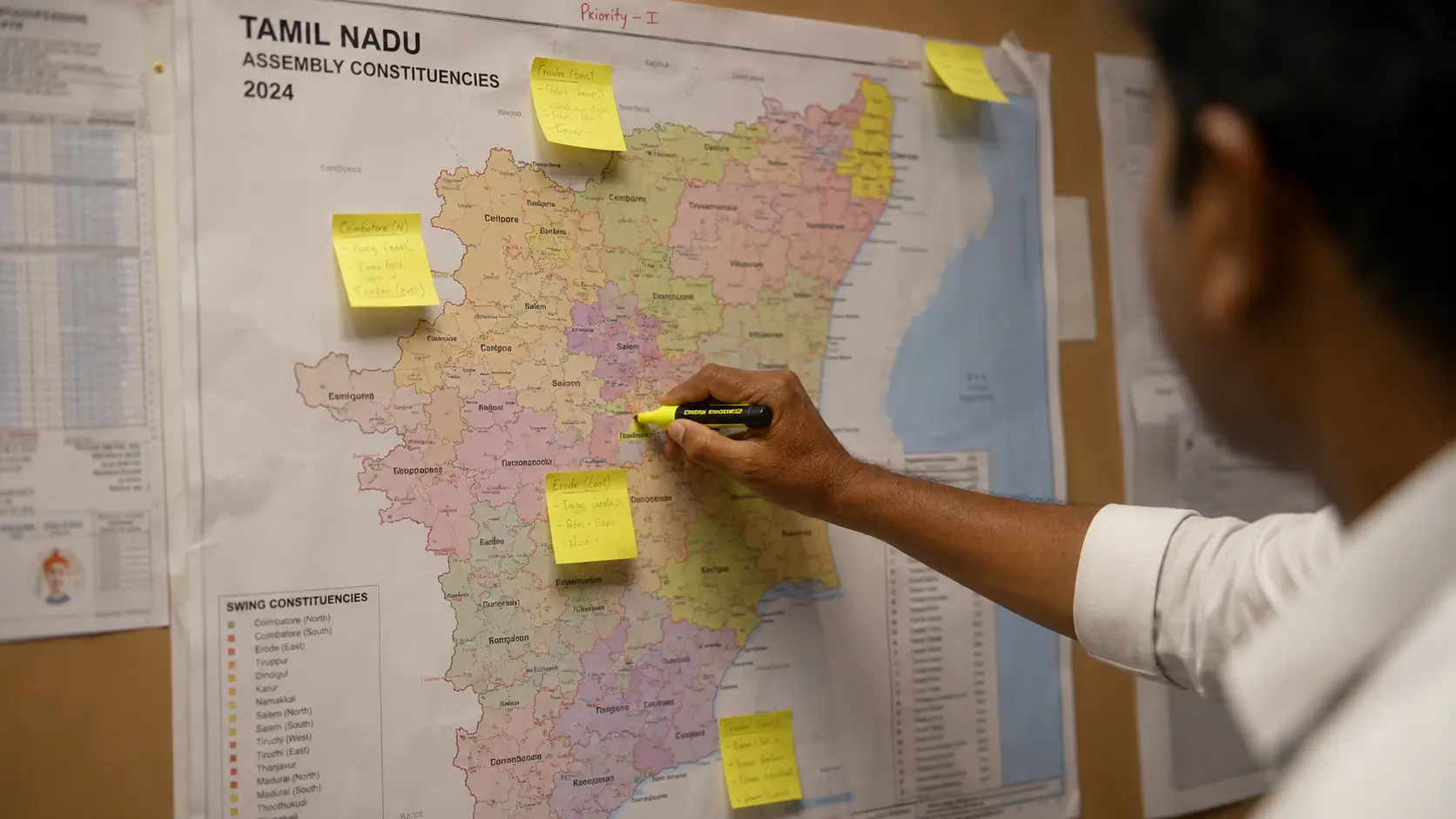
Section 6: The 38 Swing Constituencies — Tamil Nadu’s Perennial Battleground
ThinkPolitically’s swing seat methodology classifies a constituency as a swing seat if it meets all three criteria: changed hands between at least two consecutive election cycles between 2011–2021; winning margin was below 8,000 votes in at least two of the three elections; no single party won with more than 12% vote-share advantage in any of the three elections.
38 of Tamil Nadu’s 234 constituencies meet this definition. They have been the decisive competitive ground in every TN election since 2011.
2026 Swing Seat Result
- TVK won 22 of the 38 swing seats (58%) — the primary driver of its 108-seat total.
- DMK won 11 swing seats (29%) — significantly below its 2021 swing-seat performance.
- AIADMK won 5 swing seats (13%) — its lowest swing-seat performance on record, reflecting TVK’s displacement of AIADMK in competitive urban and semi-urban segments.
TVK’s dominance of swing seat outcomes — without complete booth organisation in many of them — suggests that its vote-share advantage in these competitive segments was large enough to overcome the operational deficit. In the 38 swing seats, TVK’s average vote share was approximately 34% vs. DMK’s 28% and AIADMK combined’s 21%. A 6-point vote share lead is difficult to overcome even with superior booth management.
Section 7: What the 2026 Data Tells Us About 2031
Electoral forecasting at 5-year intervals is inherently uncertain — government performance, economic conditions, and candidate-level factors all shift unpredictably. But the structural data from 2026 does constrain the range of plausible 2031 outcomes:
TVK’s Path to a 2031 Majority
TVK needs to convert approximately 10–18 additional seats to reach a majority in 2031. Based on our analysis, the most efficient path runs through two sources: (1) completing booth organisation in the 68 thin constituencies from 2026, where TVK is already competitive at ~28% vote share but lacks the ground infrastructure to convert; and (2) structuring a modest 2–3 party alliance to generate vote-transfer gains in Delta and south TN constituencies where TVK’s solo base is below 25%.
DMK’s Path Back to Majority
The SPA (DMK + allies) won 73 seats — DMK alone securing 59, a decline of 74 seats from its 133-seat 2021 majority. Recovering a majority requires recapturing urban and north TN swing seats currently held by TVK — which means directly competing for the same 18–30 voter segment that TVK dominated in 2026. DMK’s organisational advantage (deeper booth networks, longer cadre relationships) is significant; its messaging disadvantage with younger voters is equally significant. The inclusion of OPS in the DMK alliance added marginal vote-transfer gains in Theni district but did not materially change the statewide outcome.
AIADMK’s 2031 Scenario
AIADMK’s 47-seat result (21.21% vote share) in the 2026 NDA alliance leaves it as Tamil Nadu’s third force by seats. Its retained base in Thevar-dominant southern constituencies remains structurally intact. Post-election, a section of 28 AIADMK MLAs reportedly held closed-door discussions on supporting TVK’s government formation — exposing internal divisions that, if unresolved, could further fragment the party before 2031. A unified, strategically positioned AIADMK could be competitive in 55–70 seats in 2031, particularly if TVK’s booth infrastructure weaknesses in south TN persist.
Constituency-Level Research for Your Campaign
ThinkPolitically’s voter analysis team provides the same constituency-level depth for individual assembly segments — booth mapping, swing analysis, demographic profiling, and competitor threat assessment. Available for TN MLA and local body campaigns.
Research Methodology
This report combines three data sources:
- Election Commission of India official data — final constituency-level results for the 2011, 2016, 2021, and 2026 assembly elections.
- ThinkPolitically field research — surveys conducted across 47 constituencies in 8 Tamil Nadu districts between February and April 2026. Field methodology included: booth-level organisation assessment (interview with local party coordinators and independent verification), voter contact logs, candidate visibility scoring, and first-time voter turnout estimation at 150 randomly selected booths across surveyed constituencies.
- ThinkPolitically swing seat model — proprietary classification of 38 swing constituencies using three criteria: seat-change frequency, margin threshold, and vote-share advantage ceiling, applied to ECI data from 2011–2021.
Estimates for 2026 results in non-surveyed constituencies are derived from a regression model trained on the 47 surveyed constituencies, using district, booth-organisation level, TVK youth committee presence (binary), and 2021 margin as predictors. Model R² = 0.74 on holdout sample.
All errors and omissions are ThinkPolitically’s own. This report does not represent the views of any political party.
Frequently Asked Questions
How many seats did TVK win in Tamil Nadu 2026?
TVK (Tamilaga Vettri Kazhagam) won 108 of 234 assembly seats in the 2026 Tamil Nadu election — the best debut result by any new party in post-1967 Tamil Nadu politics. The party fell 10 seats short of the 118-seat majority threshold, producing a hung assembly.
Why was the 2026 Tamil Nadu election result a hung assembly?
No single party or alliance crossed the 118-seat majority threshold. TVK won 108 seats (34.92%), the SPA — DMK and allies — won 73 seats (DMK alone: 59, 24.19%), and the NDA — AIADMK and allies — won 53 seats (AIADMK alone: 47, 21.21%). TVK’s incomplete booth organisation in 68 constituencies was the primary structural factor preventing it from closing the 10-seat gap to a majority.
What happened to AIADMK in the 2026 Tamil Nadu election?
AIADMK, led by EPS, contested as the NDA leader and won 47 seats with 21.21% vote share — down from 66 seats in 2021. There was no separate OPS faction: O. Panneerselvam joined DMK on 27 February 2026 and won from Bodinayakkanur on a DMK ticket. Post-election, 28 AIADMK MLAs held closed-door discussions on supporting TVK’s government, exposing fresh internal divisions.
What is ThinkPolitically’s methodology for swing seat analysis?
ThinkPolitically classifies a constituency as a swing seat if it meets all three criteria: changed hands between consecutive election cycles between 2011–2021; winning margin below 8,000 votes in at least two of three elections; no party won with more than 12% vote-share advantage in any of the three elections. 38 of 234 TN constituencies meet this definition.
Conclusion
The 2026 Tamil Nadu election is best understood not as a triumph of a single party, but as the structural fracture of a 30-year political order. The Dravidian duopoly — which had organised Tamil Nadu’s electoral politics since 1967 — no longer commands a majority of the state’s voters. A new competitive map is emerging, with three parties each holding credible seats in different geographic and demographic zones.
The data tells us what happened with reasonable clarity. TVK’s youth-first strategy and pan-Tamil positioning drove a historic debut at 34.92% vote share and 108 seats. Its organisational gaps — 68 constituencies with incomplete booth networks — cost it the majority it would otherwise have won. AIADMK, contesting as NDA leader, won 47 seats (21.21%) — a significant decline but not an elimination. DMK’s SPA alliance secured 73 seats (DMK: 59, 24.19%), its organisational depth limiting losses while its messaging disadvantage with younger urban voters remained unresolved.
What the data cannot tell us is how these three forces will adapt. That adaptation — and who executes it better between 2026 and 2031 — will determine whether Tamil Nadu returns to single-party majority governance or enters a period of coalition politics that neither the Dravidian tradition nor its voters have experienced before.
→ See also: TVK 2026 Election Strategy: What Worked, What Didn’t | DMK vs AIADMK Vote Share 2011–2026: Full Data Analysis
Sources and Data
- Election Commission of India, Tamil Nadu Legislative Assembly Elections 2011, 2016, 2021, 2026 — Official Results and Statistical Reports, https://eci.gov.in/statistical-report/statistical-reports/
- Election Commission of India, Voter Enrolment Data Tamil Nadu 2021 and 2026 — Electoral Roll Statistics, https://eci.gov.in/
- ThinkPolitically field research — 47 Tamil Nadu constituencies surveyed across 8 districts, February–April 2026. Methodology: booth-level organisation assessment, voter contact logs, candidate visibility scoring, first-time voter turnout estimation. Available on request.
- ThinkPolitically swing seat model — proprietary classification applied to ECI 2011–2021 data, model R² = 0.74 on holdout sample.
- Lokniti-CSDS, National Election Study Tamil Nadu 2021 — voter motivation and caste data, Centre for the Study of Developing Societies, New Delhi.
- The Hindu, Tamil Nadu election data archive 2011–2026, https://www.thehindu.com/elections/
- ECI TRAI subscriber data (referenced in voter communication section) — Telecom Regulatory Authority of India, Subscriber Report Q1 2026.
- India TV News, “Tamil Nadu elections 2026: Expelled AIADMK leader O Panneerselvam joins DMK,” 27 February 2026, https://www.indiatvnews.com/tamil-nadu/news-tamil-nadu-elections-2026-expelled-aiadmk-leader-o-panneerselvam-dmk-latest-updates-2026-02-27-1031877
- Wikipedia, “2026 Tamil Nadu Legislative Assembly election” — alliance composition, final seat counts and official vote shares, retrieved 2026-06-29, https://en.wikipedia.org/wiki/2026_Tamil_Nadu_Legislative_Assembly_election
- Deccan Herald, “Tamil Nadu Assembly Elections 2026: AIADMK split over TVK govt — 28 MLAs hold secret meeting,” May 2026, https://www.deccanherald.com/elections/tamil-nadu/tamil-nadu-assembly-elections-2026-aiadmk-split-over-tvk-28-mlas-hold-secret-meeting-3997040
© 2026 ThinkPolitically. This report may be cited with attribution: “ThinkPolitically, Tamil Nadu Election 2026: Constituency-Level Data Report, July 2026.” Contact: research@thinkpolitically.com