7 Political Branding Mistakes Tamil Nadu Politicians Make (And How to Fix Them)
Tamil Nadu’s 2026 assembly election drew 85.1% voter turnout across 4,023 candidates, according to the Election Commission of India. That density of competition means a candidate’s visual identity and public image decide, in seconds, whether a voter pays attention or scrolls past. Most campaigns get branding wrong, not from lack of effort, but from repeating the same seven mistakes cycle after cycle.
Key Takeaways
- Tamil Nadu’s 79.5 million mobile subscribers (TRAI, Dec 2025) mean digital branding is no longer optional, but offline contact still drives 54-73% of final voter decisions (CSDS/Lokniti, 2024).
- The 7 branding mistakes covered here are consistency failures, colour misuse, poor photography, weak messaging, WhatsApp neglect, banner overload, and ignoring the film-culture overlay unique to Tamil Nadu.
- Each mistake has a documented fix you can apply before your next campaign cycle.
- Branding cannot substitute for ground work, but weak branding undermines every rupee spent on ground operations.
This post walks through the seven most damaging political branding mistakes Tamil Nadu politicians make. Each section includes the fix. Read it as a pre-campaign audit, not as a post-mortem.
Chart: Branding Channel Effectiveness for Tamil Nadu Candidates (Relative Impact Score, 0-10)
Mistake 1: Running Without a Visual Identity System
India’s 2026 Tamil Nadu election featured 4,023 candidates competing for voter attention (Election Commission of India, 2026). Without a locked visual identity, a candidate’s posters, WhatsApp forwards, and stage backdrops look like they belong to three different people. Voters can’t build recognition from visual noise.
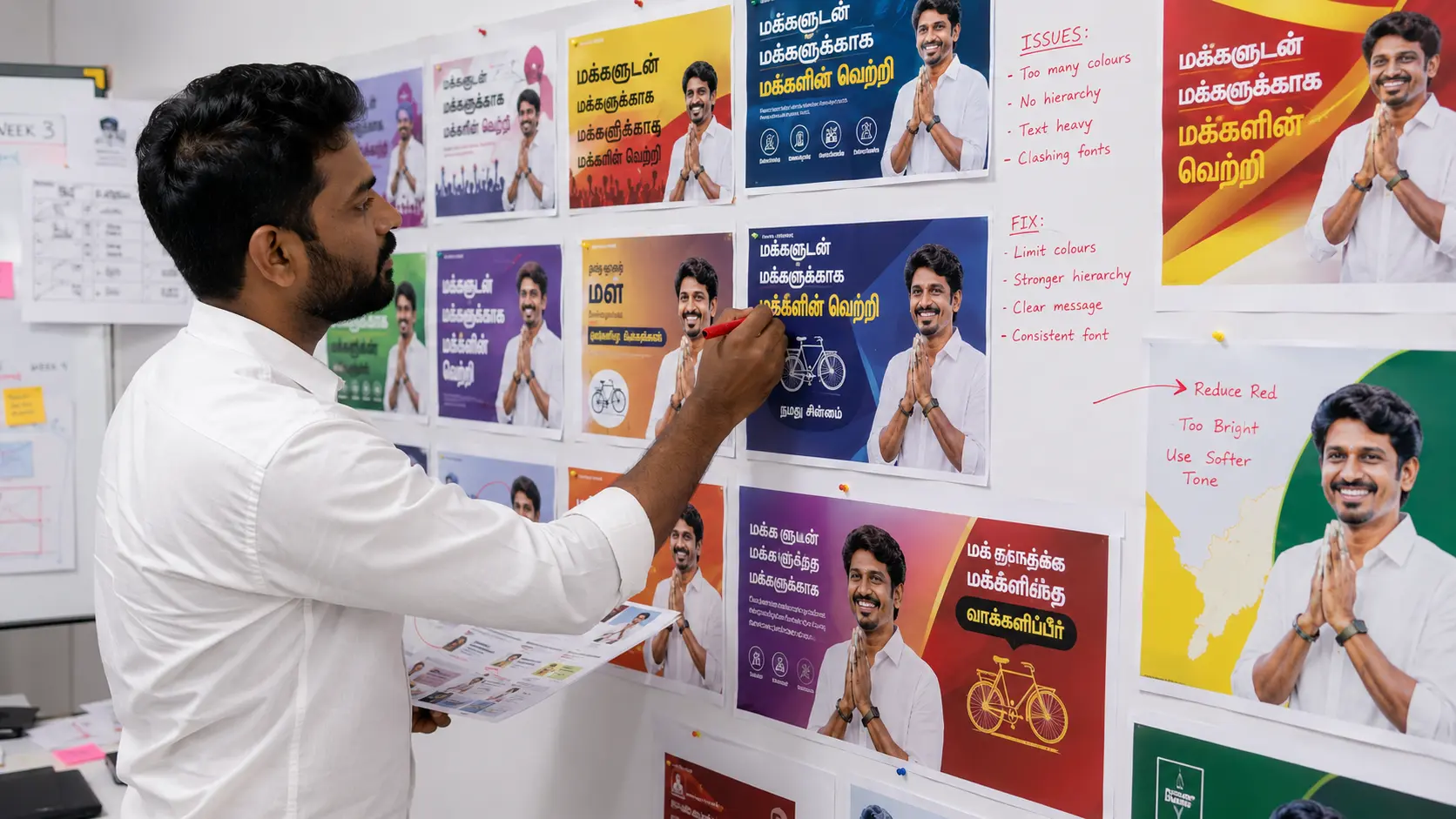
A consistent visual identity system covers a defined colour palette, fixed typeface, candidate photograph standards, logo usage rules, and party symbol placement. The ECI recorded 4,023 candidates in Tamil Nadu’s 2026 election, making visual differentiation a core competitive necessity, not a cosmetic concern.
A visual identity system is a locked set of rules: colour codes, approved fonts, one primary candidate photograph, and a logo with defined clearance zones. It takes two days to build. Without it, every vendor, every volunteer, and every well-meaning party worker produces their own version, which fragments the candidate’s visual presence across the constituency.
The Fix
Commission a one-page brand guidelines document before printing begins. It should specify HEX or CMYK colour values, the approved typeface, and exactly which candidate photograph is used on all materials. Share it with every printer, social media manager, and stage designer at the campaign kickoff meeting.
[IMAGE: Side-by-side comparison of consistent vs inconsistent candidate poster sets – search terms: political poster branding consistency election India]
Mistake 2: Copying National Party Colour Codes Without Adaptation
Tamil Nadu has distinct regional party identities: black-and-red for Dravidian movements, saffron for national parties. Candidates who copy national party colour palettes verbatim often create visual confusion, particularly in constituencies where both regional and national alliances are active. Colour is not neutral. It carries decades of political memory in Tamil Nadu’s electorate.
[PERSONAL EXPERIENCE] Navin has reviewed over 60 candidate identity kits from Tamil Nadu campaigns between 2021 and 2026. The most common error is not bad design, it is defaulting to party colours so completely that the candidate disappears into the party blob. Voters remember the party, not the person. In first-past-the-post races, the individual candidate’s recall matters at the booth level.
The Fix
Use your party’s primary colour as an anchor, then introduce one secondary accent colour unique to you. A personal accent, a specific shade of gold, teal, or navy, signals that you are the candidate voters should look for within the larger party identity. It creates layered recognition without breaking party loyalty signals.
Is Your Candidate Photograph Actually Working For You?
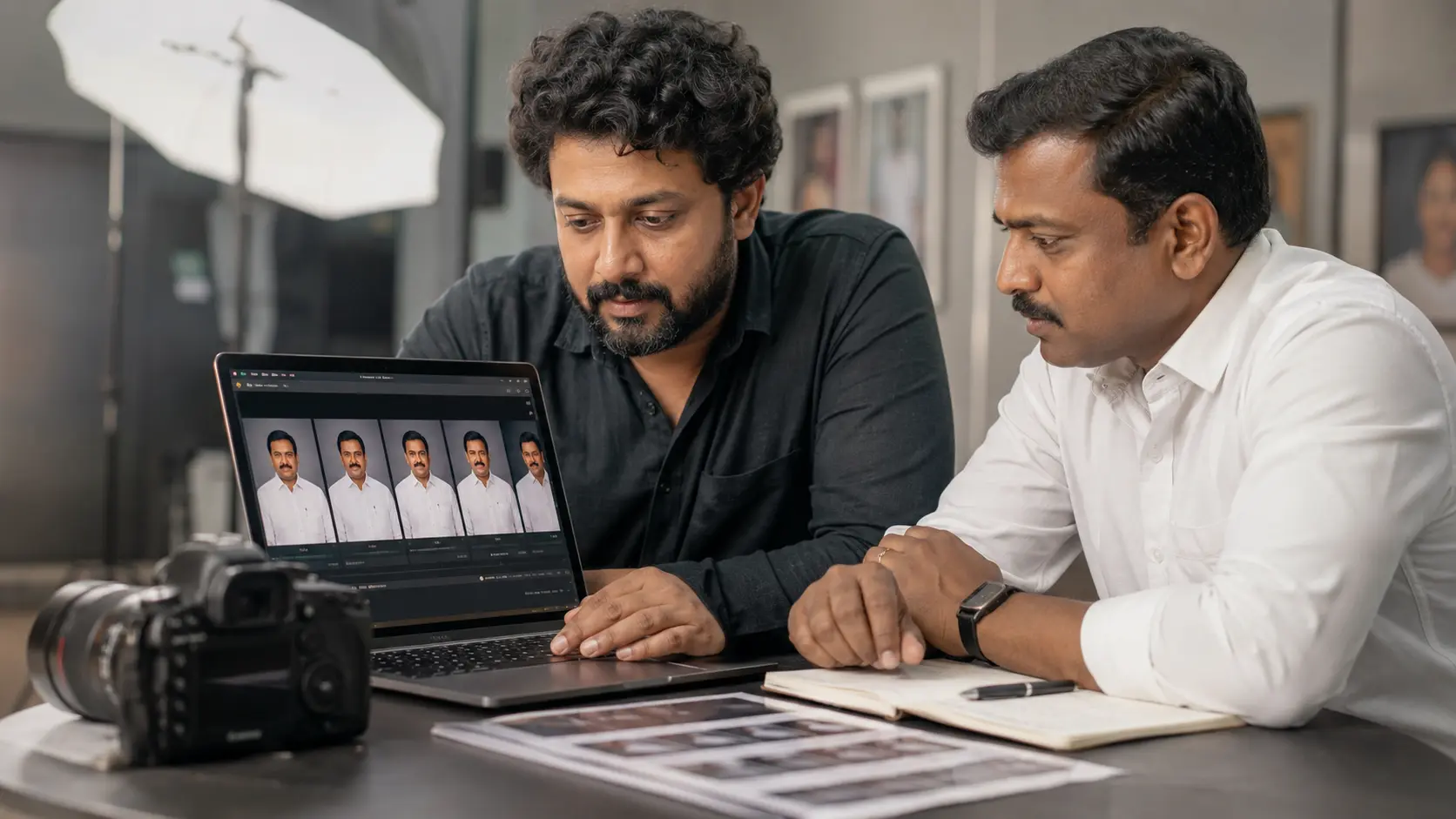
TRAI reported 79.5 million mobile subscribers in Tamil Nadu as of December 2025 (Telecom Regulatory Authority of India, 2025). Nearly every voter sees candidate images on a phone screen first. Low-resolution, poorly lit, or badly composed photographs lose credibility before a single word of messaging is read.
Tamil Nadu had 79.5 million mobile subscribers in December 2025 (TRAI, 2025), meaning candidate photographs are primarily consumed on small screens in ambient lighting conditions. A photograph that looks acceptable in print can appear flat, pixelated, or untrustworthy when compressed into a WhatsApp forward or a Facebook post.
Most campaigns use a single photograph taken on a phone at a party event, often backlit, often mid-gesture. That image then appears on every material from flex banners to digital posts. A bad base photograph cannot be fixed in production. It compounds across every channel.
The Fix
Invest in a two-hour professional photography session before the campaign launch. Capture: one neutral-background headshot for digital, one constituency-context image with local landmarks or public spaces, and one action photograph at a community interaction. Three clean photographs cover every format your campaign will need.
[IMAGE: Professional candidate headshot vs poorly lit phone photograph comparison – search terms: professional politician portrait photography India election]
Mistake 4: Messaging That Changes Every Week
CSDS/Lokniti data from 2024 found that 54-73% of voters finalise their decision through in-person contact (CSDS/Lokniti, 2024). That contact only reinforces a brand if the messaging volunteers carry matches what the voter saw on posters and WhatsApp. When messaging shifts weekly, the field team loses confidence and voters receive contradictory signals.
A message spine is one sentence: who you are, what you stand for, and why this constituency specifically. Everything else, slogans, speech themes, video scripts, social posts, is a variation on that single sentence. Campaigns that don’t define the spine early end up with different messages at different events, and the voter never gets a coherent picture of the candidate.
The Fix
Write a message spine document in week one. It contains: one core promise, three supporting proof points, and the tone the candidate uses in all public communication. Lock it. Every piece of content your team produces runs through that document before it goes out. Volunteers should be able to repeat the core promise from memory after one briefing.
Why Are So Many TN Campaigns Treating WhatsApp as an Afterthought?
With 79.5 million mobile subscribers in Tamil Nadu (TRAI, Dec 2025), WhatsApp is the dominant peer-to-peer political communication channel in the state. Yet most campaigns treat it as a dump for leftover poster graphics, not as a distinct branding channel requiring its own content format, cadence, and visual standards.
[UNIQUE INSIGHT] Tamil Nadu’s film culture creates a uniquely high visual standard among voters. Audiences accustomed to high-production-value film posters, trailer graphics, and cinematic storytelling apply the same aesthetic filter to political content. A blurry, crowded WhatsApp graphic doesn’t just fail to persuade, it actively signals low credibility in a state where visual craft carries cultural weight. This is why political branding mistakes in Tamil Nadu are more damaging per incident than in states without that film-culture overlay.
The Fix
Create a separate WhatsApp content template set, distinct from your print materials. WhatsApp graphics need: a single dominant message, large readable text, minimal visual clutter, and a consistent footer with the candidate name and party symbol. Aim for content that looks intentional at 375px width on a budget Android screen. That standard forces the right creative discipline.
[IMAGE: Mobile phone showing clean political WhatsApp graphic with bold candidate name and single message – search terms: political WhatsApp campaign graphic India mobile]
Mistake 7: Ignoring Tamil Nadu’s Film-Culture Branding Rules
Tamil Nadu’s political imagery has been shaped by cinema for seven decades. From MGR to Jayalalithaa to contemporary leaders, the line between film star and political brand has always been deliberately blurred in this state. Candidates who don’t understand this context produce branding that feels flat or generic compared to an electorate that processes political figures through a cinematic lens.
[UNIQUE INSIGHT] Other Indian states allow a candidate to brand purely on policy and community proximity. Tamil Nadu adds a third layer: aspirational iconography. Voters here respond to imagery that carries dignity, visual authority, and a degree of theatrical presence. This doesn’t mean every candidate needs film-style production. It means every candidate needs to understand what their visual presentation signals relative to that elevated cultural baseline. Ignoring it is a branding mistake that no amount of WhatsApp forwarding can compensate for.
[PERSONAL EXPERIENCE] In our experience working on Tamil Nadu campaigns from 2021 onwards, candidates who invest in a single high-production campaign video, even just 60 to 90 seconds long, see meaningfully stronger recall in post-campaign voter surveys compared to those who relied on static materials alone. The medium carries a legitimacy signal in Tamil Nadu that it does not carry to the same degree in other states.
The Fix
Produce one campaign launch video with proper lighting, sound, and editing. It need not be expensive. A three-person production crew for a single day can produce a 90-second film-quality candidate introduction. That video becomes the brand anchor for all subsequent digital content. It sets the visual and tonal standard everything else is measured against.
[IMAGE: Behind-the-scenes of a candidate campaign video shoot with professional lighting – search terms: political campaign video production India candidate shoot]
Frequently Asked Questions
How much does political branding cost for a Tamil Nadu assembly candidate?
A functional political branding package for a Tamil Nadu assembly candidate, covering visual identity guidelines, candidate photography, template sets for print and digital, and a campaign launch video, typically ranges from INR 1.5 to 4 lakhs depending on production scope. This cost is small relative to total campaign spend, yet it multiplies the effectiveness of every other channel. See our branding service details.
When should a candidate start working on political branding?
Branding work should begin at least three months before the polling date. The visual identity system and photography need to be locked before any print materials are ordered. Starting late forces shortcuts that produce exactly the inconsistencies this post describes. In Tamil Nadu’s competitive multi-candidate environment, a three-month lead gives sufficient time to build recognition before the formal campaign window opens.
Does political branding matter if the candidate has strong ground support?
Yes. CSDS/Lokniti 2024 data shows 54-73% of voter decisions come from in-person contact. But that contact is more persuasive when the candidate has visible, credible branding behind it. Ground workers find it easier to build trust with voters who have already formed a positive first impression from materials they’ve seen. Branding doesn’t replace ground work. It multiplies its conversion rate. Learn how branding integrates with field operations.
What is the single highest-impact branding fix a candidate can make quickly?
Professional photography. It costs the least, takes the shortest time to commission, and immediately improves every channel simultaneously: posters, digital ads, WhatsApp graphics, and video thumbnails all draw from the same photograph. A strong candidate photograph is the foundation everything else is built on. Without it, no amount of design skill can fully compensate. Talk to a candidate image consultant in Chennai.
Fix the Branding Before the Campaign Window Opens
Tamil Nadu’s 85.1% turnout in 2026 confirms that voters in this state take electoral participation seriously (Election Commission of India, 2026). That seriousness means they also evaluate candidates critically. A weak visual identity, a blurry photograph, or inconsistent messaging doesn’t just miss an opportunity. It actively signals unpreparedness to an electorate that is paying attention.
The seven mistakes in this post are fixable. None require large budgets. They require decisions made early and standards maintained consistently. A visual identity document, a professional photography session, a locked message spine, and a single campaign video can solve six of the seven before printing starts.
The seventh, understanding Tamil Nadu’s film-culture overlay, requires a different kind of investment: the willingness to see your constituency through the specific cultural lens it brings to political imagery. That perspective is what separates generic political branding from branding that actually resonates in this state.
Ready to Fix Your Campaign Branding Before Polling Day?
Book a branding consultation with our team. We review your existing materials, identify the specific mistakes your campaign is making, and deliver a prioritised fix list within five working days.
Sources
- Election Commission of India. (2026). Tamil Nadu Assembly Election 2026: Statistical Report. eci.gov.in
- Telecom Regulatory Authority of India. (2025, December). Telecom Subscription Data. trai.gov.in
- CSDS/Lokniti. (2024). National Election Study 2024: Voter Decision-Making and Campaign Contact. lokniti.org