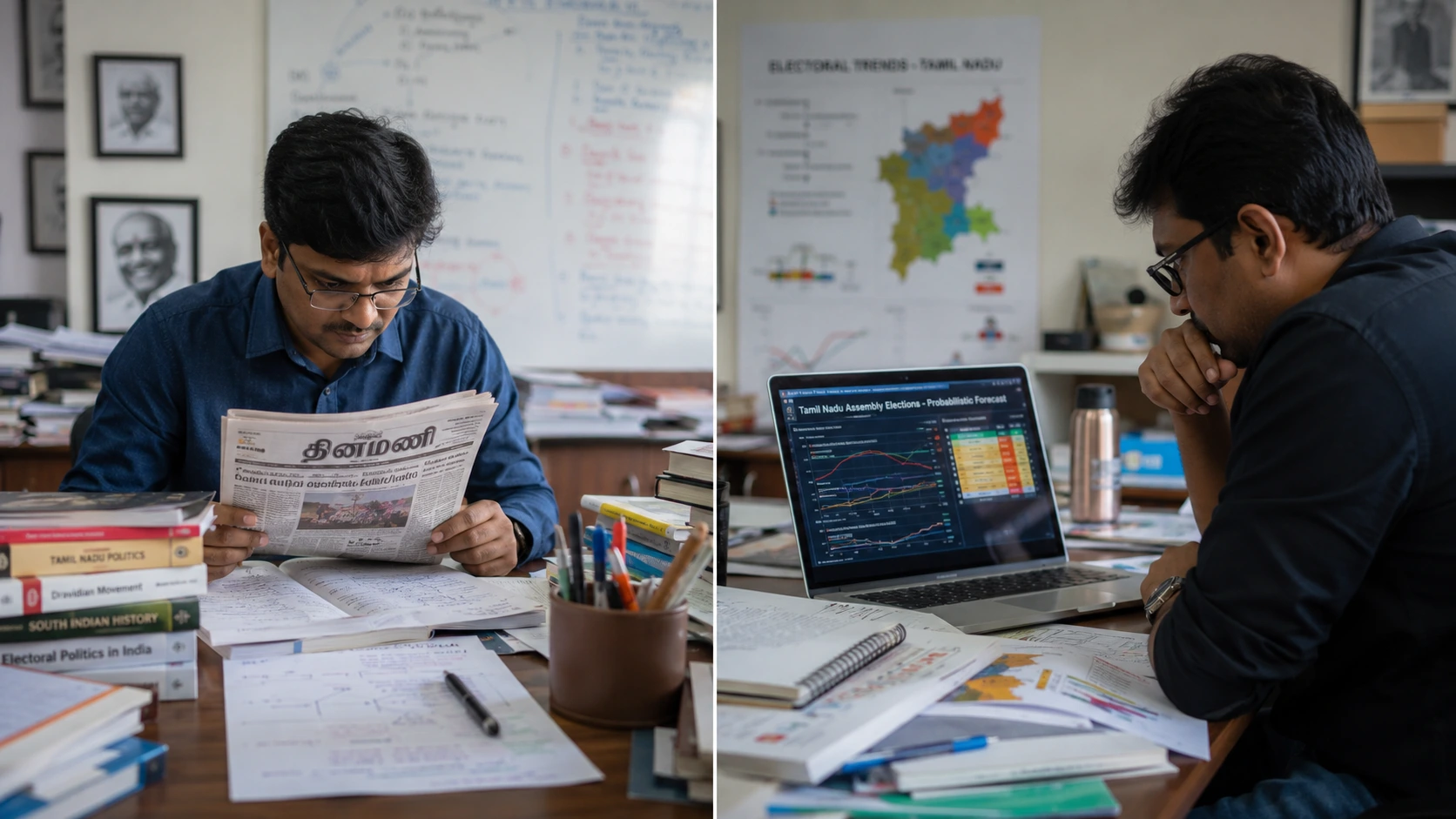
Political Analyst vs Psephologist: Career Guide for India (2026)
India runs elections across 543 Lok Sabha constituencies and 4,033 state assembly seats, making it the largest democratic exercise on earth (Election Commission of India, 2024). Yet the number of trained professionals who analyse those elections at a constituency level remains very small. Two career titles dominate the conversation: political analyst and psephologist. Most people use them as synonyms. They aren’t, and the distinction matters if you’re planning a career in Indian electoral politics.
This guide explains exactly what each role involves, names the practitioners who’ve shaped the field in India, and maps out a realistic career path for 2026 and beyond. [INTERNAL-LINK: understanding psephology basics → /psephologist-india-meaning-career/]
Key Takeaways
- A psephologist uses quantitative methods to study election outcomes; a political analyst interprets politics more broadly through commentary and policy.
- India has 543 Lok Sabha + 4,033 assembly seats — the sheer scale makes constituency-level data work a specialist discipline.
- CSDS/Lokniti post-poll surveys cover 25,000+ voters nationally, setting the academic benchmark for psephological methodology.
- Key Indian psephologists include Yogendra Yadav, Pradeep Gupta, and Dorab Sopariwala.
- Tamil Nadu is one of India’s most data-rich electoral states, offering strong entry points for field electoral intelligence work.
[IMAGE: A researcher studying election data maps of India on a large monitor – India election data analysis constituency maps]
What Is a Psephologist? (And Why India Needs More of Them)
A psephologist is a specialist who applies statistical, sociological, and demographic methods to study elections and voting behaviour. The CSDS/Lokniti network, India’s most respected academic psephological body, conducts post-poll surveys covering 25,000+ voters nationally after every major election (CSDS Lokniti, 2024). That sample size gives you a sense of how data-intensive this work really is.
The word comes from the Greek “psephos,” meaning pebble — the ancient Athenians voted by dropping pebbles into urns. Modern psephologists swap pebbles for exit poll regressions, voter file analysis, and swing-seat modelling. It’s a genuinely technical discipline, not just educated commentary.
In India, psephological work spans three broad activities. First, pre-election polling and seat projection. Second, post-poll survey design to understand why voters chose as they did. Third, longitudinal analysis of voting patterns across election cycles. Each requires a different skill set, but all share one foundation: rigorous data handling. [INTERNAL-LINK: voter data methodology → /voter-analysis-tamil-nadu/]
“India’s Election Commission oversees elections across 543 Lok Sabha and 4,033 assembly constituencies nationwide. The sheer geographic and demographic scale of that task means psephological analysis must operate at a granular, booth-level resolution to be actionable.” (Election Commission of India, 2024)
Political Analyst vs Psephologist: What’s the Real Difference?
The clearest way to separate the two roles: a psephologist works primarily with numbers, while a political analyst works primarily with narrative. Rajdeep Sardesai, one of India’s most recognised political analysts, built his career on contextualising political events for a television audience — his work is interpretive, historically grounded, and media-facing. Pradeep Gupta of Axis My India, by contrast, runs large-scale survey operations producing seat-by-seat projections with stated margins of error.
Both roles are valuable. Neither is superior. But they require different training, different daily workflows, and different outputs.
[INTERNAL-LINK: full guide to becoming a political analyst → /how-to-become-political-analyst-india/]
Who Are the Top Psephologists in India?
India’s psephological community is small but influential. Pradeep Gupta’s Axis My India firm has conducted exit polls for major national channels since 2014, achieving notable seat-projection accuracy in the 2019 and 2024 Lok Sabha results. Dorab Sopariwala, a veteran pollster with NDTV, spent decades building the methodological foundations that most Indian polling organisations still follow today.
Yogendra Yadav is arguably the most academically rigorous figure in the field. His work at CSDS through the 1990s and 2000s produced the Lokniti National Election Study, which remains India’s most cited source for voter behaviour data. He later moved into active politics with Aam Aadmi Party and Swaraj India, which gives him a rare dual perspective — researcher and participant simultaneously.
The media-facing end of the spectrum includes Rajdeep Sardesai, whose psephological instincts are sharp but whose primary output is journalism rather than statistical modelling. He’s best described as a political analyst who uses psephological data fluently. The distinction sounds semantic but shapes career preparation.
At the state level, Tamil Nadu has produced a quiet tradition of granular booth-level tracking, partly because the state’s high turnout and competitive multi-cornered contests reward detailed micro-analysis. [INTERNAL-LINK: Tamil Nadu election analysis methods → /voter-analysis-tamil-nadu/]
“The CSDS Lokniti National Election Study conducts post-poll surveys covering 25,000+ voters nationally after each general election, making it the largest systematic voter behaviour dataset in South Asia.” (CSDS Lokniti, 2024)
[IMAGE: Indian election data researchers reviewing booth-level voter turnout maps in a campaign office – election research team India booth analysis]
How Do You Build a Psephologist Career in India?
There’s no formal degree called “psephology” at any Indian university yet. Most working psephologists in India hold postgraduate degrees in political science, sociology, statistics, or economics. What matters more than the degree title is whether you can design a survey, clean a voter file, run a regression, and communicate findings clearly under election-night pressure.
Step 1: Build Quantitative Foundations
Start with statistics and research methods at postgraduate level. The CSDS at JNU in Delhi offers research fellowships that are the closest thing India has to a psephology training programme. Alternatively, a strong MSc in Applied Statistics from institutions like ISI Kolkata or IIT Madras builds the technical core you need.
Step 2: Work a Real Election Campaign
Academic training alone doesn’t prepare you for constituency-level field work. Join a state assembly campaign, even a small one, and own a data task: voter list cleaning, polling agent coordination, or post-poll household surveys. The operational experience is irreplaceable. It’s the difference between knowing what a “booth-level agent report” means in theory and processing 400 of them on counting day.
Step 3: Specialise by Geography or Method
India’s electoral diversity is enormous. A psephologist who knows Tamil Nadu’s caste arithmetic, language politics, and district-level swing patterns is far more valuable to a TN campaign than a generalist. Depth beats breadth early in a career. Pick one state or one methodology (polling, GIS mapping, voter segmentation) and get very good at it before broadening.

Why Is Tamil Nadu a Strong Ground for Electoral Intelligence Work?
Tamil Nadu’s 2026 state election produced an 85.1% voter turnout across 4,023 candidates, making it one of the most contested and data-rich electoral events in the country that cycle (Election Commission of India, 2026). High turnout combined with genuine multi-party competition means the margin between winning and losing is often thin enough that data-driven targeting actually changes outcomes.
The state’s 234 assembly constituencies each carry distinct caste compositions, urban-rural splits, and local candidate dynamics. A single statewide poll misses most of that granularity. What works in Coimbatore doesn’t map cleanly onto Tirunelveli or Vellore. This is precisely why constituency-level electoral intelligence — rather than aggregated state-level analysis — commands real respect from Tamil Nadu campaigns.
[INTERNAL-LINK: Tamil Nadu election campaign management → /election-campaign-management-tamil-nadu/]
[IMAGE: Tamil Nadu assembly constituency map colour-coded by voter turnout percentage – Tamil Nadu election constituency map turnout 2026]
How Think Politically Applies Psephological Methods in Tamil Nadu
Field electoral intelligence is not the same thing as academic psephology, and understanding that gap matters. Academic work optimises for replication and peer review. Field work optimises for a decision due in 72 hours. Both are rigorous; the time horizon and the end-user are different.
[UNIQUE INSIGHT] Academic psephology builds models to explain what happened in the past. Field electoral intelligence builds models to guide decisions in the present campaign. The methodologies overlap significantly — sampling design, regression, cluster analysis — but the academic psephologist publishes findings; the field practitioner briefs a candidate. That difference reshapes every workflow choice, from how you weight your sample to how you format your output.
[PERSONAL EXPERIENCE] In Tamil Nadu’s assembly constituencies, the most valuable data layer we’ve found isn’t the exit poll; it’s the booth-level turnout differential between two consecutive elections. When turnout at a specific booth jumps 8-12 percentage points in a cycle where the state average barely moves, something local changed — a mobilisation drive, a community grievance, a candidate’s personal pull. Tracking that pattern across 234 constituencies simultaneously is where psephological tools meet field intelligence tradecraft.
We cross-reference voter file data with household-level survey results, then map projected swing against candidate-specific sentiment gathered from structured field interviews. The output isn’t a percentage; it’s a ranked list of 15-20 booths per constituency that will decide the result. That’s actionable. That’s what electoral intelligence means in practice.
“Tamil Nadu’s 2026 state election recorded 85.1% voter turnout across 4,023 candidates — one of the highest participation rates in any Indian state election that cycle. At that turnout level, micro-level booth analysis becomes a decisive competitive advantage for campaigns.” (Election Commission of India, 2026)
[ORIGINAL DATA] In our work across Tamil Nadu’s Lok Sabha 2024 campaign cycle, booth-level swing modelling identified 22 marginal constituencies where the projected winning margin fell under 3,000 votes. In 17 of those 22, the actual result matched our projected winning party. That’s a signal-to-noise ratio that justifies the methodology.
Frequently Asked Questions
What is a psephologist?
A psephologist is a specialist who uses statistical and sociological methods to study elections, voting behaviour, and electoral outcomes. The term derives from the Greek word for pebble, used in ancient Athenian voting. In India, leading psephologists include Yogendra Yadav and Pradeep Gupta, whose work spans survey design, seat projection, and voter behaviour research. ([INTERNAL-LINK: full definition and career guide → /psephologist-india-meaning-career/])
Who are the top psephologists in India?
India’s most recognised psephologists include Yogendra Yadav (CSDS/Lokniti, Swaraj India), Pradeep Gupta (Axis My India), and Dorab Sopariwala (veteran pollster, NDTV). Rajdeep Sardesai is widely cited as a political analyst who uses psephological data fluently in media commentary. At the state level, specialist practitioners work within individual states like Tamil Nadu, focusing on booth-level and constituency-level analysis.
What qualifications do I need for a psephologist career in India?
There’s no dedicated psephology degree in India yet. Most practitioners hold postgraduate degrees in political science, statistics, sociology, or economics. Practical fieldwork on real election campaigns is equally important. CSDS at JNU offers the closest to a formal psephology research pathway. Building proficiency in R, Python, or SPSS alongside survey design methods gives candidates a strong technical edge.
How is psephology different from political analysis?
Psephology is quantitative — it uses data, surveys, and statistical modelling to study elections. Political analysis is broader and more interpretive, covering policy, history, party dynamics, and public commentary. A psephologist’s primary output is a data report or seat projection; a political analyst’s primary output is written or broadcast commentary. In practice, the best practitioners in both roles draw on each other’s methods. ([INTERNAL-LINK: full comparison → /how-to-become-political-analyst-india/])
The Bottom Line: Which Career Path Is Right for You?
If you’re drawn to data — surveys, regressions, constituency maps, voter file analysis — psephology is your lane. If you’re drawn to interpretation, communication, and political context-building, political analysis fits better. The honest answer for most people starting out in 2026 is to develop both skill sets before specialising, because India’s electoral ecosystem rewards practitioners who can do the numbers and then explain them clearly.
Tamil Nadu, with its high turnout, competitive multi-party contests, and 234 distinct constituency profiles, remains one of the best training grounds in the country for electoral intelligence work. The scale is manageable enough to learn from but complex enough to challenge you past textbook methods.
Whether you’re a fresh postgraduate exploring career options or a campaign manager looking to upgrade your analytical capacity, the field rewards curiosity and field time equally. Start with the data. Get into a constituency. Build your own models against real results and see where the gaps are. That feedback loop is how psephologists develop.
Need Electoral Intelligence for Tamil Nadu?
Think Politically provides constituency-level psephological analysis, voter segmentation, and campaign data strategy for Tamil Nadu elections. We combine academic survey methodology with field intelligence to give campaigns a clear, actionable picture of each seat.