- Under the Conduct of Elections Rules, 1961, each candidate (or election agent) may appoint one polling agent and two relievers per polling station — untrained agents waste this allocation.
- Official polling agent handbooks recommend appointing agents at least 10 days before polling day, leaving time for structured training before election day itself.
- A trained agent’s core job is verifying the mock poll, tracking the movement sheet through the day, and reporting turnout back to a central coordination point — not campaigning inside the booth.
- Booth committees that rehearse a written checklist consistently outperform committees relying on verbal instructions alone, especially in multi-booth Tamil Nadu constituencies.
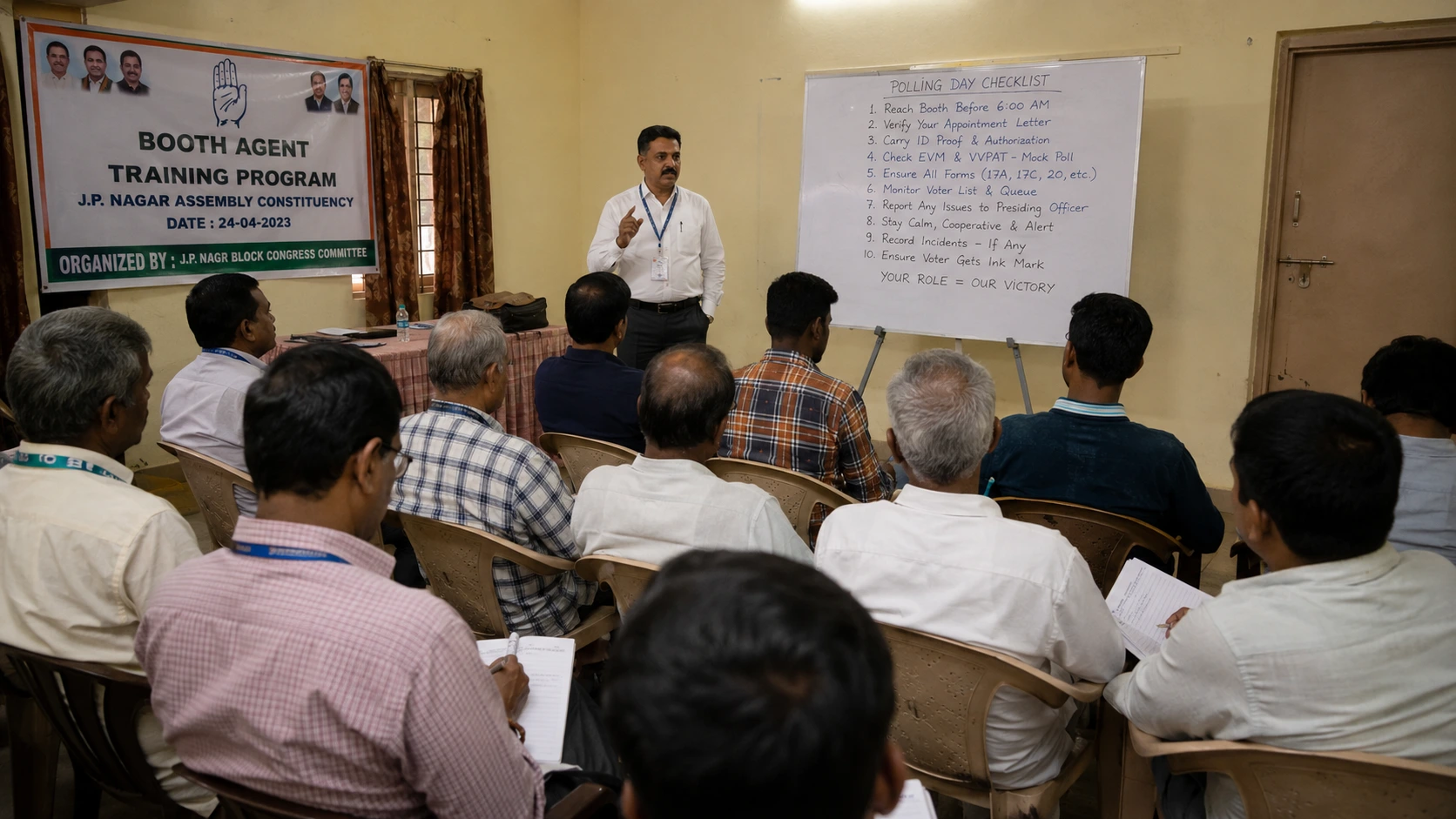
Every Tamil Nadu election is ultimately decided booth by booth. A campaign can have the best strategy, the best candidate, and the best digital presence in the constituency — and still lose ground on election day if its booth agents are undertrained.
Booth agent training is one of the most under-invested parts of Tamil Nadu campaign operations, largely because it happens in the final week before polling, under time pressure, with volunteers who may never have been inside a polling station before. This guide sets out a practical training structure, based on official polling agent handbooks issued by state Chief Electoral Officer offices and ThinkPolitically’s own field operations across Tamil Nadu constituencies.
For the broader booth management strategy this training sits inside, see our complete guide to booth management in Tamil Nadu.
Who Can Be Appointed as a Polling Agent in a Tamil Nadu Election?
Under the Conduct of Elections Rules, 1961, each candidate or their election agent may appoint one polling agent and up to two relievers at every polling station. This is a fixed, legally defined allocation — it cannot be expanded by having “extra” people present, so the person you appoint needs to be the most reliable, procedurally literate person available for that booth, not simply the most enthusiastic volunteer.
What to look for when selecting a booth agent
- Comfortable reading and filling structured forms under time pressure
- Locally known and trusted in that specific booth’s neighbourhood — outsiders draw scrutiny and are less effective at spotting irregularities
- Available for the full polling day, from before the mock poll to after counting-related sealing procedures
- Calm under pressure — booths can get tense, especially in closely contested wards
What Should Booth Agent Training Cover Before Polling Day?
Official handbooks for polling agents published by state election authorities lay out the core procedural duties every agent must understand before election day. Structure your internal training session around these five blocks.
1. Mock poll verification
Agents must arrive early enough to observe the mock poll and confirm the EVM and VVPAT are functioning correctly before real voting begins. Train agents to know exactly what a correct mock poll looks like, so they can recognise and flag a problem rather than assuming officials will catch everything.
2. Materials and movement sheet tracking
Pre-poll duties include understanding what materials are brought into the booth, tracking the movement sheet, and following sealing procedures at the close of poll. Give each agent a simple physical or printed checklist — do not rely on memory alone during a 10-12 hour polling day.
3. Voter identity challenges — the narrow, correct use
Polling agents may challenge a voter’s identity only if they have personal knowledge that the person is not who they claim to be — indiscriminate challenges are explicitly discouraged because they slow the poll and can frustrate legitimate voters, including your own supporters. Train agents on this distinction clearly: a challenge is a specific tool, not a general delay tactic.
ThinkPolitically field observation: In the Tamil Nadu booths we’ve supported, the agents who performed best were not the ones with the longest political experience — they were the ones who had physically walked through a full mock-poll-to-close-of-poll rehearsal at least once before election day, even if it was only a dry run with a paper checklist.
4. Reporting cadence to the war room
Every agent should know exactly when and how to report turnout numbers back to a central point — hourly is a reasonable cadence for most Tamil Nadu booths. This is what turns individual booth presence into usable, real-time campaign intelligence. See our election war room management guide for how this data gets used to redirect volunteer effort on polling day itself.
5. Conduct and cooperation with the Presiding Officer
Agents are expected to conduct themselves in a conscientious and objective manner and cooperate fully with the Presiding Officer’s instructions at all times. An agent removed from the booth for misconduct leaves the campaign with zero visibility there for the rest of the day — train agents on this risk explicitly, because it is entirely avoidable.
How Do You Structure a Booth Committee, Not Just a Single Agent?
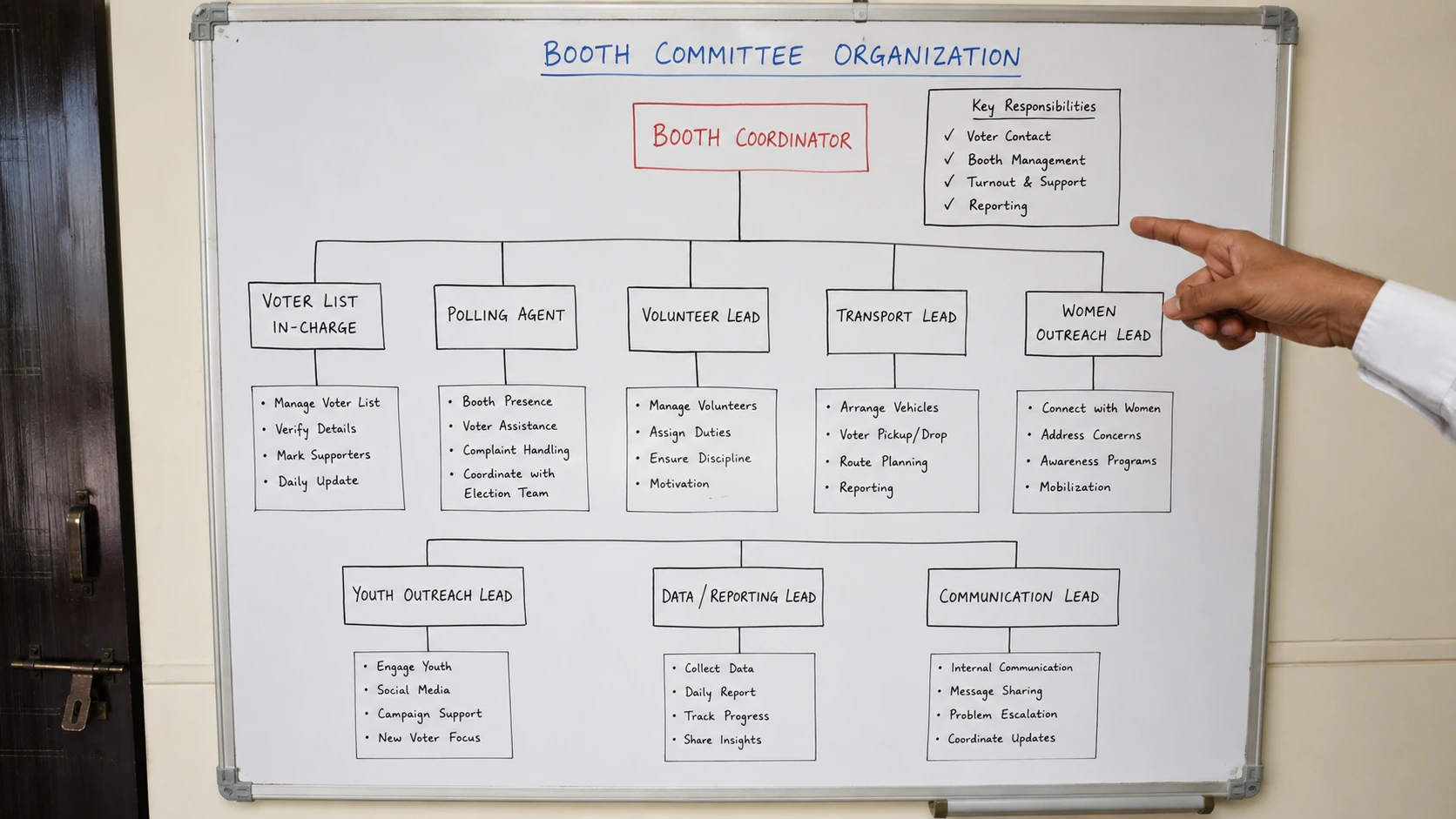
For constituencies with dozens or hundreds of booths, a single trained polling agent per booth is necessary but not sufficient. Layer a small booth committee — typically 5-7 volunteers — around each polling agent, covering:
- Voter list tracking — a volunteer cross-checking who from your supporter list has voted, to identify who still needs a turnout reminder
- Transport coordination — arranging local transport for elderly or mobility-limited supporters
- Runner/reporting — carrying turnout updates from the booth to the ward or constituency coordination point where phone signal or protocol makes direct calls impractical
Appoint and brief this committee at least 10 days before polling day, matching the same lead time official handbooks recommend for polling agents themselves — this gives enough runway for at least one full rehearsal.
Need Trained Booth Agents for Your Campaign?
ThinkPolitically designs and delivers booth agent training programs for Tamil Nadu campaigns — from single-ward panchayat contests to full assembly constituencies with hundreds of booths.
Frequently Asked Questions
How many polling agents can a candidate appoint per booth?
Under the Conduct of Elections Rules, 1961, each candidate or their election agent may appoint one polling agent and up to two relievers at every polling station — a fixed allocation that cannot be expanded.
When should booth agents be appointed and trained?
Official polling agent handbooks recommend appointing agents at least 10 days before polling day, giving enough time for a structured training session and, ideally, a full procedural rehearsal before election day itself.
Can a polling agent challenge any voter they’re unsure about?
No. A polling agent may only challenge a voter’s identity if they have personal knowledge that the person is not who they claim to be. Indiscriminate challenges are discouraged because they slow the poll and frustrate legitimate voters.
What is the most important skill for a booth agent, beyond loyalty?
Procedural literacy — the ability to verify the mock poll, track the movement sheet, and follow sealing procedures under time pressure — matters more than political experience or enthusiasm alone.
How does booth-level data connect to a campaign’s war room?
Trained agents reporting turnout at a fixed hourly cadence give the war room real-time visibility to redirect volunteer effort toward under-turned-out precincts before polls close, rather than reacting only after the fact.
What is the difference between a booth agent and a booth level officer in Indian election management?
A booth agent (or polling agent) is appointed by a candidate or their election agent to represent that candidate’s interests inside the polling station, verifying the mock poll, watching the process, and challenging voter identity when there is genuine doubt. A Booth Level Officer (BLO) is an Election Commission functionary, typically a local government employee, responsible for maintaining the electoral roll for that booth: adding new voters, removing duplicates, and verifying entries. One works for the candidate; the other works for the Election Commission.
What does booth-level agent management involve?
Recruiting and appointing agents and relievers within the legal limit per booth, training them against a written procedural checklist at least 10 days before polling, running a rehearsal where possible, and connecting every booth’s hourly reporting back to a central point so the campaign has real-time turnout visibility rather than end-of-day summaries.
What is a booth-level officer deployment plan for an election?
A booth-level officer deployment plan (distinct from a candidate’s own booth agents) maps which Booth Level Officers, the Election Commission functionaries responsible for the electoral roll, are assigned to which booths, and is used by a campaign to know who to coordinate with on roll-related queries. Campaigns don’t control BLO deployment, but tracking it helps identify which booths may need extra roll-verification follow-up before the campaign’s own cut-off dates.
What does booth agent training cover?
Booth agent training covers procedural literacy above all: verifying the mock poll, tracking the movement sheet, understanding when a voter identity challenge is legitimate versus when it slows the process unnecessarily, and following sealing procedures under time pressure. A written checklist and, where possible, a full rehearsal before polling day are what separate agents who perform under pressure from those who freeze at an unfamiliar step.
What is a field agent deployment strategy for polling day in India?
A field agent deployment strategy assigns booth agents and their relievers within the legal per-booth limit, prioritising booths by competitiveness so the most closely contested polling stations have the most experienced or best-trained agents. It also defines the hourly reporting cadence that connects every booth back to a central point, so the campaign has live turnout visibility rather than end-of-day summaries.
What is polling booth strategy?
Polling booth strategy is the plan for how a campaign allocates attention and resources across its individual polling stations, agent assignment, turnout tracking, and last-mile mobilisation, rather than one uniform plan applied evenly. It treats close, high-swing booths differently from safe strongholds, since a fixed pool of agents and volunteer hours produces more result if concentrated where it can change the outcome.
What is booth-level monitoring and escalation strategy for candidates?
A monitoring and escalation strategy defines how issues at individual booths, a missing agent, a procedural dispute, an EVM malfunction, get flagged and resolved quickly rather than sitting unaddressed until they affect turnout. It typically sets a fixed reporting cadence from booth agents, a clear channel for urgent issues to reach campaign leadership immediately, and pre-agreed response protocols for the most common problem categories.
How do you recruit and train booth-level agents in India?
Recruitment typically draws from local party networks, community leaders, or, for independent candidates, trusted volunteers with existing local credibility, since a booth agent needs to be someone voters and polling staff will take seriously. Training should be checklist-based and cover the legal limits on agent conduct, mock-poll verification, and reporting procedures, ideally delivered at least 10 days before polling day with a rehearsal where resources allow.
Conclusion
Booth agent training is unglamorous, procedural work — and it is exactly the kind of work that decides close Tamil Nadu elections. A single untrained agent who misses the mock poll verification, mishandles a voter challenge, or gets removed for misconduct can cost a campaign visibility across an entire polling day.
The fix is not complicated: appoint agents early, train them against a written checklist, rehearse once if you can, and connect every booth back to a central reporting point. Campaigns that do this consistently outperform campaigns that treat booth agents as an afterthought.
→ Read next: Election War Room Management — How ThinkPolitically Runs Real-Time Campaign Coordination
Sources
- Chief Electoral Officer, Jammu & Kashmir, Handbook for Polling Agents, retrieved 2026-07-01, https://ceojk.nic.in/pdf/Handbook_for_Polling_Agents.pdf
- Chief Electoral Officer, Goa, Handbook for Polling Agent (Document No. 324.6.EPS:HB:003:2023), retrieved 2026-07-01, https://ceogoa.nic.in/pdf/ImportantDocs/Handbook%20for%20Polling%20Agent.pdf
- Conduct of Elections Rules, 1961 — polling agent and reliever appointment provisions, as summarised in state CEO handbooks, retrieved 2026-07-01
- ThinkPolitically field operations — Tamil Nadu booth management engagements (proprietary observation)