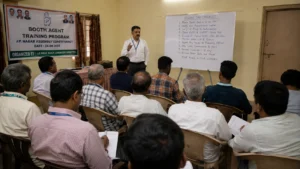
- Under the Tamil Nadu Panchayats (Reservation of Seats and Rotation of Reserved Seats) Rules, 1995, at least one-third of seats in every Village Panchayat, Panchayat Union Council, and District Panchayat are reserved for women, including SC/ST women.
- Most panchayat contests in Tamil Nadu are decided by a few hundred votes — smaller than any assembly segment — which means door-to-door contact and caste-community relationships matter more than mass media.
- Nomination is filed in Form 3 under the Tamil Nadu Panchayats (Elections) Rules, 1995, and candidates on a reserved seat must file a caste/tribe declaration.
- Campaigns that start ward-level relationship-building 4-6 months ahead of the notification consistently outperform those that begin after nomination.
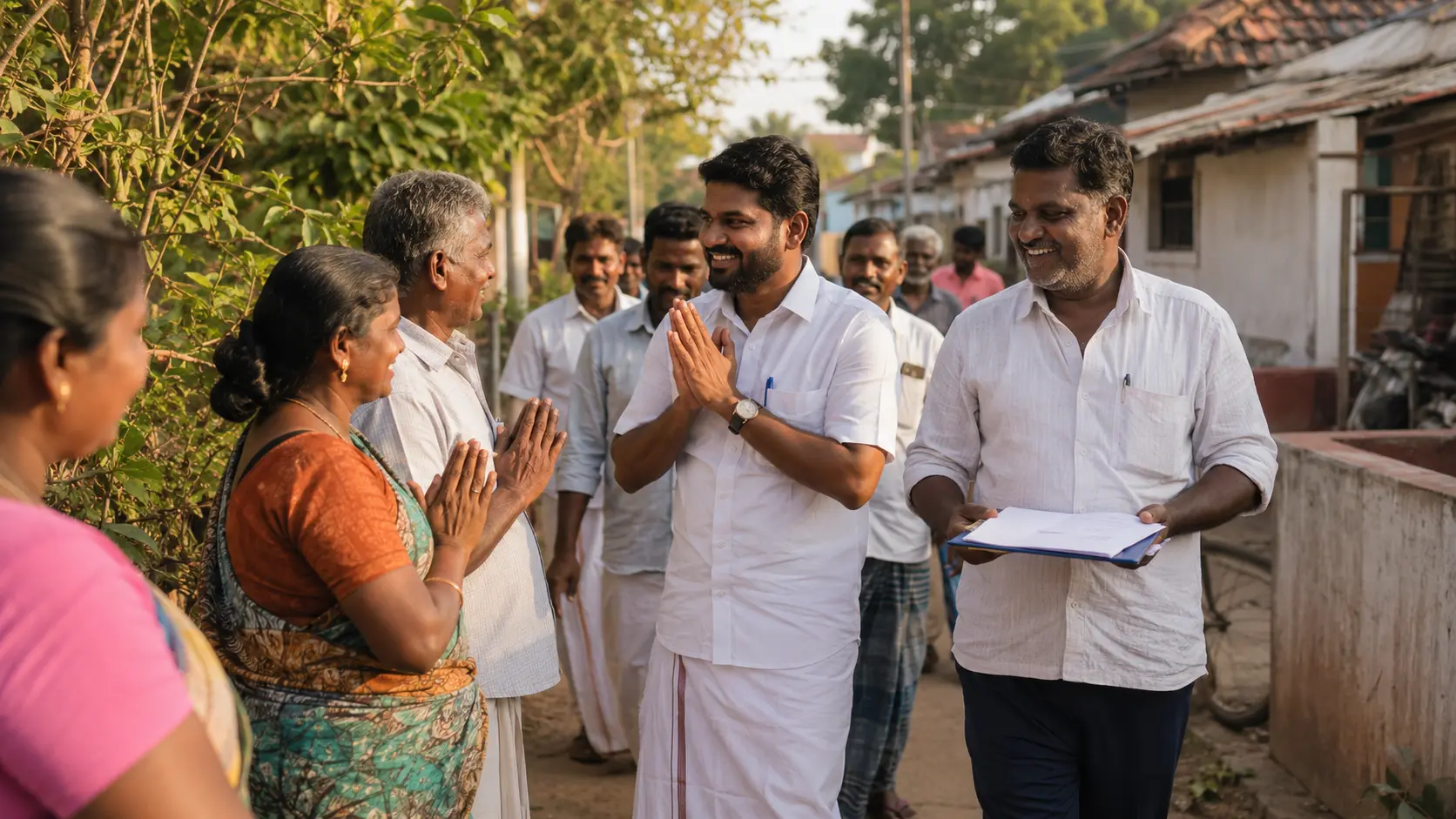
Panchayat elections are the most common electoral contest a Tamil Nadu candidate will ever fight — and the least understood by first-time candidates. Unlike an assembly or Lok Sabha campaign, a panchayat ward can be won or lost by a margin of 50 to 300 votes, decided almost entirely by direct household relationships rather than statewide messaging.
This current-year playbook covers what a Tamil Nadu panchayat candidate needs to get right in 2026: checking the notified reservation category, filing nomination correctly, preparing a ward-level organisation, and running the final 10 days before polling day. Confirm dates and ward status against the latest Tamil Nadu State Election Commission notification before acting.
Looking for durable campaign methodology rather than the 2026 rules-and-process checklist? Read the evergreen Tamil Nadu panchayat election strategy guide for ward mapping, voter outreach, community coalition building, and mobilisation principles.
For the constitutional and legal grounding, this guide draws on the Tamil Nadu Panchayats (Elections) Rules, 1995 and the state’s reservation rules, alongside ThinkPolitically’s own field operations across Tamil Nadu local body contests.
What Are the Reservation Rules for Tamil Nadu Panchayat Elections?
Before you decide to contest, confirm whether your ward is a general seat or a reserved one. Tamil Nadu panchayat reservation operates on two layers, both set out in the Tamil Nadu Panchayats (Reservation of Seats and Rotation of Reserved Seats) Rules, 1995:
- SC/ST reservation — seats reserved for Scheduled Castes and Scheduled Tribes are allotted in proportion to their share of the local population (any fractional remainder is dropped, not rounded up).
- Women’s reservation — not less than one-third of the seats in every Village Panchayat, Panchayat Union Council, and District Panchayat are reserved for women, including women from the SC/ST quota.
- Rotation — reserved wards rotate between election cycles, so a ward that was reserved in the previous term may become general this term, and vice versa. Confirm your ward’s current status with the local Tahsildar’s office or the notification published by the Tamil Nadu State Election Commission before you commit resources.
If your seat is reserved for SC or ST, you must be prepared to furnish a caste/tribe declaration in your nomination form — plan this documentation early, since delays here are one of the most common reasons nominations get rejected at scrutiny.
How Do You File Nomination for a Tamil Nadu Panchayat Election?
Nomination for Tamil Nadu panchayat candidates is filed on Form 3, prescribed under the Tamil Nadu Panchayats (Elections) Rules, 1995. Copies are available from the returning officer’s notified office once the election notification is published.
Checklist before you file
- Confirm you are on the electoral roll for the ward you intend to contest
- Prepare the caste/tribe declaration if the seat is reserved
- Arrange your proposer(s) as required under the notified rules for the panchayat tier you are contesting (village, union, or district panchayat)
- Keep certified copies of your identity and address proof ready — scrutiny rejects nominations over paperwork mismatches more often than over eligibility disputes
- File within the notified window — the Tamil Nadu State Election Commission publishes a strict nomination, scrutiny, and withdrawal calendar for each phase
For the full statewide election calendar and process FAQs, the Tamil Nadu State Election Commission’s FAQ page is the authoritative source — always cross-check dates there rather than relying on secondhand information.
What Campaign Strategy Actually Wins a Panchayat Ward in Tamil Nadu?
A panchayat ward typically has anywhere from 800 to 3,000 voters. At that scale, mass advertising is close to useless — the campaign is won household by household.
ThinkPolitically field observation: Across the local body campaigns we’ve supported, the single strongest predictor of a panchayat win was not campaign spend — it was the candidate’s pre-existing relationship density in the ward. Candidates who could name the head of every 15th household without notes consistently outperformed better-funded rivals who could not.
1. Map every household, not just every voter
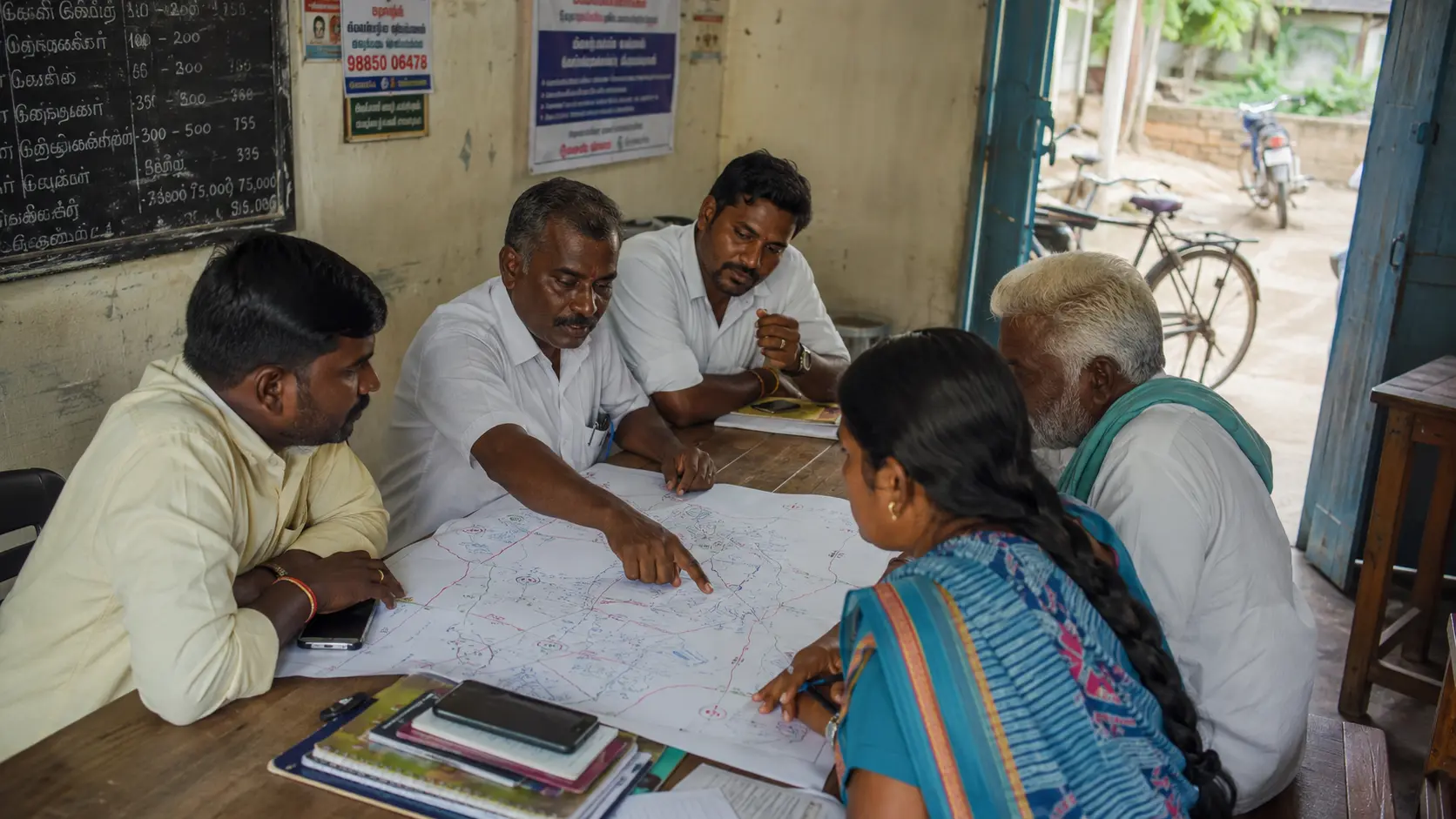
Build a household-level map of the ward, not just a voter list. Note family structure, caste-community groupings, existing local disputes (water, land boundary, drainage — these dominate panchayat-level grievances), and which households are undecided versus committed. See our guide to booth management services in Tamil Nadu for how this scales into formal booth-level organisation for larger local body contests.
2. Solve one visible local problem before polling day
Panchayat voters reward candidates who fix something tangible — a broken street light, a blocked drain, a delayed ration card. Identify one achievable, visible fix in the first month of your campaign and complete it. This does more for credibility than any messaging.
3. Build a volunteer network from existing community structures
Effective panchayat campaigns route through existing structures — self-help groups, youth associations, temple/mosque/church committees, sports clubs — rather than building a parallel volunteer network from scratch. For door-to-door canvassing methodology at scale, see our door-to-door campaign management guide.
How Do You Run Polling Day for a Panchayat Election?
Each candidate (or election agent) is entitled to appoint one polling agent and two relievers at each polling station under the Conduct of Elections Rules, 1961, and Election Commission handbooks for polling agents describe the same core duties across states. Appoint your polling agents at least 10 days before polling day — this is described as the desirable minimum lead time in official handbooks for polling agents issued by state election authorities, so your agents have time to be trained on procedure before the actual poll.
What your polling agent needs to know
- Arrive early enough to observe the mock poll and confirm the EVM/VVPAT is functioning correctly
- Track the movement sheet and voter turnout through the day, reporting numbers back to your ward coordinator at fixed intervals
- Understand the limited, narrow grounds on which a voter’s identity can be challenged — indiscriminate challenges slow down polling and can work against your own supporters waiting in line
- Cooperate fully with the Presiding Officer’s instructions — a disqualified or removed polling agent leaves you with zero visibility inside that booth for the rest of the day
For panchayat unions and district panchayats covering several booths, a lightweight central coordination point — even a single volunteer with a phone and a shared spreadsheet — makes a measurable difference in redirecting last-hour turnout effort. See our election campaign management in Tamil Nadu service for how this scales for multi-ward local body campaigns.
Contesting a Panchayat Seat in 2026?
ThinkPolitically supports Tamil Nadu candidates at every local body level — village panchayat, panchayat union, district panchayat, and municipal wards — with ward mapping, nomination support, and polling-day coordination.
Frequently Asked Questions
What percentage of panchayat seats are reserved for women in Tamil Nadu?
Not less than one-third of seats in every Village Panchayat, Panchayat Union Council, and District Panchayat are reserved for women, including women belonging to Scheduled Castes and Scheduled Tribes, under the Tamil Nadu Panchayats (Reservation of Seats and Rotation of Reserved Seats) Rules, 1995.
What form is used to file nomination for a panchayat election in Tamil Nadu?
Nomination is filed using Form 3, prescribed under the Tamil Nadu Panchayats (Elections) Rules, 1995. Copies are available from the returning officer’s office once the election is notified. Candidates on reserved seats must also file a caste or tribe declaration.
How many votes does it take to win a panchayat ward in Tamil Nadu?
Panchayat wards are much smaller than assembly constituencies, typically 800-3,000 voters. Margins of victory are frequently under 300 votes, which makes direct household-level contact far more decisive than mass media or large-scale advertising.
When should I appoint a polling agent for a panchayat election?
Election Commission guidance recommends appointing polling agents at least 10 days before polling day, giving them time to be trained on mock-poll verification, movement-sheet tracking, and the limited grounds on which they may challenge a voter’s identity.
How early should I start campaigning for a panchayat election?
Candidates who begin building ward-level relationships and identifying local grievances 4-6 months before the election notification consistently perform better than those who start campaign activity only after nomination is filed, since panchayat contests reward pre-existing trust over campaign messaging.
Conclusion
A Tamil Nadu panchayat election is won at the household level, not the media level. Understanding your ward’s reservation status, filing a clean nomination, mapping every household rather than every voter, and running a disciplined polling day are the fundamentals — everything else is secondary.
The candidates who win are rarely the best-funded. They’re the ones who did the unglamorous relationship work months before anyone else started campaigning.
→ Read next: Booth Management Services in Tamil Nadu — ThinkPolitically’s Ground Operations Model
Sources
- Tamil Nadu Rural Development & Panchayat Raj Department, Tamil Nadu Panchayats (Elections) Rules, 1995, retrieved 2026-07-01, https://www.tnrd.tn.gov.in/Pt_Raj/linkfiles/go_143_070895.pdf
- Tamil Nadu Panchayats (Reservation of Seats and Rotation of Reserved Seats) Rules, 1995, retrieved 2026-07-01, https://indiankanoon.org/doc/183399045/
- Tamil Nadu State Election Commission, FAQs, retrieved 2026-07-01, https://tnsec.tn.gov.in/tnsec_static/misc_items/faqs_e.php
- Chief Electoral Officer Jammu & Kashmir, Handbook for Polling Agents, retrieved 2026-07-01, https://ceojk.nic.in/pdf/Handbook_for_Polling_Agents.pdf
- ThinkPolitically field operations — Tamil Nadu local body campaigns (proprietary observation)
{“@context”:”https://schema.org”,”@graph”:[{“@type”:”Article”,”@id”:”https://thinkpolitically.com/how-to-win-panchayat-election-tamil-nadu-2026-playbook/#article”,”headline”:”How to Win a Panchayat Election in Tamil Nadu: 2026 Playbook”,”description”:”A field-tested playbook for Tamil Nadu panchayat elections in 2026 — reservation rules, nomination process, ward-level strategy, and booth-day execution.”,”datePublished”:”2026-07-01″,”dateModified”:”2026-07-06″,”author”:{“@type”:”Person”,”name”:”Hemanth”,”jobTitle”:”Campaign Operations Lead”,”worksFor”:{“@type”:”Organization”,”name”:”ThinkPolitically”,”url”:”https://thinkpolitically.com”}},”publisher”:{“@type”:”Organization”,”name”:”ThinkPolitically”,”url”:”https://thinkpolitically.com”},”mainEntityOfPage”:{“@type”:”WebPage”,”@id”:”https://thinkpolitically.com/how-to-win-panchayat-election-tamil-nadu-2026-playbook/”},”keywords”:[“panchayat election tamil nadu 2026″,”how to win panchayat election”,”panchayat reservation rules tamil nadu”,”village panchayat nomination”]},{“@type”:”FAQPage”,”@id”:”https://thinkpolitically.com/how-to-win-panchayat-election-tamil-nadu-2026-playbook/#faq”,”mainEntity”:[{“@type”:”Question”,”name”:”What percentage of panchayat seats are reserved for women in Tamil Nadu?”,”acceptedAnswer”:{“@type”:”Answer”,”text”:”Not less than one-third of seats in every Village Panchayat, Panchayat Union Council, and District Panchayat are reserved for women, including SC/ST women, under the 1995 Reservation Rules.”}},{“@type”:”Question”,”name”:”What form is used to file nomination for a panchayat election in Tamil Nadu?”,”acceptedAnswer”:{“@type”:”Answer”,”text”:”Nomination is filed using Form 3 under the Tamil Nadu Panchayats (Elections) Rules, 1995. Reserved-seat candidates must also file a caste or tribe declaration.”}},{“@type”:”Question”,”name”:”How many votes does it take to win a panchayat ward in Tamil Nadu?”,”acceptedAnswer”:{“@type”:”Answer”,”text”:”Panchayat wards typically have 800-3,000 voters, and margins are frequently under 300 votes, making household-level contact far more decisive than mass media.”}},{“@type”:”Question”,”name”:”When should I appoint a polling agent for a panchayat election?”,”acceptedAnswer”:{“@type”:”Answer”,”text”:”Election Commission guidance recommends appointing polling agents at least 10 days before polling day so they can be trained on mock-poll and turnout procedures.”}},{“@type”:”Question”,”name”:”How early should I start campaigning for a panchayat election?”,”acceptedAnswer”:{“@type”:”Answer”,”text”:”Starting ward-level relationship-building 4-6 months before the election notification consistently outperforms campaigns that begin only after nomination is filed.”}}]},{“@type”:”BreadcrumbList”,”itemListElement”:[{“@type”:”ListItem”,”position”:1,”name”:”Home”,”item”:”https://thinkpolitically.com/”},{“@type”:”ListItem”,”position”:2,”name”:”Blog”,”item”:”https://thinkpolitically.com/blog/”},{“@type”:”ListItem”,”position”:3,”name”:”Panchayat Election Tamil Nadu 2026 Playbook”,”item”:”https://thinkpolitically.com/how-to-win-panchayat-election-tamil-nadu-2026-playbook/”}]}]}