How to Run a Digital Campaign for Tamil Nadu Local Body Elections (2026 Guide)
Tamil Nadu has 12,620 village panchayats, 151 town panchayats, and one major municipal corporation in Chennai. That’s thousands of ward-level contests happening simultaneously, each fought at close range between candidates who often live on the same street. For years, local body campaigns ran entirely on ground muscle: party flags, autorickshaw announcements, and morning door-to-door rounds. That’s changing fast. With Tamil Nadu recording 79.5 million mobile subscribers as of December 2025 (TRAI, 2025), a candidate who ignores digital outreach is handing votes to opponents who don’t. This guide gives you a practical, ward-level digital campaign framework built specifically for Tamil Nadu local body contests.
For the operational layer behind this channel plan, use our Tamil Nadu election campaign management framework.
Key Takeaways
- Tamil Nadu has 79.5 million mobile subscribers (TRAI, Dec 2025) — local body voters are reachable on WhatsApp before they’re reachable at the door.
- WhatsApp should absorb 40% of a local body digital budget; it’s the platform where ward-level conversations actually happen.
- Local body voters respond differently to digital content than assembly election voters — hyper-local issues, not party narratives, drive engagement.
- A structured panchayat election digital campaign runs on three platforms: WhatsApp for mobilization, Facebook/Instagram for awareness, YouTube for candidate credibility.
- The four most common digital mistakes cost candidates 5-15% of persuadable voters in competitive wards.
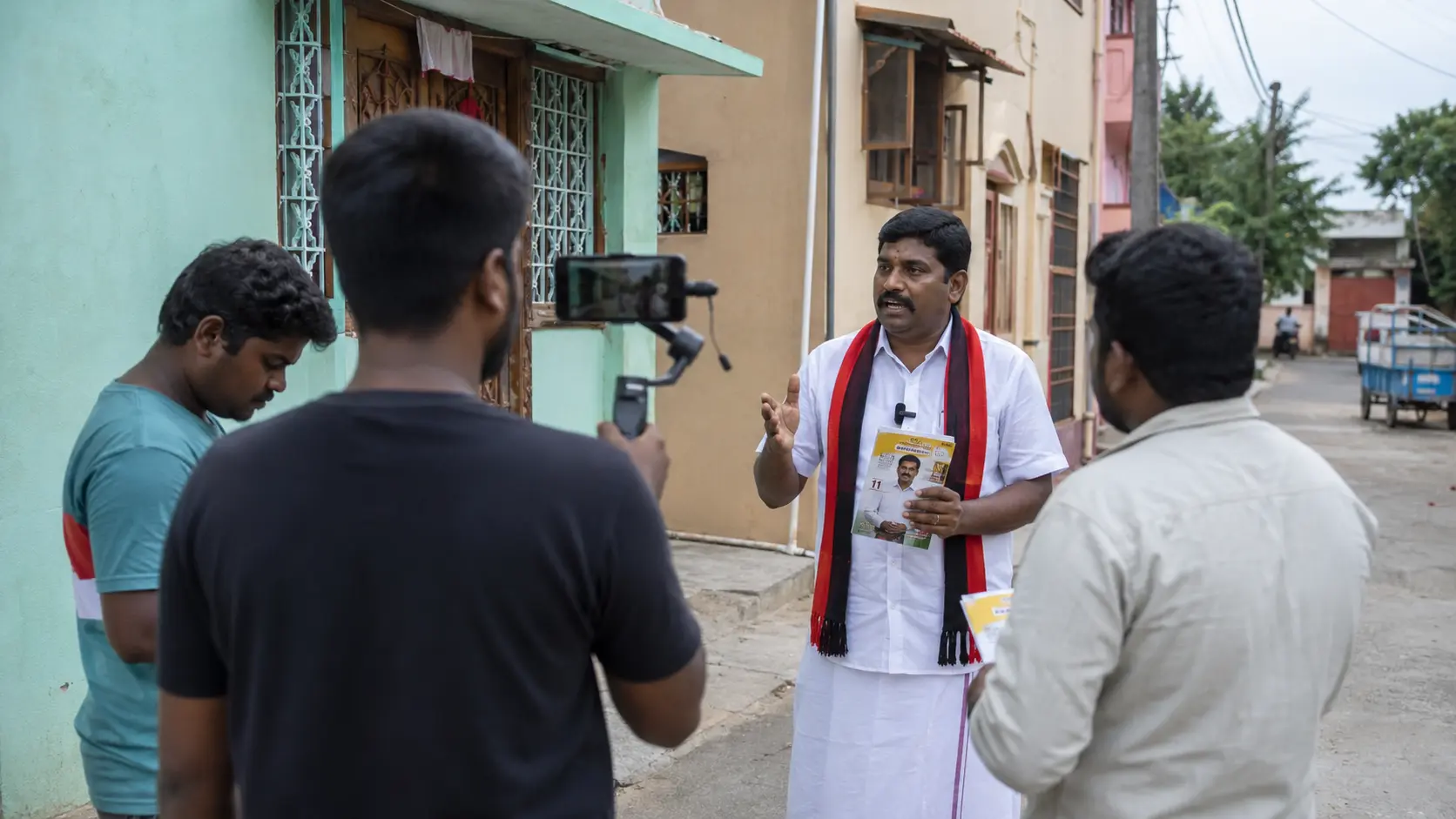
[IMAGE: Ward-level candidate meeting voters in a Tamil Nadu panchayat with mobile phones visible — search terms: Tamil Nadu panchayat election voter outreach village ward]
Why Does Digital Outreach Matter for Tamil Nadu Local Body Elections?
Digital outreach matters for local body elections because mobile penetration has made Tamil Nadu’s village voters reachable at a fraction of the cost of physical contact. Tamil Nadu recorded 79.5 million mobile subscribers in December 2025 (TRAI, 2025). Even in semi-rural panchayats, the overwhelming majority of adults carry a smartphone and use WhatsApp daily. A digital campaign for local body elections isn’t replacing ground work — it’s multiplying it.
Tamil Nadu’s 79.5 million mobile subscribers (TRAI, December 2025) mean that nearly every voter in a panchayat ward is reachable via WhatsApp or Facebook. A well-run digital campaign local body elections Tamil Nadu effort can reach 500-2,000 ward voters at under Rs. 5 per contact — compared to Rs. 80-150 per door visit when accounting for volunteer time and materials.
The CSDS/Lokniti 2024 survey found that 90% of party workers used WhatsApp or Facebook to share campaign content during elections, pushing approximately 55 posts per day during active campaign periods (CSDS/Lokniti, 2024). Local body elections are no exception. The question isn’t whether voters see campaign content digitally — they do. The question is whether that content is from your candidate or your opponent.
[UNIQUE INSIGHT] Local body voters respond differently to digital content than assembly election voters do. In assembly campaigns, party brand and state-level narratives carry weight. In a panchayat or ward election, voters are evaluating a neighbor — and they tune out party messaging almost completely. The digital content that works at the local body level is hyper-local: a blocked drain, a pending streetlight, a water supply complaint that’s been ignored for two years. Candidates who push state-level party content on their ward WhatsApp groups consistently underperform compared to those who document local problems and promise specific solutions.
See how these ward-level tactics fit into a broader Tamil Nadu political social media campaign.
[IMAGE: Smartphone screen showing a Tamil Nadu ward WhatsApp group with candidate updates — search terms: WhatsApp political campaign India local election group mobile]
How Should You Build a WhatsApp Campaign for Local Body Elections?
WhatsApp is the backbone of any panchayat election digital campaign in Tamil Nadu. India has 535.8 million WhatsApp users — accounting for 89% of all smartphone users nationally (Findly, 2025). In Tamil Nadu’s panchayat wards, WhatsApp isn’t just popular — it’s often the primary way residents communicate with each other, making it the natural channel for ward-level political outreach.
Build Your Group Architecture First
A WhatsApp campaign for local body elections runs on a deliberate group structure, not a single broadcast. Build three tiers: a core volunteer group (10-20 people), zone coordinator groups (one per street cluster), and public supporter groups. Each tier serves a different function. The volunteer group handles coordination. Zone groups push content to micro-geographies. Supporter groups are entry points for undecided voters. Don’t collapse these into one group — message discipline breaks down immediately when you do.
Content That Works in a Ward Context
Effective WhatsApp content for ward elections runs to a simple formula: one local issue, one specific commitment, one image or short video. Voice notes from the candidate perform exceptionally well — they’re personal, quick to consume, and hard to fake. Keep videos under 60 seconds. Images need Tamil text overlaid; English-only graphics get ignored at the ward level. Post between 7-9 AM and 7-9 PM — those are peak consumption windows in most Tamil Nadu households.
[PERSONAL EXPERIENCE] In our experience managing WhatsApp campaigns across multiple Tamil Nadu local body contests, the highest-engagement content is almost never what the campaign team expects. A 45-second video of the candidate walking through a flooded lane — shot on a phone, no production — consistently outperforms polished party graphics. We’ve seen ward-level videos cross 2,000 views within six hours inside a ward of 4,000 voters. Authenticity converts; polish doesn’t, at this scale.
Managing Reach Without Violating Platform Rules
WhatsApp limits broadcast lists to 256 contacts. Plan your contact database in advance and segment by street or booth number. Avoid bulk-sending identical messages across groups in rapid succession — this triggers spam detection. Stagger your sends by 15-20 minutes across groups. Keep an opt-out process simple: one “STOP” message removes anyone from future sends. Respecting opt-outs protects your reputation in a small ward community.
For contact segmentation, consent, content cadence, and volunteer workflows, read the full WhatsApp political campaign guide.
How Do Facebook and Instagram Work for Corporation and Town Panchayat Ward Campaigns?
Facebook reaches Tamil Nadu’s 35-60 age bracket more effectively than any other social platform — a critical demographic in corporation and town panchayat elections where voter turnout often concentrates in middle-age groups. Meta’s advertising platform allows ward-level geographic targeting down to a 1-km radius, making it the most cost-efficient tool for corporation election social media campaigns when used with precise audience settings.
CSDS/Lokniti 2024 data shows that 90% of party workers shared campaign content on Facebook during active election periods, averaging 55 posts per day (CSDS/Lokniti, 2024). For ward-level candidates running a corporation election social media campaign, Facebook’s ward-radius targeting means spending is concentrated on actual voters — not adjacent constituencies — cutting wasted impressions by 60-70%.
Facebook Strategy for a Ward Candidate
Create a candidate Facebook Page, not a personal profile. Pages give you access to Meta Ads Manager and post analytics. Run three content types in rotation: local issue posts (problem + your commitment), community event coverage (photos from ward visits), and short candidate intro videos under 90 seconds. Boost your best-performing organic posts rather than running cold ad creatives — boosted posts carry social proof the raw ads don’t have.
Instagram for Younger Ward Voters
Instagram matters most for wards with high concentrations of voters aged 18-35. Reels under 30 seconds showing candidate field visits get strong organic reach. Use local street names, colony names, and neighbourhood references in captions — the algorithm rewards local specificity and these references trigger ward voters to share content within their own networks. Stories work well for daily updates during the final 10 days of the campaign.
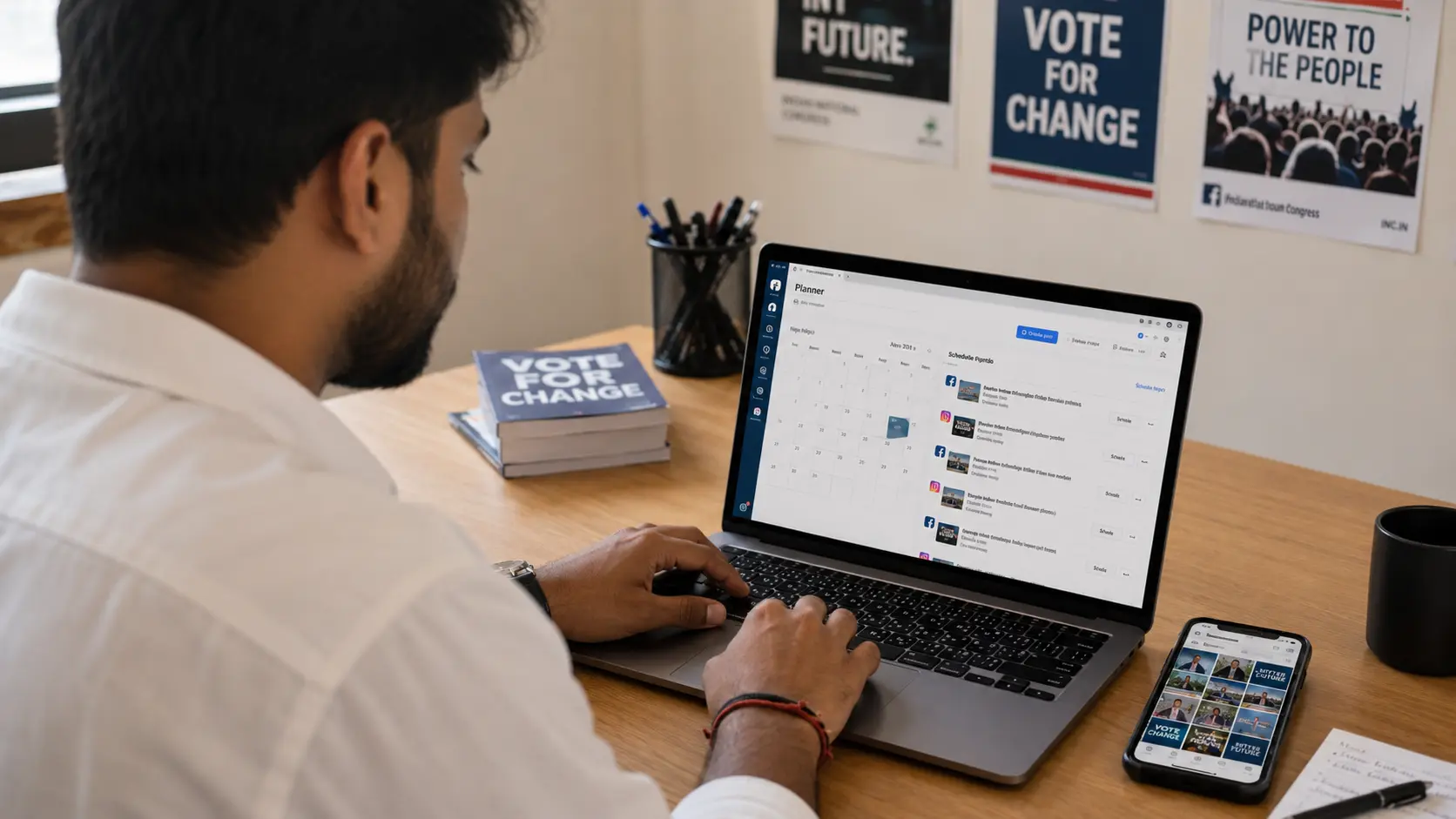
[IMAGE: Facebook ad campaign dashboard showing ward-level geo-targeting in Tamil Nadu election — search terms: Facebook political ad campaign local election India targeting]
Can YouTube Build Real Candidate Awareness at the Local Body Level?
YouTube works for local body elections when used for a specific purpose: credibility building, not entertainment. A candidate with two or three well-produced YouTube videos establishing their background, their ward work history, and their development commitments signals seriousness to first-time voters. India has over 467 million YouTube users as of 2025 (Statista, 2025), and Tamil Nadu’s urban wards see strong YouTube consumption among 20-45 year olds.
What to Put on YouTube
Three video types earn their production cost at the ward level. First, a 2-3 minute candidate introduction video — personal story, ward connection, development vision. Second, a ward walkthrough series: short field videos showing problems the candidate has documented and raised. Third, testimonial videos from local residents, religious leaders, or self-help group members. Keep total channel volume manageable. Five strong videos outperform 40 forgettable ones.
YouTube Ads for Ward Reach
YouTube pre-roll ads can be geo-targeted at the district level in India. For a panchayat election digital campaign with limited budgets, run skippable in-stream ads targeting your district and suppress adjacent districts. Bid on Tamil-language content channels that your ward voters are already watching. A Rs. 5,000-10,000 YouTube ad budget, managed well, delivers 15,000-30,000 impressions within a targeted area — enough to reinforce ground-level awareness without waste.
Campaign scale and voter behaviour vary by region; use the Tamil Nadu district campaign directory to connect digital outreach with district-level operations.
How Should a Local Body Candidate Allocate the Digital Campaign Budget?
Budget allocation for a digital campaign local body elections Tamil Nadu effort should weight heavily toward WhatsApp — it’s the highest-conversion platform at ward level. A practical split for a panchayat or town panchayat ward with 3,000-8,000 voters: 40% WhatsApp (content production, group management tools), 25% Facebook and Instagram (boosted posts and ward-radius ads), 20% YouTube (video production and pre-roll ads), 15% other (SMS, local news portals, WhatsApp Status ads).
Source: Think Politically framework, based on campaign data across Tamil Nadu local body contests
Digital
Budget
- WhatsApp — 40%
- Facebook & Instagram — 25%
- YouTube — 20%
- Others (SMS, portals) — 15%
Scaling the Budget by Ward Size
A village panchayat ward with 1,500-2,000 voters can run an effective digital campaign on Rs. 15,000-25,000 total. A town panchayat ward (3,000-6,000 voters) warrants Rs. 30,000-60,000. A Chennai corporation ward, where voter density and competition are both much higher, typically requires Rs. 75,000-1,50,000 to achieve meaningful reach. These figures cover content production, ad spend, and basic design — not agency fees if you’re self-managing.
What the Budget Should Not Fund
Don’t spend digital budget on generic party propaganda, state-level leader content reposts, or expensive video production in early campaign phases. The marginal return on a Rs. 25,000 video production is far lower than the return on Rs. 25,000 of targeted Facebook ward-radius ads. Digital spend at the local body level works when it’s hyper-local and frequent — not when it’s glossy and infrequent.
Pair this digital budget with a disciplined booth management operation so online reach turns into voter contact and turnout.
What Are the Most Common Digital Campaign Mistakes in Local Body Elections?
The most damaging mistakes in a panchayat election digital campaign are structural, not creative. They’re not about bad graphics or poor captions — they’re about misunderstanding how ward-level voters use digital platforms. CSDS/Lokniti’s 2024 data shows that 90% of party workers shared content digitally during campaigns (CSDS/Lokniti, 2024), yet most local body digital efforts produce negligible voter movement. The gap is strategy, not effort.
Despite 90% of party workers using WhatsApp or Facebook to share campaign content — averaging 55 posts per day during active campaign periods (CSDS/Lokniti, 2024) — most local body digital campaigns fail to convert digital reach into vote share. The reason is almost always the same: content is designed for party approval, not for ward voter concerns.
Mistake 1: Using a Single WhatsApp Group for Everything
A single all-purpose group gets unmanageable within two weeks. Coordination messages, voter concerns, and content distribution collide. Volunteers stop reading. Create separate groups by function from day one: internal team, zone coordinators, and supporter channels. This isn’t complexity — it’s the minimum structure needed for a ward campaign to function under pressure.
Mistake 2: Pushing Party-Level Content to Ward Audiences
State leader photos, party achievement posters, and national-level political content get ignored at the ward level. Ward voters filter for information about their street, their water supply, their bin collection. When your content doesn’t address these, you lose attention permanently. Audit every piece of content against one question: “Would a voter in Ward 14 of Erode care about this specifically?” If the answer is no, don’t post it.
Mistake 3: Starting Digital Outreach Too Late
Most ward candidates start digital activity in the final two weeks. That’s too late to build credibility. A digital campaign for local body elections should begin 60-90 days before polling day with low-intensity, community-building content. Document your ward visits. Respond to local complaints publicly on Facebook. By the time the formal campaign window opens, your digital presence already has traction.
Mistake 4: Ignoring WhatsApp Status
WhatsApp Status reaches contacts who aren’t in your campaign groups. Every volunteer’s Status is a free content channel that the campaign almost never uses deliberately. Brief your volunteer network on Status content norms: one post per day, local focus, Tamil text included. A network of 50 volunteers posting consistent Status content reaches 5,000-10,000 unique contacts per day without a single rupee in ad spend.
[IMAGE: Candidate field visit documentation for WhatsApp campaign showing road condition report — search terms: ward election candidate field visit Tamil Nadu local problem documentation]
Frequently Asked Questions
How much does a digital campaign for a village panchayat ward cost in Tamil Nadu?
A village panchayat ward digital campaign covering WhatsApp group management, basic content creation, and boosted Facebook posts typically costs Rs. 15,000-25,000 for a 60-day campaign covering 1,500-2,500 voters. Tamil Nadu has 12,620 village panchayats, so ward-level competition is intense — even a modest, well-structured budget outperforms an unplanned larger spend. Prioritise WhatsApp (40% of budget) and Facebook ward-radius ads (25%) first. See how this fits into a complete Tamil Nadu election campaign management plan.
What is the best platform for a WhatsApp campaign in a Tamil Nadu local body election?
WhatsApp is the best primary platform — India has 535.8 million WhatsApp users representing 89% of smartphone users (Findly, 2025). For ward-level campaigns, WhatsApp group architecture (volunteer groups, zone coordinator groups, supporter groups) delivers direct, personal reach that no other platform matches. Pair it with Facebook for paid awareness and YouTube for candidate credibility content. Use the detailed WhatsApp political campaign guide to design the group structure.
How is running a digital campaign for a local body election different from an assembly election?
Local body voters respond to hyper-local content, not party narratives. In assembly campaigns, brand association with a state leader drives a large share of vote decision. In a ward contest, voters are choosing a neighbor based on specific local commitments. Digital content must reflect local problems and concrete promises — generic party content performs poorly. Content format also shifts: voice notes and field videos beat polished graphics at ward level.
When should a ward candidate start digital outreach before Tamil Nadu local body elections?
Start 60-90 days before the polling date, well before the formal campaign window. Early digital activity builds organic credibility — documenting ward visits, responding to local complaints on Facebook, and establishing WhatsApp group presence. Candidates who start in the final two weeks are playing catch-up against opponents who’ve already built an audience. Review the Tamil Nadu district campaign hub for location-specific planning.
What is political digital campaigning?
Political digital campaigning is the use of WhatsApp, social media, and other online channels to reach and persuade voters as part of an election effort, run alongside, not instead of, ground operations. For local body elections specifically, digital campaigning skews toward hyper-local content, ward-level Facebook groups, WhatsApp chains, and voice notes, rather than the broader brand messaging that works at assembly or state level.
Building a Digital Campaign That Actually Wins Wards
Tamil Nadu’s local body elections are won at the intersection of ground relationships and digital reach. With 79.5 million mobile subscribers (TRAI, Dec 2025) and 90% of party workers already pushing campaign content digitally (CSDS/Lokniti, 2024), the digital space in every ward is already crowded. What differentiates winners is discipline: a structured WhatsApp group architecture, hyper-local content that speaks to ward-specific problems, Facebook ads targeted to the right geography, and YouTube videos that build candidate credibility before the campaign window even opens.
The budget split matters too. Forty percent on WhatsApp, 25% on Facebook and Instagram, 20% on YouTube, and 15% on other channels is a framework, not a rule. Adjust based on your ward’s demographics — younger urban wards may shift more toward Instagram; older rural panchayat wards may weight WhatsApp even higher. What doesn’t change is the principle: spend where your ward voters actually are.
Start early. Build the group structure before you need it. Post local content consistently. And pair every digital effort with the ground operations that close the vote. Digital reach without a volunteer follow-up structure is noise. Together, they’re how close ward contests get decided.
Digital outreach performs best when it supports field operations. Connect this plan to booth management, a clear election war room reporting system, and the broader campaign management process.
Planning a local body campaign in Tamil Nadu?
We consult directly on ward-level digital campaign strategy — WhatsApp group architecture, content planning, and Facebook targeting for panchayat and corporation ward contests. Message us on WhatsApp and we’ll respond within 24 hours.