- A political campaign strategy has five building blocks: your win number, target voters, message, resource allocation, and timeline. Tactics are how you execute each block; strategy is what determines them.
- Most “campaign strategy” guides online describe a template without giving you one. This guide includes a copy-ready planning checklist below, not a gated PDF download.
- Indian campaigns operate under constraints most generic strategy advice ignores: the Model Code of Conduct takes effect the moment an election is announced, and candidate spending is capped by law (₹40 lakh for an assembly seat, ₹95 lakh for Lok Sabha, per ECI’s January 2022 notification).
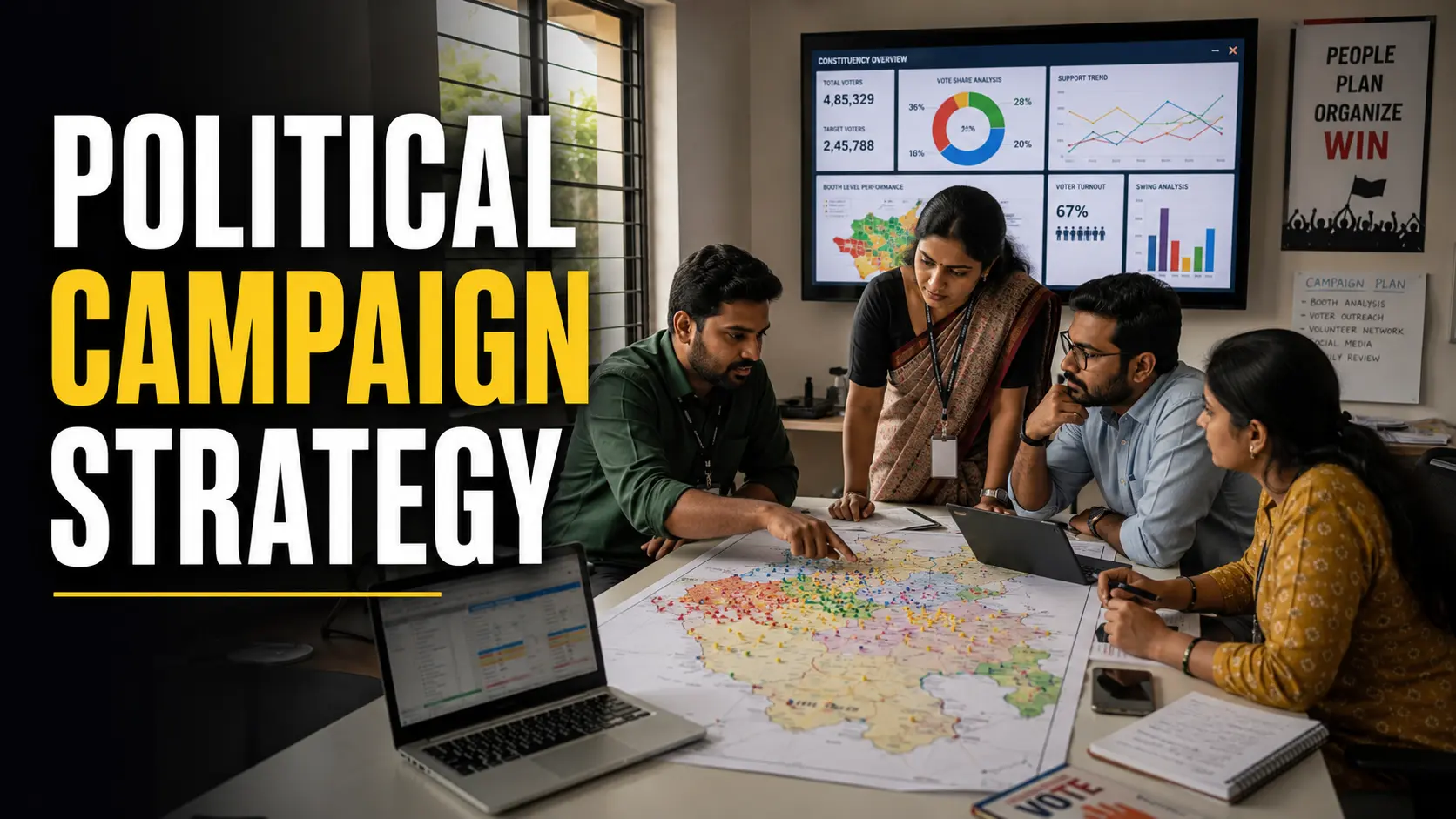
A political campaign strategy is the set of decisions, who you’re trying to reach, what you’re telling them, and how you’re allocating time and money to reach them, that determines whether a campaign wins. Tactics (a specific WhatsApp broadcast, a particular rally, one piece of ad creative) are how a strategy gets executed day to day. Get the strategy wrong and no amount of tactical execution fixes it; get it right and even an imperfectly executed campaign has a real path to winning.
This guide breaks the strategy down into five building blocks, walks through a worked example so “strategy” stops being an abstraction, and gives you a checklist you can actually use, not just read about.
The 5 Building Blocks of a Political Campaign Strategy
Every credible political campaign strategy, regardless of scale, answers the same five questions:
- Win number: How many votes do you actually need? This depends on turnout expectations, the number of candidates in the race, and past-election margins in your constituency, not a round number picked out of instinct.
- Target voters: Who is persuadable, who already supports you, and who is unreachable? Most campaigns waste resources treating the whole electorate as one audience.
- Message: What’s the one or two things this campaign is about, in the voter’s own terms, not the candidate’s? A message that takes more than one sentence to explain usually isn’t one yet.
- Resource allocation: Time, money, and volunteer effort are all finite. A strategy states, explicitly, where they go first and why.
- Timeline: When does each phase happen, relative to nomination filing, the Model Code of Conduct taking effect, and polling day? Strategy without a timeline is a wish list.
If a campaign plan can’t answer all five in a paragraph each, it’s not a strategy yet, it’s a set of activities. For the operational side of turning this into a running campaign, see our guide on election campaign management.
Political Campaign Strategy Example: A Worked Illustration
Here’s what the five building blocks look like applied to a hypothetical case, a first-time candidate contesting a Tamil Nadu assembly seat with roughly 2 lakh voters, a two-way contest against an incumbent:
- Win number: Past two cycles show roughly 68% turnout and a 6-point margin. At projected turnout, the campaign sets a target of 52% of the vote share, a buffer above the historical winning margin.
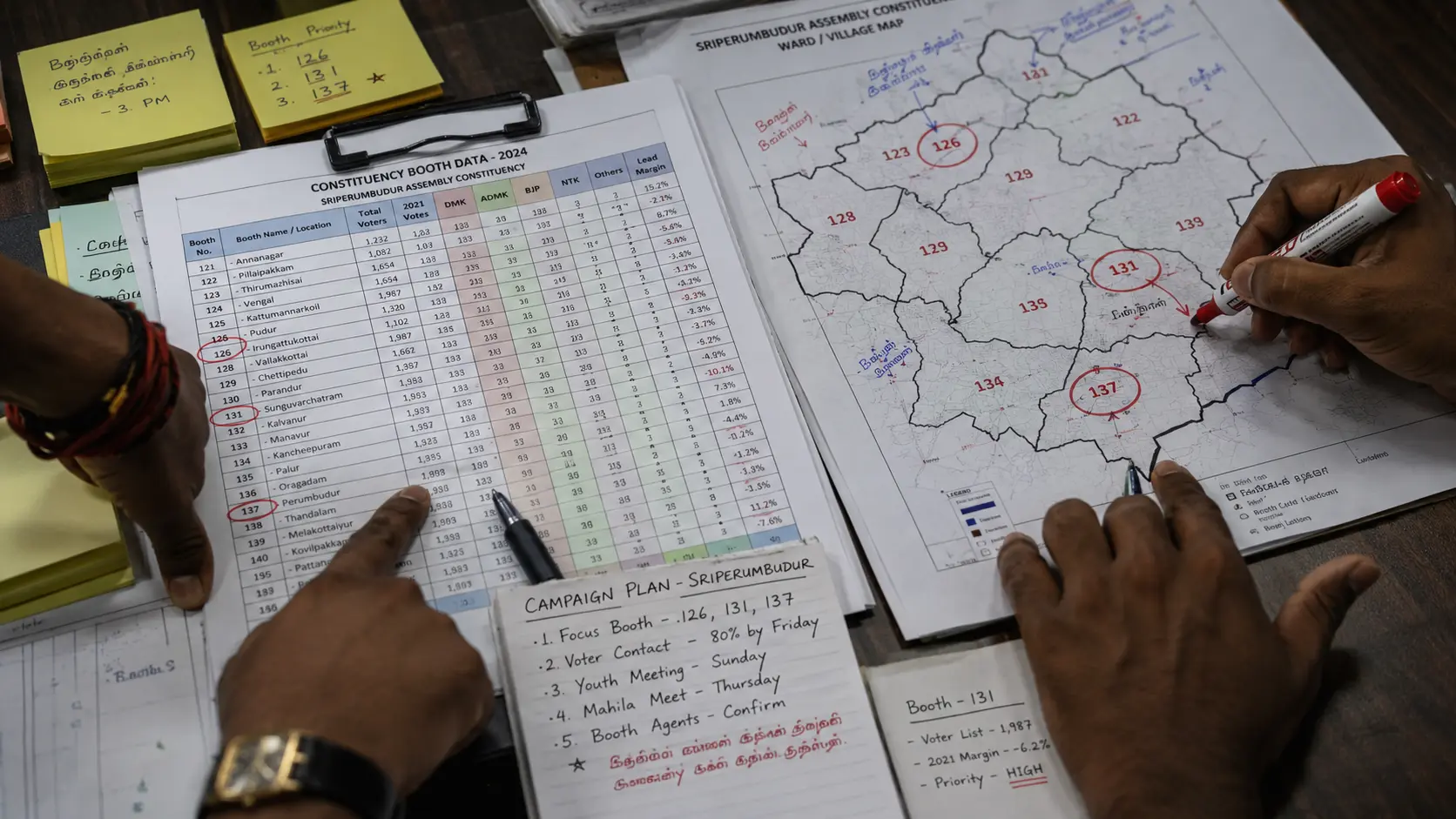
- Target voters: Booth-level analysis of the last two elections identifies 40 of 220 booths as genuinely contested (neither side won by more than 8 points); campaign field effort is weighted 3x toward those booths versus safe ones.
- Message: A single local infrastructure issue (water supply, in this case) that polling and door-to-door feedback confirmed as the top concern in the contested booths, not a generic party-line message.
- Resource allocation: 60% of the field budget goes to the 40 contested booths; digital spend is concentrated in the final six weeks rather than spread evenly across the campaign, timed to peak attention closer to polling day.
- Timeline: Constituency mapping and booth prioritisation happen 9-12 months out; the message is locked and tested 4-6 months out; the final resource surge happens in the last 6 weeks, coordinated with, not against, Model Code of Conduct restrictions once the election is formally announced.
Nothing here is complicated in isolation. What makes it a strategy, rather than five disconnected activities, is that each decision is derived from the same data and points at the same win number.
Political Campaign Strategy Checklist (Copy This)
Most guides on this topic describe a planning template without actually giving you one. Here’s a working checklist, not a gated download, you can copy directly into a document and fill in for your own campaign:
- ☐ Calculate your win number from turnout projections and past-election margins
- ☐ Identify your genuinely contested booths/wards (not the whole constituency)
- ☐ Write your core message in one sentence, in a voter’s words, not the candidate’s
- ☐ Set a resource-allocation split (field vs. digital vs. media) with a reason for each number
- ☐ Build a timeline anchored to nomination filing, MCC coming into effect, and polling day
- ☐ Assign a single owner for each of the five blocks above, not one person doing all five
- ☐ Set a weekly review point to check actual field data against the plan, and adjust
How Campaign Strategy Works Differently for Indian Elections
Most political campaign strategy content available online is written for U.S. or U.K. campaigns and doesn’t account for constraints unique to Indian elections:
- The Model Code of Conduct (MCC) comes into force the moment the Election Commission announces the election schedule, not on nomination day, and stays in force until the process concludes. It restricts government-scheme announcements by the ruling party, use of official machinery for campaigning, and content of campaign material near polling booths. A strategy timeline that doesn’t explicitly account for the MCC’s start date will get disrupted mid-execution.
- Candidate spending is capped by law: ₹40 lakh for an assembly constituency and ₹95 lakh for a Lok Sabha constituency, per the Election Commission’s January 2022 notification. This shapes resource-allocation decisions differently than in systems with no hard spending ceiling, since above a certain scale, the constraint isn’t “how much can we raise,” it’s “how do we get the most from a fixed amount.”
- Local body, assembly, and Lok Sabha contests need different strategies, not the same plan at different scales. A panchayat or corporation campaign lives and dies on booth-level personal contact; an assembly or Lok Sabha campaign needs a media and digital layer a local body race usually doesn’t.
For the definitional groundwork, what a campaign strategy actually is as a concept, see our companion guide, what is an election campaign in India.
Need a Strategy Built for Your Constituency?
The five building blocks above are the framework; the actual numbers, your win number, your contested booths, your message, come from constituency-specific data. That’s what our political strategy consulting work does.
Frequently Asked Questions
What is the best political campaign strategy?
There’s no single “best” strategy that applies to every campaign, but every effective one is built on the same five elements: a data-based win number, a clearly defined set of target voters, a one-sentence message, deliberate resource allocation, and a timeline anchored to real dates like the Model Code of Conduct’s start and polling day.
What’s an example of a good political strategy?
A good political strategy example ties every decision back to the same data. For instance: identifying the specific booths or wards where an election is actually contested (rather than treating the whole constituency the same), then weighting field effort, message testing, and resource allocation toward those booths specifically.
How do you write a political campaign strategy plan?
Start with your win number (votes needed, based on turnout and past margins), then work through target voters, message, resource allocation, and timeline in that order. Each later block should be derived from the ones before it, not decided independently. The checklist above walks through this in order.
What should be included in a campaign strategy template?
At minimum: a win-number calculation, a list of contested booths/wards with supporting data, a one-sentence core message, a resource-allocation breakdown by channel, and a timeline anchored to nomination filing, MCC start, and polling day. The checklist section above is a usable version of this.
Conclusion
A political campaign strategy isn’t a document you write once and file away, it’s a small set of decisions (win number, target voters, message, resources, timeline) that every subsequent tactical choice should trace back to. The campaigns that struggle are usually not short on activity; they’re short on a strategy those activities are actually serving.
→ Read next: What Is an Election Campaign in India? A Complete Guide
Sources
- Election Commission of India, Model Code of Conduct guidelines — timing and scope of enforcement (comes into force on announcement of election schedule, stays in force until the process concludes).
- Election Commission of India, candidate election-expenditure limit notification, January 2022 — ₹40 lakh (assembly), ₹95 lakh (Lok Sabha).
- Compendium of Instructions on Model Code of Conduct, Chief Electoral Officer, Delhi (ceodelhi.gov.in).